



KATHMANDU: An American writer, Gore Vidal, once said, “Write something. If you can’t find anything, write a suicide note.”
Writers often say writing isn’t hard. Lay a blank page before you, let your heart drip onto it, and the words will come.
Every moment holds potential. The same 24 hours that allowed Bill Gates to build an empire also gave rise to Osama bin Laden. Abundant oil reserves mean little when people still starve — Sudan itself was split into two nations less by borders than by hunger. And in just one day, bin Laden, too, was erased from the world.
Nelson Mandela’s life was not long enough for the world to appreciate. At his farewell, people everywhere flocked to temples, churches and mosques to pray for his long life. When independent India’s first Prime Minister, Jawaharlal Nehru, left, three generations lined the streets, sobbing and weeping.
The Dalai Lama has no shortage of material comfort, yet he carries the deep pain of a homeland lost. Nepal’s leaders, who have always had a country to call their own, would grasp this truth if they looked more closely. People protest and complain because of problems, but every era has faced them. Even in Rama’s time, there were challenges, and in the Kalyuga, such troubles are inescapable.
Imagine, if there were no problems, how would people spend their 24 hours? The very effort to solve problems has produced inventions beyond belief. Otherwise someone hauling a car from Bhimphedi to Nol would be history, not the present.
Our society is filled with different types of people. Some accept everything as it is, content whether the river is the Ganges or the Yamuna. Others are so extreme that they manage to find problems even within solutions. And then there is a third kind, afflicted with a strange malady, who collect the world’s sorrows, make them their own, and still go searching for happiness.
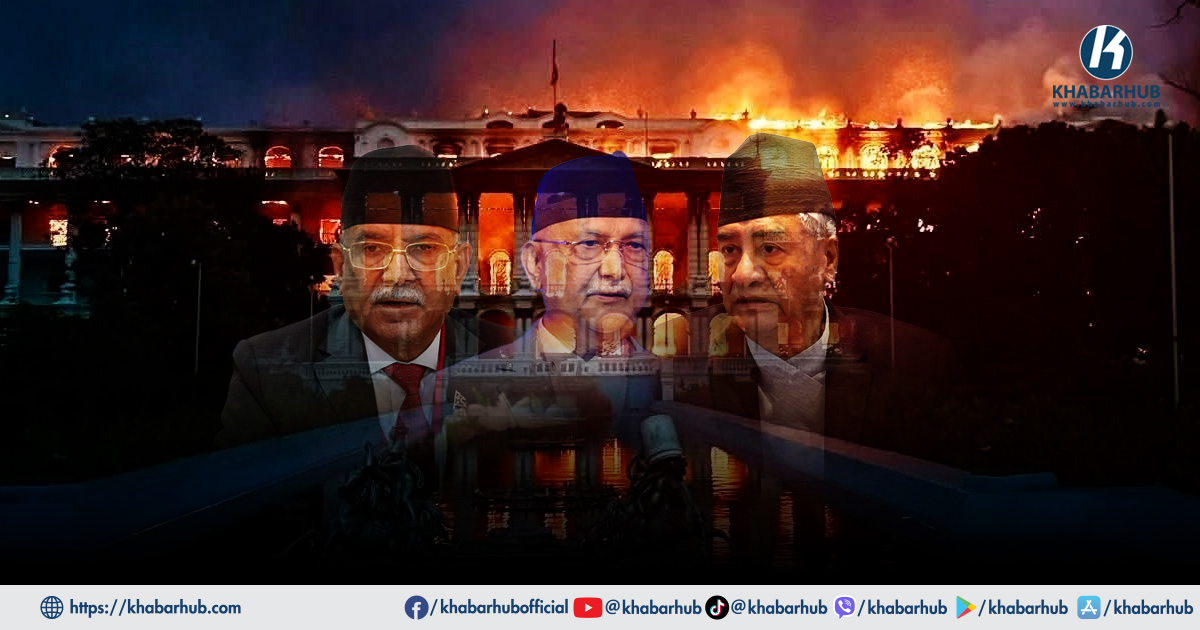
Under the cover of protest, anarchic actors have scattered weapons across the country. Yet no one seems concerned about these loose, uncontrolled arms. If the weapons legitimized in the name of the Gen-Z movement are turned to crime, what then? Seized weapons are like a child lost in a fair, breathless and helpless. Meanwhile, the army watches passively, like a boat adrift on the water.
There was a time in Milan when Benito Mussolini could draw millions even for the most modest event. Wherever Mussolini went, the crowd followed. Youth chanted “Duce! Duce!” in his honor.
To millions, Mussolini was more than a leader; he was a god. Yet within just five years, those same crowds turned on him, lynching him and his lover in the streets, hanging their bodies upside down as the nation spat in contempt. Illusions, however powerful, eventually collapse. The Gen-Z uprising has already shown how Nepal’s leaders may be forced to face a Mussolini-like reckoning.
Only those who truly take pride in their homeland can inhale the fragrance of its soil. Guided by knowledge and truth, a person can even make honey from weeds. But those who cause suffering to others never taste happiness. And yet, most of our political architects are well educated — tell me, which leader has not traveled abroad? Which officer, whether military or civil, has not studied overseas?
Lee Kuan Yew’s vision to make a litter-free country, Deng Xiaoping’s economic revolution, Mahathir Mohammad’s resolve, these names are on every leader’s tongue. Influenced by Sri Lanka, Lee Kuan Yew built Singapore into a paradise; yet Sri Lanka itself has been reduced to ashes and is only now attempting to recover.
Half a century ago, countries like South Korea, Thailand and Vietnam, which used to import food from Nepal, now enjoy per-capita incomes up to $24,000. We remain shamefully far behind in a race of three hundred. When political charlatans teach people to beg rather than to live, dark clouds gather.
In the days of monarchy, politicians tried to ride above the waves by blaming the king for every wrong. Today, they admit that disorder exists but refuse to shoulder any responsibility. Not one politician in the last four decades has matched the moral courage of Keshar Bahadur Bista, who resigned after a stadium stampede killed innocent people.
True ethics is simply the duty of one’s own nature, the voice of the soul. Yet finger-pointing has replaced accountability. If a stadium gate is left open, who takes responsibility? If someone is killed with a kukri, is the knife to blame or the hand that wielded it? When reason is exhausted, sophistry takes over. The political drama we see today is nothing more than the product of such moral emptiness.
The petty bribery once whispered about under the table has become a fable. Corruption has grown into an institutional, almost natural process. Distinguishing the corrupt from the virtuous is becoming as difficult as separating sugar from sand. Parties and their licensed brokers have turned every state institution into a torment.
Kautilya’s wisdom says: “Just as a fish cannot be seen when it drinks water, so a government official’s taking a bribe is unseen.” Corruption that a Panchayat could have committed in lakhs has, in the new Nepal, grown into billions. The revolutionary style now is not ‘ask for a bribe’ but ‘you must give it’. Nearly Rs 2 billion sent for local development are being parceled out along party lines. No political party seems even slightly concerned about ensuring that the people’s hard-earned money is used properly.
All these scenes tell us: policy is king, politics has become an industry, and the party has become a private limited company. Parties in power are busy looting. Opposition parties, unable to warm their hands at the fire of power, resort to sour acting and theatrics. Communist politics dominate our national scene. While leaders of communist revolutions elsewhere may have done more theatre than substance, Nepal’s situation is the opposite.
Those who preach that no one has the right to celebrate with cake until the people have bread now sip wine in steel glasses and perform hypocrisy. The author need not say more, Mao Tse-tung said it well, “The death of someone who dies for the country and people is as heavy as a mountain. The death of someone who dies only for himself is as light as fluff.”
To Mao’s followers here, I ask: comrades, which death will you choose?




Comment