




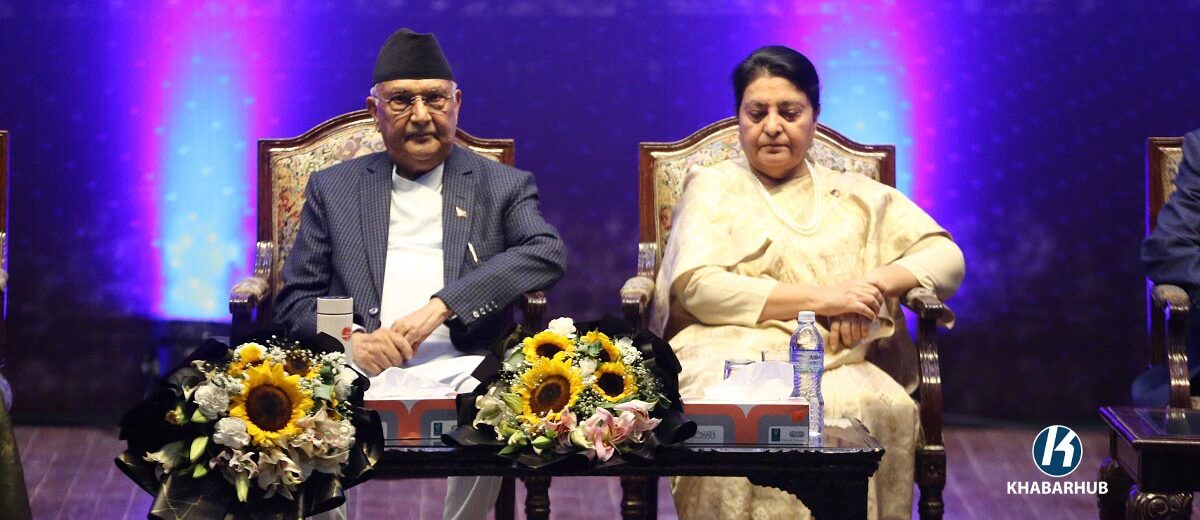
KATHMANDU: A fresh confrontation has broken out in the CPN-UML, Nepal’s main opposition party, after former President Bidya Devi Bhandari inaugurated a new contact office in Thapagaun this week.
The move has brought to the surface a simmering conflict between UML Chair KP Sharma Oli and the former head of state, deepening speculation that the party could be inching toward a formal split.
The office, named the Madan Bhandari 75th Birth Anniversary Main Organizing Committee Contact Office, was formally opened on Thursday, almost a year before the late communist leader’s 75th birth anniversary. While the event was framed as part of preparations for upcoming commemorations, its timing and political symbolism have stirred controversy inside the party.
The inauguration was attended by three UML vice-chairpersons, as well as several central leaders and cadres. Their presence was interpreted by many as a subtle show of defiance against Oli’s leadership, particularly since the central committee had recently passed a resolution restricting Bhandari’s role within the party.
A challenge to Oli’s grip
The central committee, meeting in Chyasal earlier this month, had made it explicit that Bhandari could no longer claim active membership in UML. The reasoning was straightforward: upon being elected as Nepal’s president in 2015, she had formally renounced her party membership to occupy a non-partisan constitutional role. Party leaders argued that once relinquished, membership could not be revived at will.
But speaking at the Thapagaun event, Bhandari directly challenged that stance. “Chyasal may have raised questions about my membership, but I have been a UML cadre since 1979. I will continue working in the party as I always have,” she declared.
Her statement was seen not only as a rebuttal to Oli but also as an attempt to assert her long-standing political identity and influence. Having risen through UML ranks before becoming Nepal’s first woman president, Bhandari remains a popular figure among many cadres who believe Oli has increasingly monopolized power.
Oli’s counterattack
Oli, for his part, responded with characteristic sharpness. Addressing a separate UML event the following day, he dismissed Bhandari’s claim of party membership as “deception.”
“It was Bidya Devi Bhandari herself who renounced party membership to become president. Membership cannot be restored by pressuring staff to issue receipts or by making false claims. If party membership was so dear, she should not have gone for the presidency in the first place,” Oli said.
The remarks drew a clear line: Oli is unwilling to accommodate Bhandari in UML’s formal structure, viewing her actions as a potential threat to his undisputed control of the party.
The foundation factor
At the heart of this struggle lies the Madan Bhandari Foundation, a body established in memory of Bhandari’s late husband, the popular communist leader Madan Bhandari. Once seen as a symbolic platform under Oli’s influence, the foundation has in recent years shifted closer to Bhandari’s family. Her daughter, Usha Kiran Bhandari, currently leads it.
Oli had previously used the foundation as a strategic counterweight to rival factions inside UML, but the balance has now shifted. With the foundation increasingly operating as an independent power base, it provides Bhandari with a platform to re-engage in active politics despite her constitutional retirement.
This dynamic has already created two parallel institutions within the UML ecosystem: the Madan-Ashrit Memorial Foundation, chaired by Deputy General Secretary Pradeep Gyawali and loyal to Oli, and the Madan Bhandari Foundation, now controlled by Bhandari’s circle.
Leaders caught in the middle
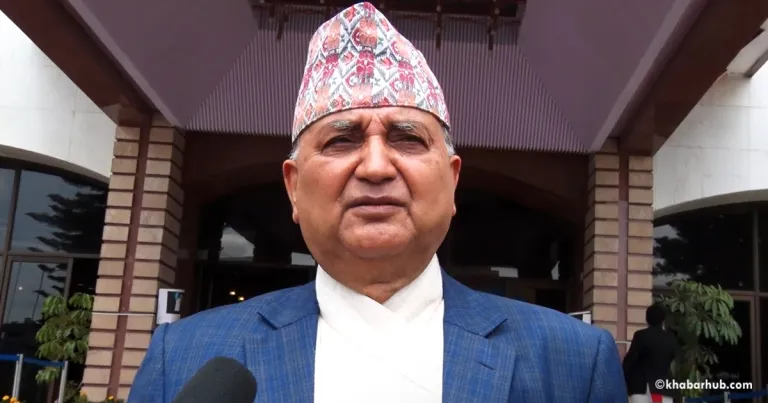
The presence of senior vice-chair Ishwar Pokhrel and other high-ranking leaders at the Thapagaun inauguration has exposed widening cracks within UML. Pokhrel, speaking at the event, highlighted the need to “democratize leadership transfer within the communist movement,” a remark widely read as supportive of Bhandari’s position.
Other leaders are said to be weighing their options carefully, aware that open alignment with either Oli or Bhandari could determine their future in the party.
The dispute goes beyond individual egos. It cuts to the heart of how UML manages leadership succession, internal dissent, and its historical legacy. For Oli, retaining sole authority over party membership and ideological institutions is key to maintaining his dominance. For Bhandari, reclaiming her place in UML is about securing both her personal political relevance and the legacy of Madan Bhandari, whose name remains central to the party’s identity.
Analysts note that the symbolic power of Madan Bhandari’s memory continues to resonate with cadres. Any attempt to sideline Bidya Devi Bhandari could therefore risk alienating a segment of the party base.
Toward a split?
The confrontation has sparked open debate: is UML on the brink of another division? While a formal split has not yet materialized, the emergence of parallel structures, sharp rhetoric, and visible factional alignment point to an increasingly unstable situation.
Whether this evolves into a complete rupture will depend on two factors: Oli’s willingness to tolerate Bhandari’s symbolic defiance, and Bhandari’s own readiness to push beyond symbolic gestures into building a structured alternative power center.
For now, UML remains intact, but the latest clash has made one thing clear: the rivalry between Oli and Bidya Devi Bhandari is no longer private. It has spilled into the open, forcing cadres and leaders alike to reckon with the question: can UML remain united under Oli’s singular authority, or is it heading toward yet another historic split?




Comment