




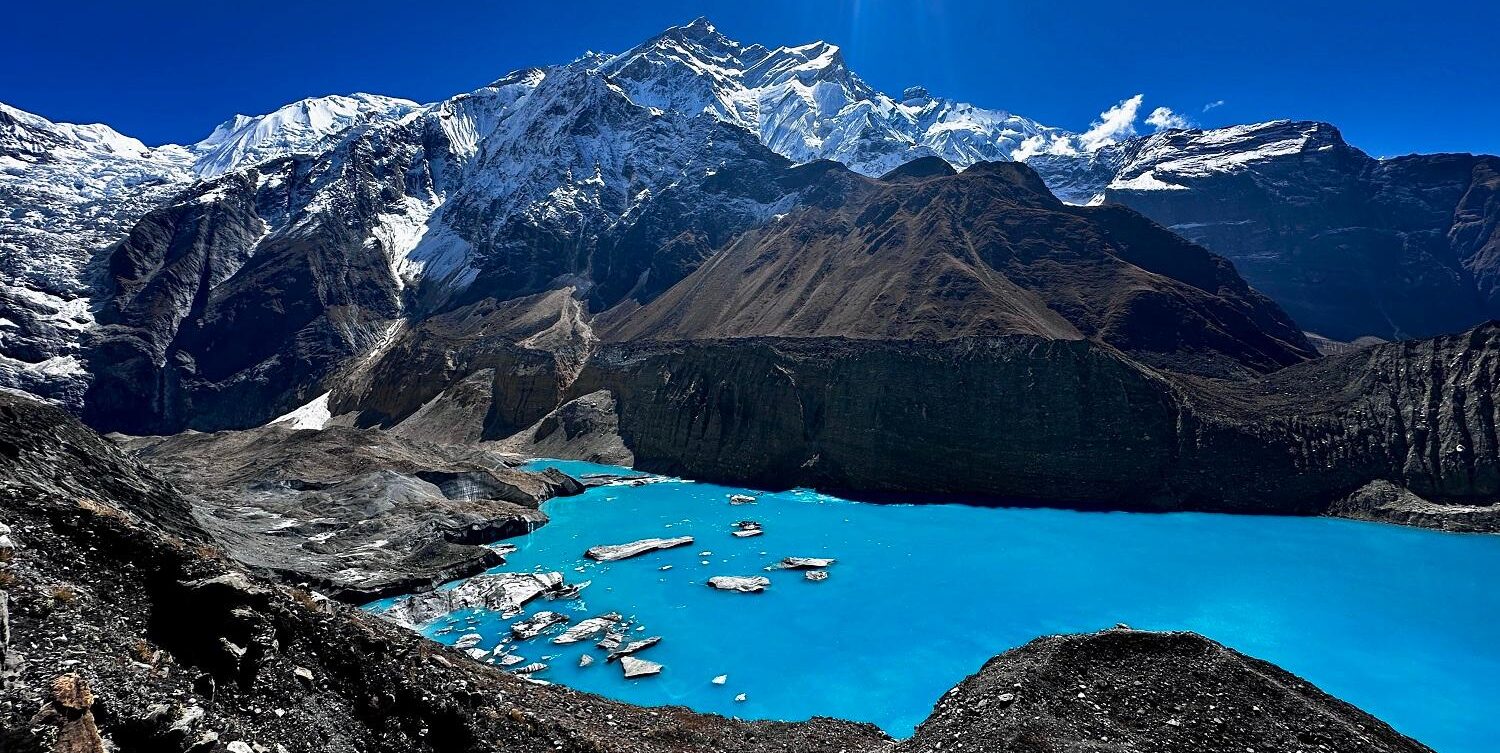
MYAGDI: Towering mountains rise in three directions—north, east, and west—while dry, snowless slopes surround a serene lake nestled at their base. Its waters gleam blue, mirroring the Nilgiri Himal when the sky clears. At sunrise, the lake glows gold; at night, it shimmers silver.
This is the enchanting Panchakunda Lake, located in Narchyang, Ward No. 4 of Annapurna Rural Municipality, Myagdi. The round-shaped glacial lake lies at the foot of Annapurna, Frank, Tilicho, and Nilgiri Himals, at an elevation of 4,050 meters above sea level. With its striking natural beauty and increasing popularity, Panchakunda has emerged as a promising new tourist destination.
Situated along the ‘Maurice Herzog’ trekking route, which connects Narchyang to the Annapurna Base Camp, Panchakunda has recently become a favorite among trekkers.
Nima, a tourist from Italy, shared, “What makes Panchakunda special is that you can experience the mountains, the base camp, and the lake all at once. The beauty around the lake filled me with joy and made me forget all my worries.”
The lake spans 17,684 square meters and was formed by the melting glaciers of the Annapurna range. It is not only a natural wonder but also a cultural and spiritual site. Tourists visit to enjoy the tranquil environment, take photographs, meditate, and create social media content with the scenic backdrop of snow-capped peaks.
Just two years ago, Panchakunda was relatively unknown, with little to no infrastructure. However, following the development of the Maurice Herzog trekking trail and the promotion of the area, the number of visitors has surged.
Tourism boom and challenges
Narimaya Garbuja Gurung, a local hotel operator, said, “We now receive 300 to 500 tourists daily. After gaining popularity through media and social platforms, the number of domestic visitors during Dashain and Tihar was overwhelming, even exceeding our accommodation capacity.”
Panchakunda also holds deep religious significance. According to local resident Chandrajit Pun, the name ‘Panchakunda’ refers to five sacred tanks: Rakta, Dugga, Tamra, Shuddha, and Suvarna.
“These tanks are mentioned in the Hindu scripture Panch Ramayana, though now they have merged into one due to glacial melting,” he said. Legend has it that sage Kagbhusundi meditated here and spread the spiritual value of this site.
A Shiva temple has been constructed on the lake premises, and the nearby mountain is locally known as Kagbhusundi, further deepening its religious association. It is believed that offering pinda (ritual offerings) here in memory of one’s ancestors brings spiritual merit.
Getting there
Panchakunda Lake is accessed via the Beni-Jomsom-Korla road along the Kaligandaki Corridor. From Nagdhunga in Annapurna Rural Municipality-2, visitors travel 20 km on an unpaved road to Humkhola via Narchyang Valley, followed by a six-hour trek.
Trekkers can follow a scenic route from Humkhola to Guransedanda, Phutphute Falls, Sadhikharka, Gufaphant, Akashe Gufa, Rato Falls, Bhusket Mela, and Sunkhola, eventually reaching Panchakunda and Annapurna Base Camp. Fast trekkers can complete the hike in a day, while others may prefer to rest overnight at Bhusket and continue the next day.
From Panchakunda, the Annapurna Base Camp—at an altitude of 4,150 meters—is just an hour’s hike away. It provides a panoramic view of both the lake and the surrounding Himalayas and serves as the starting point for mountaineers aiming to summit Annapurna.
Facilities and plans
Basic food and accommodation are available in temporary hotels along the trekking route, with guests staying in shelter houses or tents near Panchakunda Lake. Due to the high volume of visitors, hotel operator Michael Pun has urged tourists to book in advance.
However, the surge in visitors has brought environmental challenges. Waste management and lake cleanliness have become pressing concerns. As there is no suspension bridge linking the lake to the base camp, crossing streams poses risks. Visitors are also advised not to swim or walk on the frozen lake in winter due to safety concerns.
Electricity and communication services are currently unavailable. The Maurice Herzog Trail, named after the French mountaineer who led the first successful Annapurna expedition, was first identified in 2068 BS by Tej Gurung and officially opened in 2080 BS following basic infrastructure development.
In 2077 BS, Annapurna Rural Municipality organized a tourism festival to promote destinations like Panchakunda and the Annapurna Base Camp. A special event was also held this year to mark the 75th anniversary of the Annapurna climb.
According to Municipality Chair Bharat Kumar Pun, permanent structures cannot be built due to conservation rules under the Annapurna Conservation Area Project (ACAP). Instead, the municipality, ACAP, and the federal government have jointly invested in temporary shelters, trekking trails, suspension bridges, toilets, and an open museum at the base camp.
Government support and vision
Hari Bahadur Bhandari, Provincial Assembly Member from Myagdi 1(A), recently visited the base camp and committed to coordinating with all levels of government and stakeholders to enhance infrastructure and services.
“Annapurna Base Camp and Panchakunda Lake are close together and easily accessible, offering high tourism potential,” he said. “I will advocate for improved communication and electricity facilities along the trail, waste management, and the construction of a suspension bridge to ensure safe and sustainable tourism.”
(Santosh Gautam/RSS)





Comment