




KATHMANDU: The late Nepali Congress leader Girija Prasad Koirala once remarked that “Male, Masale, and Mandale are all the same,” referring to the ideological divide in Nepal’s political sphere in the year 1979.
During that period, the term ‘Mandale’—used predominantly by communists—was synonymous with royalist and reactionary politics. Even today, ‘Mandale’ remains a metaphor for royalists in Nepal.
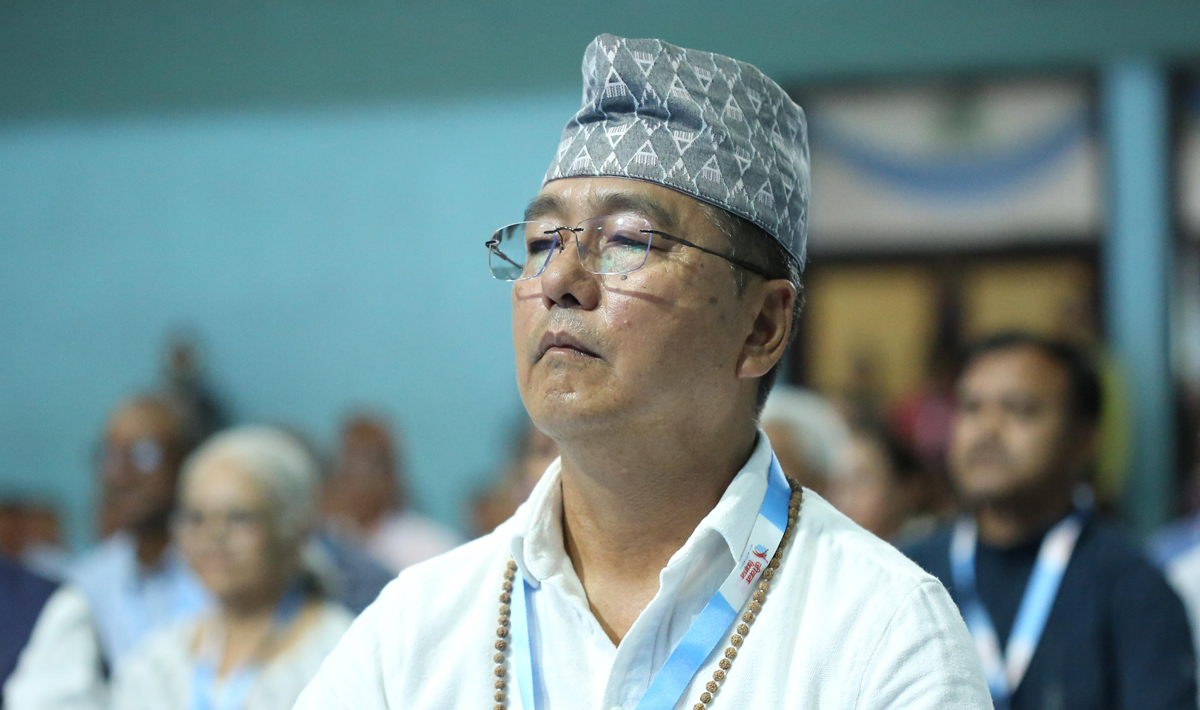
Rastriya Prajatantra Party (RPP) Chair Rajendra Lingden, who entered politics in 1979, was an active member of the Rastrabadi Swatantra Students’ Union—often labeled ‘Mandale’. He was elected as RPP’s Jhapa District Secretary in 1990 and later became the founding president of the party’s student wing, the National Democratic Student Organization, in 1992. Rising steadily, Lingden was appointed a central member and later General Secretary of the RPP by 2009.
Lingden gained national attention when he defeated veteran Nepali Congress leader Krishna Prasad Sitaula in the 2017 parliamentary elections, with support from the CPN-UML.
During the 2005/06 movement, Kamal Thapa—then Home Minister under King Gyanendra’s direct rule—was criticized by the monarch himself for inefficiency and was dismissed.
This rift with the monarchy became an opening for Lingden. Capitalizing on the fallout, Lingden, who reportedly had royal backing, went on to defeat Thapa at the RPP’s unity general convention in 2019.
Lingden is also accused of misusing the post-convention momentum to make appointments based on loyalty rather than merit. Shortly after the convention, he promoted Hemjung Gurung—who had been elected as a provincial president—to the position of central Vice-Chair.
Positioning himself as a reformist, Lingden made headlines in Parliament by branding politicians as “thieves” and launching an anti-corruption rhetoric, famously likening corruption to “drinking one’s mother’s blood.”
Controversy Brews Within
After becoming chairman, Lingden pledged to unify royalist forces. However, that goal remains unmet. His rival Kamal Thapa revived RPP Nepal, deepening the divide among monarchists.
Now, Lingden faces internal backlash. Senior leaders within the RPP accuse him of unilateral decision-making—adding and removing party officials and central committee members beyond the limits prescribed in the party’s statute.
A front has formed against him, led by Senior Vice Chair Bikram Pandey, Vice Chair Mukunda Shyam Giri, and General Secretaries Dr. Dhawal Shumsher Rana and Kunti Shahi. In a statement issued last Thursday, they alleged that Lingden’s arbitrary actions have caused irreparable damage to the party.
They emphasized the importance of strictly adhering to the party statute and expressed disappointment over what they described as growing internal authoritarianism.
The statement also referenced a meeting held at the residence of former Chairman Dr. Prakash Chandra Lohani, where Lingden reportedly reaffirmed his support for Nawaraj Subedi, a leader of the royalist movement. According to the statement, Lingden told Subedi: “Continue to fulfill your responsibilities in the party as before.”
However, Subedi was later removed from the party’s disciplinary committee—his position given to Dr. Roshan Karki, a current MP. This move sparked further dissent.
Additional grievances include Lingden’s decision to strip Sagun Lawati of his role as head of the organization department while General Secretary Rana was undergoing cancer treatment in India. Likewise, Dhawal Shumsher Rana was removed as General Secretary– both changes allegedly violating the party’s statute.
Dissenting leaders argue that these dismissals and reshuffles have sown doubt and unrest both within the party and among the general public, putting Lingden’s leadership under increasing scrutiny.
Allegations against Lingden: Unity in name only?
The first general convention of the unified Rastriya Prajatantra Party (RPP) and RPP United was held in 2019, under the banner of party unity. In that convention, Rajendra Lingden defeated his rival Kamal Thapa by a margin of 200 votes, securing the party’s leadership.
At the time, Lingden had emphasized that the election was not marked by internal rebellion or division. In his victory speech, he confidently declared, “Although there were fears that the competition between the two factions would divide the party, from today we are all one. No one belongs to any faction.”
He went further, stating: “We had no right to keep the RPP dormant and ineffective as it had been in the past. Our move to change leadership was not just necessary—it was essential to ensure the survival of the party. Despite numerous challenges and doubts, we have succeeded.”
However, that unity proved short-lived. Within just a few months of the so-called “Unity Convention,” the RPP once again splintered. Critics within the party now allege that Lingden’s leadership has been marked by increasing arbitrariness and a growing gap between rhetoric and action.
Senior leaders argue that while Lingden preached unity, his actions have often undermined it. They point to the absence of a functioning mediation mechanism within the party—no group or process currently exists to reconcile internal differences or manage dissent. This, they say, has allowed discontent to fester and grow unchecked.
According to these leaders, the lack of dialogue and compromise has weakened the party’s structure and ideology, diminishing its credibility both internally and in the public eye.
They believe that Lingden has failed to adopt a coordinating role, one that could have brought disgruntled factions together and preserved party cohesion.
Ultimately, RPP insiders claim that the party’s current internal crisis stems from Lingden’s inability to align his promises with his actions. His post-convention rhetoric of unity, they say, rings hollow in light of the internal turmoil that followed—fueling widespread dissatisfaction and pushing the party further into disarray.
Allegations against Lingden: The unraveling of a promising leadership
Following the general convention of the Rastriya Prajatantra Party (RPP), political observers and party insiders alike have begun to question whether Rajendra Lingden’s political journey has started to decline rather than ascend.
Once seen as a fresh and hopeful leader, especially among Nepal’s youth, Lingden’s leadership is now facing serious scrutiny. The promises he made before and immediately after the convention—of honesty, reform, and unity—have, according to his critics, largely remained unfulfilled.
Lingden had vowed to build a trustworthy and energetic party that could provide national political alternatives, especially appealing to the younger generation. However, shortly after the convention, his actions began to diverge from his earlier statements.
Many within the party now accuse him of abandoning the very values he had championed—honesty, integrity, and accountability. He had launched his leadership with bold anti-corruption rhetoric, famously likening corruption to “drinking one’s mother’s blood.” Yet, several RPP leaders argue that his conduct has contradicted this stance, pointing out the glaring disparity between his public declarations and his private decisions.
One of the central accusations against Lingden is that he has failed to uphold the commitments he made to the party and its supporters. Among them were ambitious promises: restoring the monarchy within six months, launching a protest movement to change the system, not participating in any government, and refusing to align the RPP with any other political force.
Instead of working toward these goals, Lingden joined the Prachanda-led government, directly defying the resolutions passed by the general convention. His critics argue that his decision to enter government undermined both his credibility and the ideological foundation of the party.
Lingden is also accused of misusing the post-convention momentum to make appointments based on loyalty rather than merit. Shortly after the convention, he promoted Hemjung Gurung—who had been elected as a provincial president—to the position of central Vice-Chair.
But what is clear is that the dissatisfaction within the party has reached a critical point—one that threatens to destabilize not only his leadership but the very identity and future of the RPP itself.
This move raised eyebrows, as it disregarded internal process and precedent. Furthermore, in contradiction to the party’s statute, Lingden appointed a vice-president to head the party’s secretariat, a role legally reserved for the general secretary. These decisions, critics say, reflect a pattern of arbitrary governance that has become a hallmark of his leadership.
Moreover, there are serious allegations that Lingden has surrounded himself with individuals facing criminal charges or past convictions. Party insiders claim that those defeated in the general convention were later rewarded with influential posts, while many of those who had earned strong mandates from the party base were sidelined. According to one leader, Lingden has effectively replaced competent voices with loyalists—”yes men” drawn from his inner circle—who offer little resistance and uphold his decisions without question.
Initially, Lingden’s decisions were tolerated, seen as part of the transitional excitement following the general convention. But over time, discontent began to grow. His handling of senior party figure Dr. Dhaval Shumsher Rana, who had played a key role in Lingden’s rise, became particularly controversial.
When Rana fell ill, instead of rallying around him, Lingden reportedly began to strip him of key responsibilities—an act seen by many as both politically opportunistic and personally insensitive.
Disillusionment deepened as Lingden continued to make unilateral decisions. His appointment of Sagun Lawati to head the International Relations Department, allegedly in violation of the party’s statute, is seen by many as the beginning of what some have dubbed a leadership style driven by favoritism and personal allegiance.
Critics argue that such moves not only violated party norms but also signaled a shift toward centralized control and internal politicking.
Lingden is also accused of undermining party democracy by marginalizing internal discussions and replacing inclusive leadership with factional control.
His decisions on selecting speakers in various provinces, particularly when the party joined provincial governments despite publicly opposing federalism, drew further criticism from party members. These inconsistencies, many argue, alienated grassroots supporters and betrayed the sentiments of the rank-and-file.
A legal complaint has even been filed with the Election Commission regarding his handling of matters involving senior leader Mukunda Shyam Giri, accusing Lingden of violating laws and internal procedures.
Beyond the party structure, Lingden’s handling of the broader royalist and Hindu nationalist movement has also drawn ire. Supporters of the movement, including those led by Nawaraj Subedi, claim Lingden not only failed to support their cause but actively weakened it.
His refusal to accept leadership outside of himself, critics argue, reflects an inability to work collaboratively—something essential for building a wider political front. According to one RPP leader, Lingden’s leadership style has become more about asserting personal control than about fostering unity or dialogue.
The consequences of these internal tensions have been far-reaching. Multiple party members and office bearers in Karnali Province have resigned, demanding that Lingden reverse his decisions and restore internal balance. District-level leaders have echoed similar sentiments, expressing frustration over their voices being ignored and their roles diminished.
What began as a leadership promising transformation and unity has, according to many within the RPP, devolved into one defined by inconsistency, centralization, and factionalism. Whether Lingden can address these accusations and restore credibility remains uncertain.
Lingden’s refusal to find common ground on key issues—whether it be joining the government, launching street protests, or clarifying the party’s agenda—has only widened the divide. Leaders warn that unless this gap is bridged, the internal conflict will deepen and potentially become irreparable.
But what is clear is that the dissatisfaction within the party has reached a critical point—one that threatens to destabilize not only his leadership but the very identity and future of the RPP itself.
Leadership under fire: Lingden’s approach fuels growing discontent in RPP
As discontent deepens within the Rastriya Prajatantra Party (RPP), senior leaders have begun voicing frustration over Chairman Rajendra Lingden’s most recent statements, arguing they are aimed more at suppressing internal dissent than resolving it. According to them, rather than acknowledging the concerns raised from within the party, Lingden appears intent on silencing criticism.
His recent remarks—echoing sentiments he shared earlier in his home district, Jhapa—have only heightened fears that the party is headed toward political disaster.
Leaders within the RPP allege that Lingden has fundamentally failed to convince both the party’s base and the broader public that the RPP can be a credible political alternative. They argue that under his leadership, the party’s ideological clarity and connection to grassroots sentiment have eroded significantly.
One senior leader pointedly remarked that Lingden had missed a historic opportunity to rise above factional interests and take a visionary approach—one that could have cemented the RPP as a formidable nationalist force in Nepal’s national politics.
Lingden is also accused of betraying the trust of those who helped elevate him to the party’s top post. A particular flashpoint came when he allegedly insulted a veteran leader who had played a major role in shaping the party, doing so while occupying the very chair the elder helped him claim. Critics see this not just as a lapse in etiquette, but a symbolic rejection of institutional memory and loyalty.
Among Lingden’s more controversial statements is his claim that “95 percent of the older generation is outside the party” and that a new generation is now emerging to take over. This, many leaders argue, is a flawed and divisive perspective.
Instead of integrating the experience of senior leaders with the energy of younger cadres, Lingden appears to be sidelining the party’s veterans—those who built and sustained the RPP over decades.
A former senior RPP leader lamented that the culture of respect for the contributions of long-serving members has disappeared. “The spirit of learning from the older generation and building a unified party through experience and energy is being lost,” the leader said. “In their place, new faces with little ideological grounding have been brought in. Lingden has been misled by a desire for cheap popularity and applause politics.”
There is a growing perception that Lingden has surrounded himself with individuals who lack deep roots in the party, and worse, some who have never supported the RPP at the ballot box. Critics say he is grooming such individuals for leadership roles purely based on loyalty to him rather than alignment with party ideals.
This practice, they warn, raises fundamental concerns about the values and beliefs that once formed the RPP’s ideological backbone.
The sense of exclusion felt by many within the party has been worsened by what some describe as Lingden’s intolerance of independent voices.
His reluctance to engage dissenters constructively, they argue, reveals an authoritarian streak. Rather than building consensus, Lingden is accused of seeking to weaken his opponents and consolidate power for himself. According to one senior RPP figure, this mindset has created a vacuum of coordination at the leadership level—a void that threatens to implode the party from within.
Unless the internal culture shifts toward reconciliation, inclusion, and respect for the party’s founding principles, the RPP’s future as a cohesive political force may be in jeopardy.
The party’s internal strife has become so visible that even those within Lingden’s faction are acknowledging its damaging impact. Some admit that the RPP is now divided into informal camps—some aligned with Dhawal Shumsher Rana, others with Lingden—while the majority of ordinary cadres remain focused on strengthening the party’s ideological foundations. However, they express concern that a small group of leaders, driven by factional motives, is undermining the broader mission.
Lingden’s refusal to find common ground on key issues—whether it be joining the government, launching street protests, or clarifying the party’s agenda—has only widened the divide. Leaders warn that unless this gap is bridged, the internal conflict will deepen and potentially become irreparable.
Analysts observing the RPP’s internal dynamics echo these concerns. They argue that Lingden’s approach reflects a desire to centralize control and dominate the leadership, rather than fostering a collective vision.
While internal political struggle is not new to the RPP, the current one is particularly corrosive, as it openly violates the party’s own norms and procedures. In the absence of a moderate, coordinating force, the RPP risks not only organizational collapse but also the loss of its ideological identity.
In the end, the emerging consensus among many RPP leaders and observers is clear: Lingden’s leadership style—marked by centralization, exclusion, and contradiction—has done little to build the unified, nationalist alternative the party once promised to become.
Unless the internal culture shifts toward reconciliation, inclusion, and respect for the party’s founding principles, the RPP’s future as a cohesive political force may be in jeopardy.
Spokesperson defends Lingden’s actions
In response to mounting criticisms against Chairman Rajendra Lingden, Rastriya Prajatantra Party (RPP) spokesperson Mohan Kumar Shrestha has come to his defense, clarifying the rationale behind recent decisions regarding the removal and appointment of key party figures.
Addressing the controversy surrounding Nawaraj Subedi, Shrestha stated that there was no need to seek an explanation from someone who had already declared their departure from the party.
Shrestha dismissed the broader dissent within the party—particularly the public criticisms by senior leaders like Dr. Prakash Chandra Lohani—as exaggerated. “This is not a serious crisis. It’s an attempt to create a storm in a teacup. There’s nothing here that requires reconsideration or panic.”
“Subedi himself publicly announced that he had left the party on Chaitra 4, 2081,” Shrestha said. “Explanations are required from those who remain within the party, not from individuals who have already made it clear they no longer wish to be a part of it. Once Subedi left, his position became vacant.”
He further noted that Dr. Roshan Karki, also a sitting Member of Parliament, was subsequently appointed as chairman of the disciplinary committee in order to fill the organizational vacuum and carry forward the party’s internal functions.
Shrestha also addressed the removal of Sagun Sundar Lawati and Mukunda Shyam Giri, stating that both were removed only from the positions to which they had been nominated, not from their elected roles.
In the case of Giri, who had been nominated as central member and vice-chairman, Shrestha argued that Lingden had acted within his rights as provided by the party statute.
“Giri was nominated to those posts by the chairman, and the statute clearly gives the chairman the authority to remove individuals from nominated positions,” Shrestha explained.
“Giri’s alignment with Nawaraj Subedi, including his visit to the Election Commission, was deemed to be against party interests. Therefore, action was taken accordingly using the statutory provision.”
Regarding Lawati, Shrestha clarified that although he remains an elected central committee member, the position of party spokesperson was a nominated role, and thus subject to the chairman’s discretionary powers. “The chairman had appointed Lawati as spokesperson to help manage party affairs. That responsibility has now been withdrawn, and the statute does not prevent the chairman from doing so.”
Shrestha dismissed the broader dissent within the party—particularly the public criticisms by senior leaders like Dr. Prakash Chandra Lohani—as exaggerated. “This is not a serious crisis. It’s an attempt to create a storm in a teacup. There’s nothing here that requires reconsideration or panic.”
He concluded by suggesting that if party members disagree with the chairman’s authority over nominations and removals, they should seek to amend the party statute itself, rather than misinterpret its provisions.
“The statute is clear. It allows the chairman to both nominate and remove. If someone believes that power should be limited, the correct approach is to revise the statute—not distort it. What’s happening now is a deliberate misreading of rules that are as clear as daylight.”




Comment