




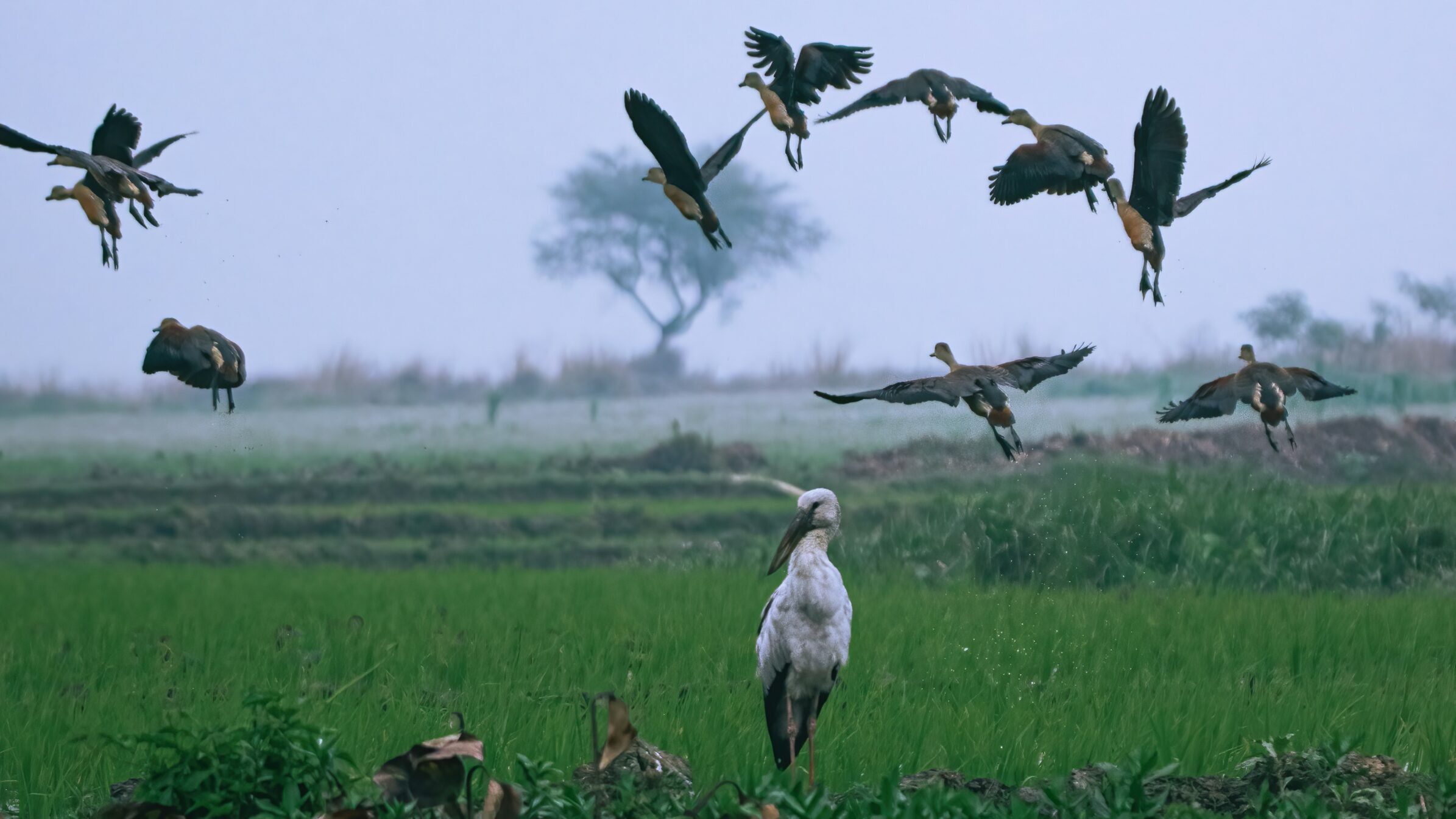
KANCHANPUR: The population of Sarus cranes, a vulnerable and protected bird species, is steadily declining in the Kanchanpur and Kailali districts of far-western Nepal, according to local conservationists.
Once commonly seen in the region’s wetlands, sightings of the tall, elegant cranes have become increasingly rare. Experts attribute the decline to multiple factors including habitat loss, chemical use in agriculture, climate change, and poaching.
“Encroachment on wetlands for farming has significantly reduced the natural habitat of the Sarus cranes,” said Hirulal Dagaura, an ornithologist with the Nepal Bird Conservation Society. “Chemical fertilizers and pesticides used by farmers have further threatened their food sources and nesting grounds.”
Recent field records show that only five Sarus cranes were spotted in Kailali, and up to 22 in Kanchanpur. These birds are typically found in Kalikich Lake inside Shuklaphanta National Park and in the wetlands of Beldandi Rural Municipality. Occasionally, they can be seen foraging in paddy fields during the monsoon or around the Ghodaghodi Lake Ramsar site in Kailali.
The Sarus crane, known for its role in pest control by feeding on crop-damaging insects, is considered beneficial to farmers. It also acts as a natural alarm system, often calling loudly when predators such as tigers, leopards, or wild boars approach.
However, the combination of habitat degradation and direct threats such as egg theft and hunting has placed the species at risk. “Protecting wetland areas is crucial, and local municipalities and communities need to be actively involved,” Dagaura emphasized. “Public awareness of the bird’s ecological role and habitat needs is essential for long-term conservation.”
Experts have called for a shift toward organic farming practices to reduce the environmental impact of conventional agriculture. Promoting the use of organic fertilizers and pesticides could benefit both local biodiversity and farming productivity.
The Sarus crane is listed as a protected species under Nepal’s National Parks and Wildlife Conservation Act 2029 (1973), and classified as “vulnerable” by the International Union for Conservation of Nature (IUCN). While only a few remain in Kanchanpur and Kailali, over 600 Sarus cranes are estimated to live in Rupandehi, Kapilvastu, and Nawalparasi. Across South Asia, their population is believed to be around 10,000.
Conservationists warn that without immediate action, the Sarus crane may disappear from many areas where it once thrived.






Comment