




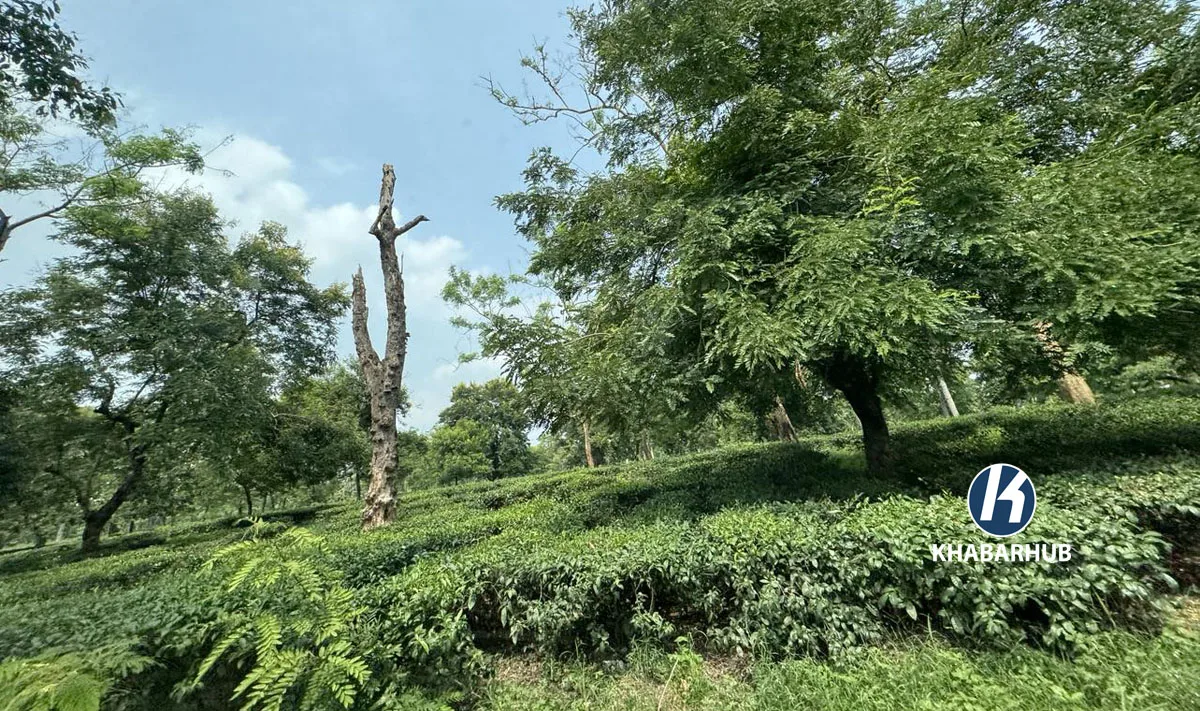
BAGLUNG: Tea farmers in Kathekhola Rural Municipality of Baglung are enthusiastic as the tea plants they cultivated by clearing overgrown bushes have started yielding commercial harvests.
The success story began in Reshma, Ward No. 7, where tea cultivation on previously unused land has now reached the stage of regular harvesting.
Currently, tea is being cultivated on 162 ropanis of land across areas such as Baur, Tingring, and other parts of Reshma.
While tea was first grown experimentally on a small scale last year, this year, with the purchase of modern processing equipment, the harvest from 70 ropanis of land has entered commercial production. Tea plants on the remaining 100 ropanis are still maturing.
The tea plants reach full productivity in five years, and harvesting has now begun on a weekly basis.
The harvest season is expected to continue until Mangsir. Dammar Bahadur Thapa, Chairperson of the Jan Kalyan Basic School Management Committee, shared that 35 ropanis of the school’s land have been used for cultivation.
He explained that what was once a firewood collection area has now been transformed into a thriving tea garden.
Tea farming is being expanded under the leadership of the Reshma Small Farmers Cooperative. According to Thapa, the school is also producing and distributing tea seedlings to support further expansion.
Of the total 162 ropanis under cultivation, 67 ropanis belong to the cooperative, 60 ropanis to local farmers, and 35 ropanis to the school.
Currently, tea is being harvested only from the 70 ropanis planted in the initial phase by the school and local residents, while the rest are still in the growing stage, said Ujeli Sharma, Chairperson of the cooperative.
Ward Chairperson Prem Lamichhane of Kathekhola-7 stated that tea production equipment worth NPR 1.8 million has been purchased locally with the goal of enabling tea exports within a year.
With promising growth in Pakhobari, farmers are now clearing previously abandoned land—left fallow due to outmigration—to expand tea cultivation.
Chairman Lamichhane added that locals are increasingly planting tea on both private and public unused land. There are also plans to plant an additional 50,000 tea saplings in the near future.
The transformation has not only boosted local agriculture but also started attracting tourists. What was a weed-covered hillside just six years ago is now a flourishing tea garden drawing visitors to the area.





Comment