




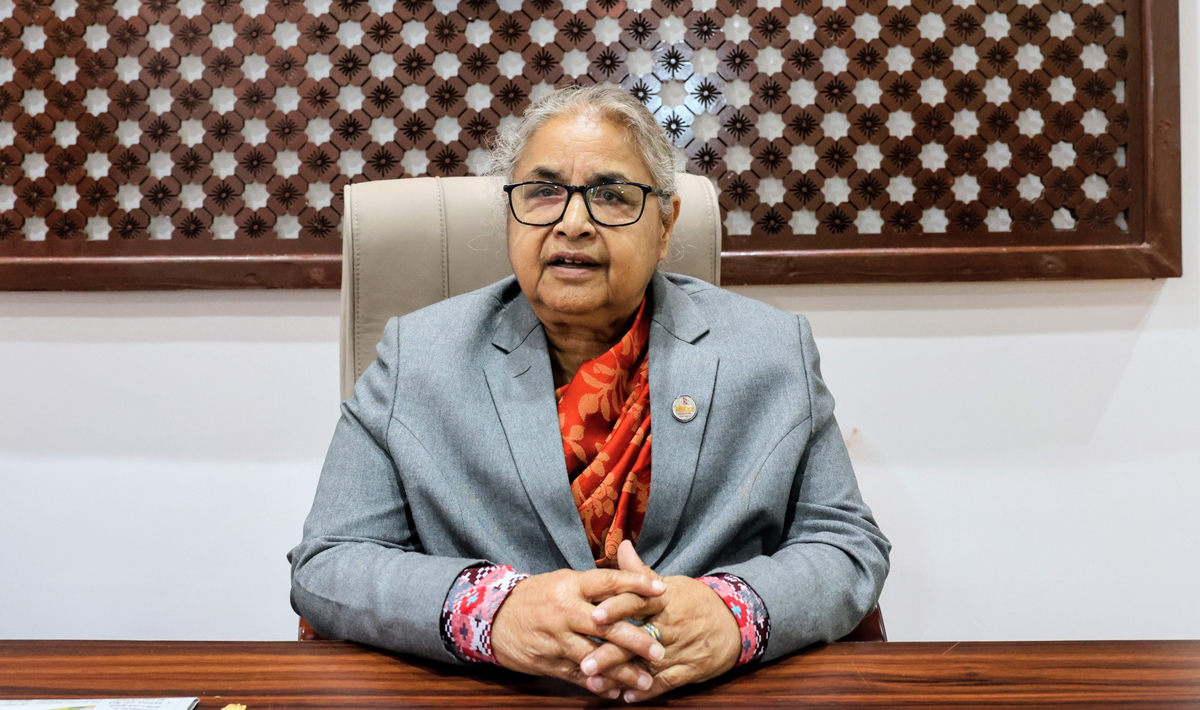
KATHMANDU: The government led by Prime Minister (PM) Sushila Karki, formed in the aftermath of the Gen-Z youth-led protests on September 8 and 9, has completed its first 100 days in office. Appointed on September 12 with a commitment to hold elections on March 5, 2026, the Karki-led government has now crossed the traditional parliamentary “honeymoon period.”
However, the government, formed amid strong public anger against corruption, nepotism, and entrenched political distortions, has failed to deliver the positive momentum many had expected during this initial phase.
Uncertainty also persists over whether elections will be held on the promised date. The debate over the government’s commitment to elections continues, while critics argue that the administration itself appears to be undermining the Gen-Z movement’s core demand: the formation of a high-level commission to investigate corruption.
Beyond a few minor reform initiatives, the government has shown little indication of challenging the entrenched political power structures it initially vowed to confront.
Three months to form Cabinet
Following the Gen-Z movement, the political vacuum made the formation of an interim or all-party government essential. Given the balance of power at the time, Sushila Karki’s rise to lead the interim government was not unexpected.
Yet despite drawing legitimacy from a mass movement, Prime Minister Karki took nearly three months to form a full cabinet. Appointed on September 12, she initially led a three-member cabinet formed on September 14. The cabinet was expanded for the fourth time only on December 12, reaching 14 members.
Why a prime minister entrusted with steering the country through a critical political transition failed, or chose not, to form a strong and functional cabinet early on remains a serious concern.
Weak Cabinet performance
Even after its expansion, the cabinet has struggled to project effectiveness. Ministers appointed under the banner of good governance and reform have largely failed to deliver concrete results or a new governing vision.
Finance and Federal Affairs Minister Rameshore Khanal initiated expenditure-cut measures soon after assuming office. While symbolically important, these steps fall short of producing long-term economic or governance reform.
Education Minister Mahabir Pun has yet to introduce any meaningful policy or programmatic reforms. Instead, his response to calls for education reform has largely been limited to assurances deferred until after elections.
Home Minister Om Prakash Aryal, a legal expert, has focused mainly on routine administrative duties. While he made efforts to address families affected during the Gen-Z movement, substantive progress on major corruption or criminal cases has been limited. Although the Central Investigation Bureau has shown increased activity, longstanding high-profile cases have yet to gain momentum.
Minister Kulman Ghising, who oversees three ministries, has been the most visibly active. He has pushed to terminate contracts for hundreds of long-stalled projects and has personally monitored infrastructure sites. However, critics argue that terminating contracts without addressing structural weaknesses could further destabilize development projects.
His recent decisions regarding electricity imports from India have also sparked controversy. Despite his activism, Ghising has yet to initiate deeper policy reforms capable of setting new standards in development and construction.
Other ministers, appointed in phases, have made little visible impact. Overall, the cabinet lacks cohesion and collective urgency, particularly in creating a credible environment for elections and advancing governance reforms.
As a result, political parties and the public remain skeptical. One hundred days on, the government has struggled to convert popular mandate into measurable action, leaving hope dimmed and the path to elections uncertain.
Investigation entrusted to a controversial figure
The interim government formed a high-level inquiry commission on September 21 through a Cabinet decision to investigate incidents related to the Gen-Z movement. The commission is led by former judge Gauri Bahadur Karki. However, controversy arose from the outset, as Karki had publicly expressed his views on the Gen-Z movement on social media even before being appointed to head the commission.
The CPN-UML, which was leading the government with a two-thirds majority at the time of the movement, has stated that it will not accept a commission led by someone who had already made public judgments prior to the investigation. UML leaders have further warned that they would resist any attempt by the commission to take statements from former Prime Minister KP Sharma Oli.
Even three months after its formation, the commission has yet to record statements from key figures such as former Prime Minister Oli and then Home Minister Ramesh Lekhak. This delay has raised serious questions about the credibility, independence, and effectiveness of the inquiry.
Reluctance on corruption investigation
One of the core demands of the Gen-G movement was a comprehensive investigation into corruption. Prime Minister Sushila Karki had publicly aligned herself with the agenda of good governance and repeatedly stated that a high-level commission to probe corruption was necessary.
However, even during the government’s honeymoon period, no concrete steps have been taken to initiate such an investigation. This inaction has raised doubts about Karki’s commitment to the Gen-Z mandate and has led to growing skepticism over whether the government is genuinely aligned with the spirit of the movement or merely using it to legitimize its authority.
Protection of controversial individuals
Prime Minister Karki, who built her public image around integrity and good governance, has increasingly come under criticism for actions that appear contradictory to those principles. From appointing close family members within her secretariat to defending controversial decisions, her leadership has raised questions about consistency and accountability.
Despite the expectations raised after the Gen-Z movement, the government has taken no significant policy, programmatic, or practical steps to reform the bureaucracy. Instead, Prime Minister Karki approved the decision, widely criticized as vindictive, by Energy Minister Kulman Ghising to remove Hitendra Shakya from the post of Managing Director of the Nepal Electricity Authority.
Furthermore, the Prime Minister declined to remove or even investigate Attorney General Sabita Bhandari, who has been linked to a serious controversy involving the alleged purchase and sale of a teenager’s eggs.
Similarly, the government defended the contentious tax exemption granted to the Dolma Impact Fund, a proposal advanced by Finance Minister Khanal.
These actions have reinforced perceptions that the government is selectively protecting controversial individuals rather than upholding principles of transparency and accountability.
Failure to create an electoral environment
The primary mandate of the interim government is to hold elections on March 5, 2026. However, the Karki-led government has failed to build consensus among major political parties and Gen-Z movement supporters regarding the electoral process.
Based on the results of the 2079 BS elections, the CPN-UML has consistently maintained that the current government lacks the capacity and legitimacy to conduct elections. Both major parties, the UML and the Nepali Congress, have approached the Supreme Court seeking the restoration of parliament.
Meanwhile, a group led by Miraj Dhungana has announced protests starting Sunday, accusing the government of deviating from the spirit of the Gen-G movement. The inability of the government to gain the confidence of both traditional political forces and Gen-Z-aligned groups has heightened fears of another political crisis if elections fail to take place on March 5, 2026.




Comment