




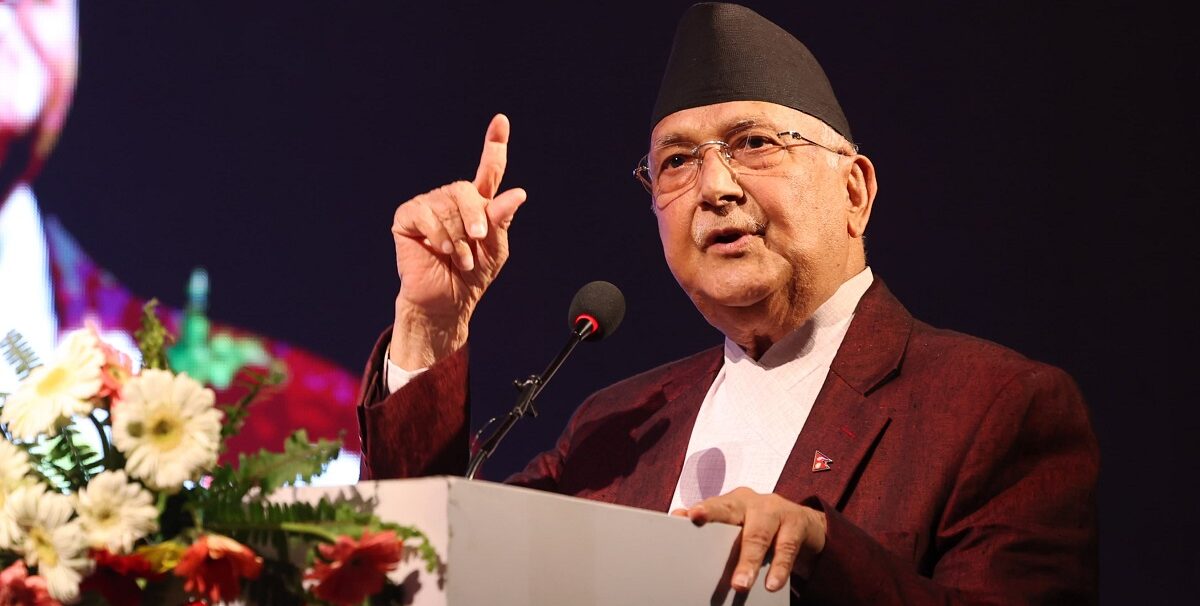
KATHMANDU: Lately, even casual conversations in tea shops are circling around one burning question: is the Oli government on the verge of collapse?
Surprisingly, it’s not just the public—concern is growing within the ranks of the UML itself, with party leaders and cadres expressing unease and asking similar questions.
Prime Minister KP Sharma Oli is well aware of the swirling rumors. In fact, during the last week of April, he had to reassure his own party members that the government is not going to fall and urged them to remain confident.
Taking a cue from Nepali Congress (NC) President Sher Bahadur Deuba—who recently returned from Bangkok—Oli assured UML members that the coalition government remains secure.
He also instructed party cadres, many of whom have been inactive due to internal stagnation, to begin preparations for the 2084 BS (2027) elections.
A stable majority, but persistent rumors
Despite the clear majority held by the ruling coalition, speculation continues to circulate about the government’s instability.
After Prime Minister Oli publicly declared that his administration is not at risk, many felt compelled to believe it.
Parliamentary math supports his claim: the Nepali Congress and CPN-UML alliance holds a comfortable majority, and their seven-point agreement clearly states that this government will continue until 2084 BS (2027).
Still, anxiety lingers among the ruling party’s leaders and workers. Much of the Prime Minister’s energy appears to be going into countering speculation rather than promoting policy.
Even though opposition parties—including the Maoists and other smaller factions—lack the numbers to challenge the government, doubts about the coalition’s longevity persist.
This has raised questions about the government’s inability to convey political stability to the public. Despite being backed by the two largest parties in the country, the Oli government seems to be operating in a defensive posture.
Prime Minister Oli, who took office in July 2024, has now completed 10 months in power. If the political landscape remains steady, his term is expected to last until July 2026, leaving him about 13 months in office.
Yet, from the beginning, Oli has repeatedly emphasized that the alliance will last until 2084 BS (2027).
No serious threat, yet a defensive stance
There are no visible signs of opposition efforts to topple the government. Nonetheless, Oli often speaks as though an unseen enemy is plotting against him. In repeated speeches, he asserts that the government will not fall and that the alliance will remain intact until 2084 BS.
Meanwhile, the Prime Minister’s secretariat has become active in the narrative battle. When a brief power outage occurred last week, rumors spread quickly that load shedding had returned.
In response, the Prime Minister’s chief political advisor, Bishnu Rimal, posted a strongly worded status online:
“Mr. Hitendra Shakya, you are the Managing Director of the Nepal Electricity Authority. You are competent in your role and honest in your vision. But be cautious—some are sitting under electric lamps and writing posts claiming ‘the electricity is gone.’ These are the same people who deify those who bring power without knowing how it actually comes. In our society, narrative creators get the spotlight, not service providers. Even your honest efforts won’t appear in the ‘feed’—because they are not part of the ‘frame.’”
This post sparked debate. Was it appropriate for the Prime Minister’s top advisor to publicly defend NEA officials in this manner? Regardless, it reflects a broader strategy in the government to directly confront and manage public perception—especially on social media.
A fight on the digital front
Addressing a program earlier this week, Prime Minister Oli again voiced concern over digital criticism. He said:
“Anarchic forces who oppose peace, development, and national progress are using social media and digital platforms to attack the UML. We must recognize this and respond accordingly. Our fight has been insufficient.”
This ongoing tension between political power and public perception has highlighted the Oli administration’s increasing preoccupation with narrative control. While the numbers are in his favor, the real challenge appears to be winning—and maintaining—public confidence.
Is Prime Minister Oli really free from risk?
Prime Minister Oli, who recently claimed that the “UML’s struggle has weakened,” found himself at odds with Kathmandu Mayor Balendra Shah on Monday.
Oli’s remarks came after Mayor Shah failed to attend a meeting of the Republic Main Celebration Committee, prompting the Prime Minister to respond in a manner that subtly signaled Shah’s exclusion from the prestigious but non-executive body.
The committee, which includes government officials and public representatives, is symbolic in nature. However, during Monday’s meeting, Oli instructed that those who do not participate should no longer be listed as members.
“If someone doesn’t attend, don’t include their name anymore,” he said bluntly.
Such remarks, at a time when the Prime Minister should be focused on reducing the number of his critics, raise questions. Do they contribute positively to the party and the government?
Or do they instead deepen the perception of a defensive administration? Are these comments in the spirit of Madan Bhandari’s inclusive politics, or do they reflect the rigid, centralized thinking associated with Stalin’s one-man rule? These are questions that CPN-UML leaders and cadres must grapple with.
Deuba’s return from Thailand and the shadow of suspicion
Nepali Congress President Deuba recently returned from medical visits to Bangkok and Singapore. His latest trip to Bangkok for a follow-up sparked rumors in Kathmandu that he was planning to engineer the collapse of the government. However, upon returning, Deuba clearly stated that he was not in conflict with Oli.
Still, the two leaders met in Baluwatar on Tuesday, reportedly to discuss the pending appointment of the Nepal Rastra Bank governor—a meeting that was followed by speculation that the cabinet session was also part of their agenda. This has reignited debate over the government’s stability.
Oli’s theatrical dismissal of collapse rumors
Prime Minister Oli, never one to shy away from rhetorical flair, delivered a characteristically theatrical response to rumors of the government’s downfall:
“It toppled, it toppled, it toppled! Now what? As soon as Sher Bahadur Deuba arrived, it was supposed to fall? From the airport? Right after he landed? Now what’s the issue? I told my friends—don’t chase rumors. Let’s focus on Mission-84. Let’s prepare for elections.
These rumor-mongers keep saying the government will fall. And when it doesn’t, they have nowhere to go. Let’s stop running after them and start doing our job.
When Sher Bahadur said the government won’t fall, the rumor crowd got furious—spitting in anger, hands flailing. What more can they look to abroad for now?”
Oli’s exaggerated dismissal of opposition claims reflects both his signature style and the sense of insecurity that lingers beneath the surface. While he projects confidence, the very frequency of these rebuttals raises doubts: if there is truly no risk, why must he keep insisting so?
Deuba’s balancing act
Nepali Congress President Deuba appears keen on avoiding confrontation. In light of disputes over the appointment of the central bank governor, he clarified to the media that the issue lies within the Nepal Rastra Bank—not with Oli.
“He hasn’t said Congress should not be given the post. In fact, he’s supported us,” Deuba remarked, attempting to diffuse tension.
He also admitted the difficulty of forming a new majority, saying: “No single party can currently secure a majority. We are in an alliance with KP Oli’s UML, and he has not obstructed the government’s formation.”
If all is well, why the anxiety? If both Oli and Deuba insist the government is secure, why do they repeatedly raise the issue of its possible collapse? Who exactly is trying to bring it down?
Looking at the internal dynamics, it seems the real threat to the Oli government comes not from external actors, but from within the Congress-UML alliance itself.
The top leaders have been unable to convince even their own party bases that the government is stable. They are forced to reaffirm, almost daily, that “the government will not fall.”
Arguments citing the fragility of the coalition include: Growing factionalism within both the CPN-UML and Nepali Congress; disagreements over the central bank governor’s appointment; tensions between Oli and Foreign Minister Arzu Rana regarding NRN (Non-Resident Nepali) restructuring; NC’s unease over the potential revival of the NCP after Oli’s unexpected meeting with Prachanda; NC discontent following the corruption case against ex-Minister Mohan Bahadur Basnet; former President Bidya Devi Bhandari’s increasing involvement in UML affairs; policy disagreements between the coalition partners; differences over the budget and development priorities’ and deteriorating diplomatic optics, with even regional neighbors reportedly uncomfortable with the Oli government.
So, is the Oli government really at risk? On paper, the numbers are in Oli’s favor. The coalition holds a majority, and neither the Maoists nor other smaller parties have the strength to challenge it.
Yet, the very fact that the Prime Minister and his allies must constantly defend their position suggests deep-seated unease. Prime Minister Oli may not face an imminent collapse. But he is certainly not free from risk.
Further questions might arise. Is the Congress-UML coalition government heading toward a crisis? Are opposition parties actively trying to topple the government, or are they simply remaining silent?
Has discord within the ruling alliance itself intensified? Or, as Prime Minister Oli claims, is the narrative of an imminent government collapse merely a wave of misleading social media propaganda?
Though the government claims numerical strength in Parliament, Prime Minister KP Oli doesn’t appear entirely immune from political risk.
With growing public skepticism toward the Congress-UML coalition, similar doubts are now surfacing within the parties themselves. Both the Nepali Congress and CPN-UML are witnessing internal questioning over the validity and future of the alliance.
Shankar Tiwari, a political analyst and youth leader close to Congress General Secretary Gagan Thapa, has described the Congress’s alliance with KP Oli as “political suicide.”
The Congress-Oli alliance is ‘suicidal’
At present, the Oli-led government does not appear to be facing an immediate threat. However, that doesn’t rule out the possibility of deeper troubles brewing beneath the surface. Several intriguing dynamics are at play:
The ‘cut the bamboo twigs’ strategy:
Prime Minister Oli seems to have embraced an aggressive, multi-pronged approach to neutralize his opponents.
His recent moves reflect this mindset—Durga Prasai has been marginalized, Kulman Ghising sidelined, royalist forces weakened, Ravi Lamichhane and Rabindra Mishra politically boxed in, Chief Administrative Officer recalled, and Balendra Shah put under scrutiny.
He may now target Madhav Nepal, Baburam Bhattarai, Prachanda, and Barshaman Pun—possibly through legal cases.
Even within the Nepali Congress, leaders like Mohan Bahadur Basnet have been removed from Parliament, and Oli might be entertaining the possibility of taking action against others through judicial mechanisms.
This approach echoes an old story from Jhapa around 2028/29 BS, when a campaign to “cut off the heads of feudal lords” was launched.
Oli’s contemporaries recall him saying, “To cut bamboo, you must first trim its surrounding branches (twigs)—only then can you enter the thicket and fell the bamboo.”
In this analogy, the “branches or the twigs” are the opposition figures being selectively targeted, one after another.
Now emboldened, Oli and his UML party are signaling an escalation of confrontations, not just against political rivals but also against the media and vocal civil society actors.
A recent example: A media organization came under cyber scrutiny after publishing a photo showing an empty chair during the PM’s speech in Lumbini.
The press circle leadership itself took to social media in protest. Such actions indicate that the Oli government may be preparing to deploy a “cyber army” against critical media voices. The Prime Minister himself declared, “We must fight. Our struggle has weakened.”
Taken together, these developments suggest that Oli is growing increasingly assertive and confident in his grip on power. Perhaps he sees himself heading toward another electoral majority in the 2027 elections and is preparing accordingly.
Internal discord within the Nepali Congress:
It is evident that internal tensions within the Nepali Congress are rising. These fissures are now being interpreted as a “crisis of Sher Bahadur Deuba.”
If that internal conflict intensifies, it could indirectly impact the Oli-led government. However, this does not yet constitute a clear and present threat.
Power struggle within UML:
Within the UML, there are reports that some leaders are quietly promoting former President Bidya Devi Bhandari as a possible alternative to Oli. But so far, there’s no sign of real momentum or any indication that Oli’s position is weakening.
The upcoming UML general convention in Mangsir 2083 BS could shed more light. As per a previous seven-point agreement, Oli is supposed to transfer the prime ministership to Deuba before the convention. Even so, the internal contradictions within UML don’t currently appear strong enough to threaten Oli’s leadership.
Weak opposition arithmetic:
Opposition parties like the Maoists and Rastriya Swatantra Party do not command the numbers to challenge the government. Nor have they made any serious moves to form a majority coalition. Therefore, Oli seems to face no immediate danger from the opposition front either.
Some diplomatic murmurs in Kathmandu suggest that international actors haven’t backed the current Oli government, and that efforts were made to stop Sher Bahadur Deuba from becoming PM by removing him as the Congress parliamentary leader.
However, following the recent terrorist attack in Kashmir, Nepal’s pro-India stance has pleased New Delhi. The Indian ambassador even thanked Prime Minister Oli in person for Nepal’s position. This suggests that Oli isn’t under pressure from either domestic or foreign quarters.
Former President Bhandari’s China visit:
Starting Saturday, former President Bidya Devi Bhandari is visiting China. Her trip may prompt Beijing to push for greater unity between Nepal’s communist forces (UML and Maoist Centre).
Still, whatever preferences may come from the north or south, the current reality remains: Oli and Deuba are together out of necessity, not affinity.
In essence, they have constitutionally captured state power. And when power is seized, no one lets go of it easily.
“Considering all these factors, it appears unlikely that the Oli-Deuba coalition will collapse immediately. However, if the ruling alliance fails to pass the upcoming budget and the Nepali Congress decides to withdraw from the government, the coalition could fall apart—potentially paving the way for the Congress to form a new government as the largest party. Otherwise, the current government is likely to remain intact, allowing Oli to stay in power at least until Asad 2083.”





Comment