




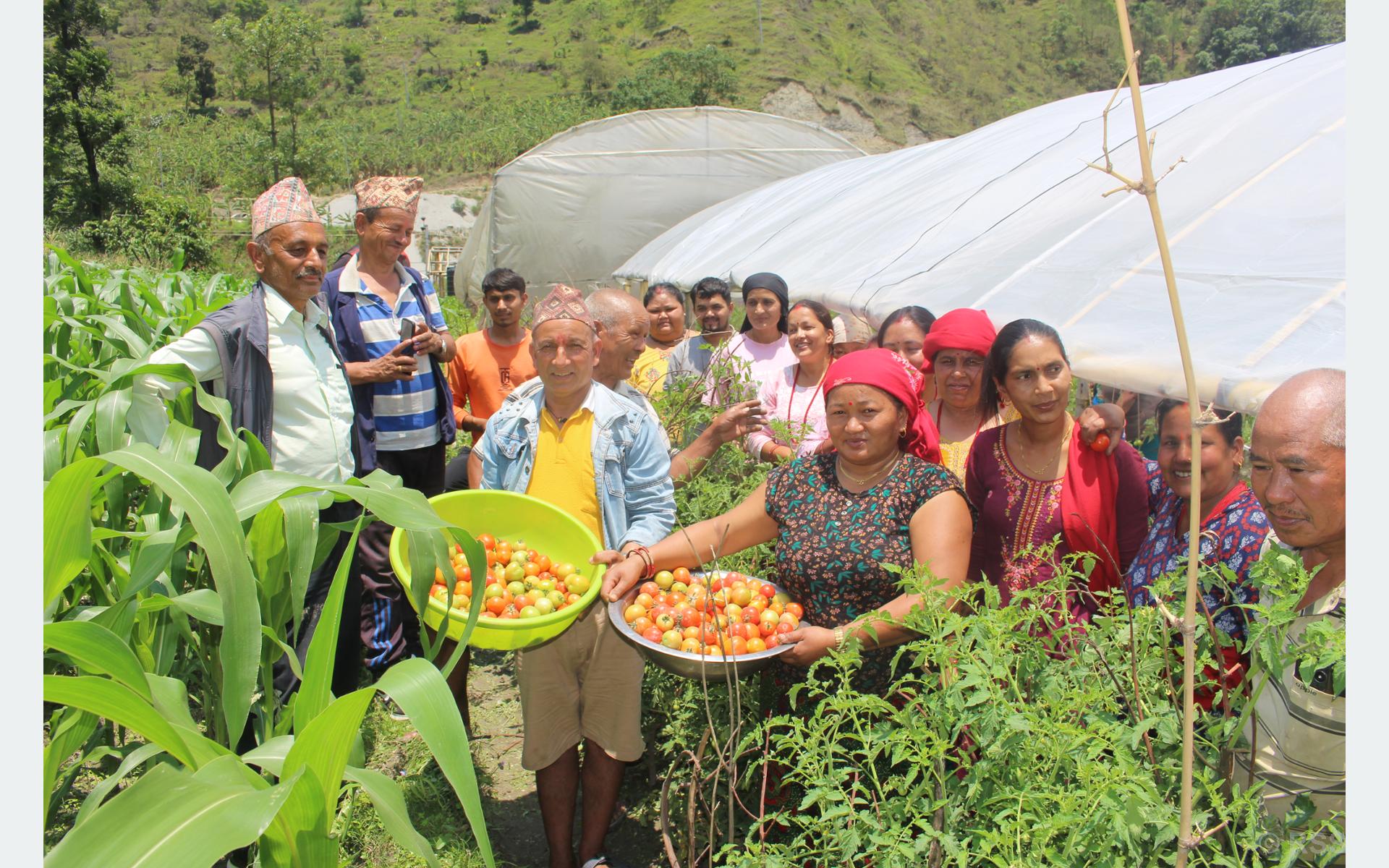
BENI: Rudra Bahadur Thapa of Anandabagar, Beni Municipality-1, now heads to his field not just with a hoe and spade, but also with a pen in hand. While farmers traditionally carry tools for physical labor, Thapa carries a pen to take notes—symbolizing a shift toward knowledge-based agriculture.
Since last six months, 25 farmers from Anandabagar have been attending a weekly Integrated Pest Management (IPM) Farmers’ School initiated by Beni Municipality.
The program is designed to improve farmers’ knowledge, skills, and capacity in organic production. Classes are conducted directly in the fields, where learning and farming go hand in hand.
As part of the training, members of the Anandabagar IPM Farmers’ School have collectively cultivated sorghum. The school provides practical education in various aspects of farming, including seed selection, nursery preparation, land management, planting techniques, fertilization, tilling, and post-harvest practices.
Local farmer Sarita Baniya Khadka shared that the school gave them valuable theoretical and practical knowledge—from seed storage and pest control to harvesting.
“The IPM Farmers’ School was very effective in teaching basic farming skills. We also learned how to identify pests and apply appropriate organic remedies,” said Baniya.
The participants also received hands-on training in gourd cultivation using tunnel and open field methods. The gourds planted in December are now ready for consumption.
The plan is to distribute the harvest among the participating farmers, and sell the surplus if production is high.
Another IPM school is operating in Dandakhet, Beni Municipality-4, where farmers have collectively planted grain crops that are now thriving.
The farmers are enthusiastic after receiving training in modern farming techniques and organic pest management. The IPM model focuses on helping farmers specialize in one crop, guiding them from seed selection and seedling transplantation to fruit care, harvest, consumption, and marketing.
This year, Beni Municipality has launched similar IPM Farmers’ Schools in several wards, each focusing on a specific crop. In Anandabagar, Ward 1, the focus is on tomato cultivation.
In Ward 2, Gaushwara, farmers are learning about cauliflower farming. Bhakimli in Ward 3 is focusing on Akbare chili, Dandakhet in Ward 4 is also growing tomatoes, Ward 6 Dammara is concentrating on Kosebari beans, and Wards 5 Pulachaur and 9 Ghatan are working on potato farming.
According to Agriculture Officer Akriti Dhungana, each school runs for 18 to 22 weeks and offers both theoretical and practical training.
“Facilitators have trained farmers to produce without relying on chemical pesticides and to increase the use of organic fertilizers. The municipality continues this program every year in different locations with the hope of encouraging farmers to grow healthy crops and improve their skills,” said Dhungana.
To operate each IPM Farmers’ School, the municipality has allocated a budget of Rs 150,000 per group.
The schools are facilitated by experienced local farmers including Sobit Sharma, Kshetra Bahadur Katuwal, and Hariram Poudel. Classes are held once a week, lasting four hours each session.
In addition to vegetable farming, the curriculum also includes organic pest management techniques using cow urine and other locally available bio-pesticides.
Farmers are trained to handle common problems affecting staple crops like rice, maize, and wheat, as well as fruits like oranges and lemons—ensuring a broader understanding of sustainable and chemical-free agriculture.






Comment