




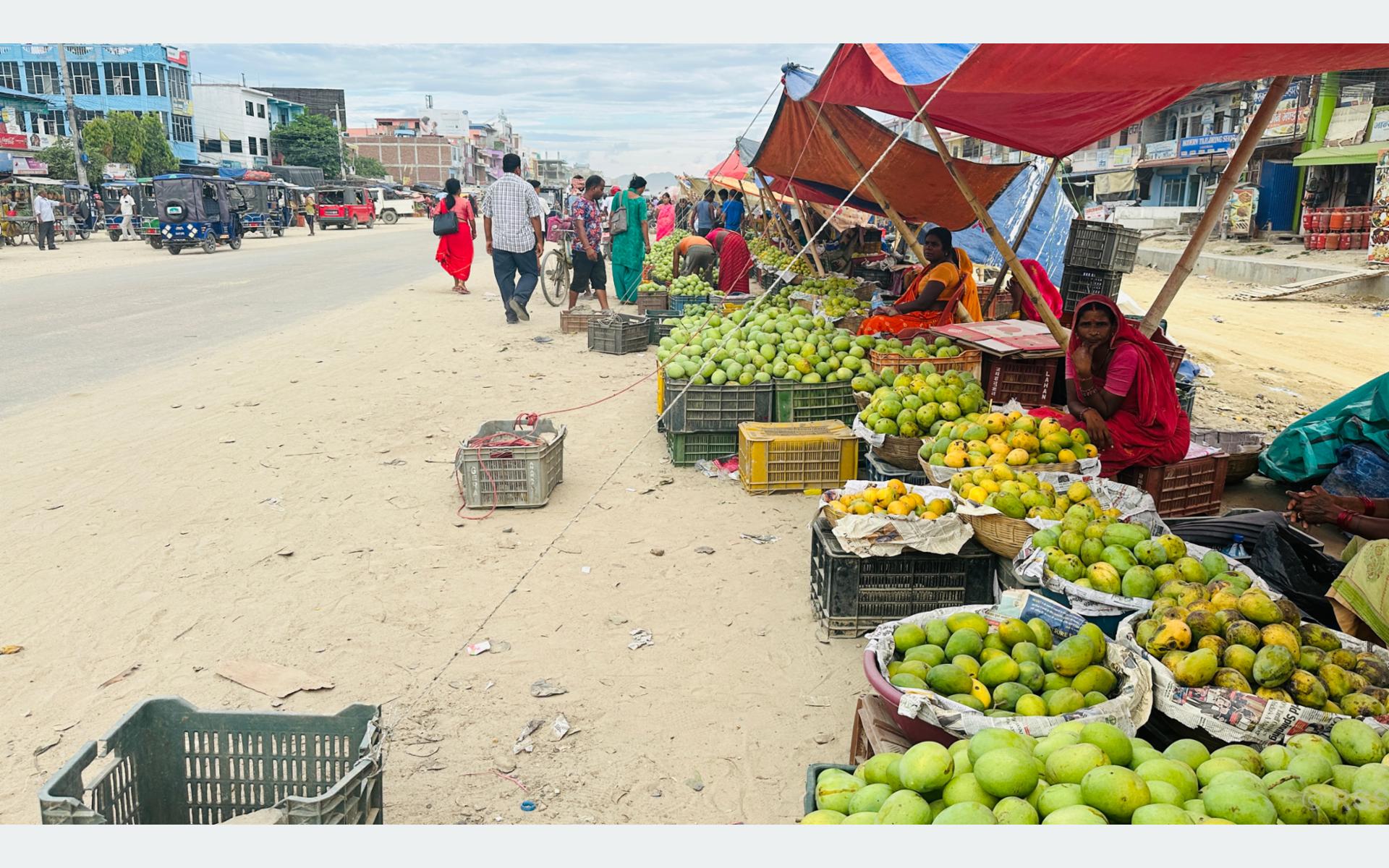
SIRAHA: With the arrival of mango season, the sweet aroma of ripe mangoes fills the air in Siraha. Mangoes are not only abundant in the markets but also line the roadsides, especially along the East-West Highway.
While some farmers patiently wait for customers, others struggle to sell their harvest. The scent of mangoes drifts through courtyards, gardens, and marketplaces, defining Siraha’s seasonal identity — an identity that blends flavor with livelihoods, commerce, and self-reliance.
Siraha is widely regarded as Nepal’s unofficial “Capital of Mangoes,” a title born not from formal recognition but from the region’s high production, ideal climate, fertile plains, and the exceptional quality of its fruit.
Mangoes in Siraha represent more than just a seasonal delight. They are tied to nutrition, health, culture, and most importantly, the economy.
For thousands of farmers, mango cultivation is a pillar of livelihood. One such example is the large-scale mango orchard established by farmers Bharat Yadav and Neeraj Singh in Musaharnia, Golbazar Municipality-3.
Spread across 100 bighas, it is now the district’s largest commercial mango farm and has inspired others to pursue mango farming as a business.
“Earlier, we farmed traditionally, but now we’ve moved toward commercial cultivation with a focus on market demand, technology, and proper management,” said Neeraj Singh.
“Every day, 25 to 30 people get employment here. We pick and pack between 200 to 500 cartons of mangoes each season and supply them to Kathmandu, Pokhara, Birgunj, and Janakpur.” According to him, the orchard generates mango sales worth lakhs of rupees annually.
However, Singh expressed concern over the growing influx of Indian mangoes in Nepal’s markets, even before the local harvest reaches maturity.
“Indian mangoes have dominated the urban markets since the second week of Jestha, while our local mangoes ripen only by the first or second week of Asar. This has put commercial farmers at a disadvantage,” he said.
Due to cheaper imports, Nepali mango farmers are struggling to compete. Bharat Yadav, also from Musaharnia, added, “Despite our hard work, we’ve incurred losses. On one hand, production has declined, and on the other, market prices haven’t improved.”
Although Indian mangoes are often cheaper, consumers complain about chemical use, poor taste, and lack of freshness. Farmers argue that weak border monitoring, absence of clear import policies, and lack of protection for domestic produce are major challenges.
“The government talks about self-reliance, but there’s little real support for farmers,” they say.
Despite having better flavor and quality, local mangoes are losing market ground. According to Shambhu Chaudhary, a commercial mango farmer from Lahan-24, “We use mostly organic practices and avoid excessive pesticide use. Our mangoes are fresher, tastier, and safer for consumers.”
Siraha leads in mango production
Madhes Province is Nepal’s leading mango-producing region, with favorable soil and climate conditions. Commercial mango cultivation is widespread across eight districts: Saptari, Siraha, Dhanusha, Mahottari, Sarlahi, Rautahat, Bara, and Parsa. According to Dr. Umesh Dahal, Secretary at the Ministry of Land Management, Agriculture, and Cooperatives of Madhes Province, over 77 percent of Nepal’s mangoes come from this region.
Ministry data shows that mangoes are cultivated on 42,773 hectares nationwide, producing 513,055 metric tons annually. Of this, 29,099 hectares are in Madhes Province, yielding 395,794 metric tons.
Siraha ranks first in mango production, producing 14,676 metric tons annually. Other key producers include Saptari (96,000 metric tons), Dhanusha (36,916), Mahottari (32,722), Sarlahi (39,118), Rautahat (62,561), Bara (19,269), and Parsa (4,731 metric tons).
Among Nepal’s cities, Lahan’s Malda mango is especially renowned for its rich flavor. However, its reputation has recently been undermined by counterfeit labeling, early harvesting, and increased pesticide use.
Prakash Sah Halwai, Head of the Agriculture Branch at Lahan Municipality, said, “Consumers who’ve tasted the real Mald mango praise its natural sweetness, fragrance, and juiciness. Unfortunately, substandard or imported mangoes are often falsely sold under the same name.”
Despite being the leader in mango production and quality, Siraha lacks critical post-harvest infrastructure such as a moisture control center, which would help preserve freshness and enhance market value.
Without such facilities, farmers remain vulnerable to spoilage, limited shelf life, and market loss.
Locals and stakeholders continue to call on the government for better support, infrastructure, and policies to protect local mango farmers and promote Nepal’s mango industry both nationally and internationally.






Comment