




Nepal has spent decades searching for a development model that can deliver sustained growth, quality jobs, and economic dignity at home. Despite progress in recent years, the economy remains heavily dependent on remittances, low-productivity agriculture, and small-scale trade—a structure that leaves millions vulnerable and forces young Nepalis to seek opportunity abroad.
A new technological shift now offers a rare chance to break this cycle. Artificial intelligence is rapidly becoming the foundation of global economic activity, reshaping how value is created across industries, borders, and labour markets. Countries that move early will define new supply chains and accumulate long-term advantages; those that delay risk being locked into the margins of the global economy.
For Nepal, AI is not a distant or abstract trend. Combined with its vast untapped hydropower potential and a young, digitally adaptive population, the AI boom presents a realistic pathway for the country to leapfrog traditional development stages and emerge as a major South Asian economy within the next decade—if it acts decisively.
For much of the 20th century, economic transformation was driven by industrialisation and manufacturing. In the early 2000s, information technology and mobile connectivity reshaped growth trajectories. Today, AI is performing a similar role, driving productivity, innovation, and competitiveness across every sector. Nations that harness it early will command new industries and geopolitical influence; those that hesitate will remain stuck in low-value labour markets.
AI-focused institutes, coding schools, and vocational programmes must be expanded, while universities modernise curricula around AI, cloud computing, and cybersecurity. A modern data-governance and cybersecurity framework is needed to build trust and attract investors.
Nepal stands at an inflection point. The traditional development path—building heavy manufacturing bases, fossil-fuel industries, or large export processing zones—is neither practical nor competitive given the country’s geography, market size, and resource constraints. AI, however, changes the rules. It lowers entry barriers and rewards countries that can combine clean energy, digital infrastructure, and human capital.
One of the least discussed but most critical drivers of the AI economy is electricity. Training large AI models, running cloud platforms, and operating data centres consume enormous amounts of power. Globally, data centres are among the fastest-growing sources of energy demand, and governments from the United States to India are racing to secure clean, reliable, and affordable electricity for AI infrastructure.
This is where Nepal holds an extraordinary advantage. With over 83,000 megawatts of hydropower potential—roughly half of it commercially viable—Nepal is one of the world’s richest countries in renewable energy. Yet only a small fraction has been developed. Meanwhile, much of South Asia faces rising energy demand, fossil-heavy grids, transmission bottlenecks, and growing environmental constraints.
In an AI-driven world where clean electrons are becoming a strategic currency, Nepal possesses something more valuable than oil: scalable, green, reliable power. If this advantage is channelled strategically, hydropower can become the foundation of a new digital industrial base.
Nepal has a credible opportunity to position itself as South Asia’s green compute hub. Global technology companies such as Amazon, Google, Microsoft, and Nvidia—along with Indian IT leaders like Infosys, TCS, and HCL—are actively seeking locations with long-term renewable energy, political stability, predictable regulation, and competitive costs. India’s data centre market is expanding rapidly, but power constraints, land shortages, and environmental pressures in major cities are already emerging.
Nepal can help fill this gap. By combining hydropower surplus with targeted policies, the country could host data centres, AI clusters, cloud operations, and disaster-recovery facilities powered entirely by clean energy.
This would attract billions in foreign direct investment, create thousands of high-skilled jobs, accelerate grid upgrades, and provide a stable long-term market for electricity. Countries such as Iceland and Norway have already demonstrated how hydropower can be transformed into digital infrastructure wealth. Nepal can do the same—but it must move quickly.
AI also offers Nepal a pathway out of its long-standing dependence on remittances. For decades, Nepali workers have powered labour markets in the Middle East, Malaysia, and beyond. Remittances have sustained the economy, but at a high social cost, draining talent from communities and separating families for years.
The AI economy allows for a different model. AI-powered productivity tools—from coding assistants to design generators and automated analytics—are lowering skill barriers and enabling participation in global digital industries from anywhere.
Combined with remote work and cloud platforms, AI can allow Nepali youth to access global IT, design, data, and cybersecurity roles without leaving the country. It can create tens of thousands of location-independent jobs and allow small Nepali firms to export digital services while remaining rooted domestically.
Nepal has one of the youngest and most digitally adaptive populations in South Asia. With the right policy push, a remittance-driven labour pool can be transformed into a knowledge-based digital workforce that contributes to domestic growth rather than foreign economies.
Beyond jobs, AI can act as a powerful multiplier across Nepal’s key sectors. In agriculture, AI-enabled irrigation control, crop disease detection, demand forecasting, and supply-chain optimisation can increase yields, reduce losses, and improve farmer incomes. In tourism, AI-driven marketing, personalised travel planning, and smart booking systems can help Nepal attract higher-value visitors and diversify beyond traditional trekking routes.
In healthcare, AI-enabled diagnostics and telemedicine can extend affordable services to rural populations at scale. In government, AI can simplify public services, reduce corruption, improve procurement, and strengthen tax administration—raising efficiency without raising rates. In education, AI tutors and adaptive learning platforms can help bridge the urban–rural skills divide.
Nepal does not need to invent frontier AI models to benefit. It needs to adopt and apply AI strategically to solve its most pressing economic challenges—and, in doing so, modernise faster than countries burdened by heavier legacy systems.
With clean energy, a young workforce, and decisive leadership, the country can replace remittance dependence with a knowledge-driven growth model, build industries that did not exist a decade ago, and secure a more prosperous future for its people.
This opportunity will not realise itself automatically. It requires bold leadership and a clear national strategy. Nepal should formulate a National AI and Digital Industrial Strategy that reserves a portion of hydropower for digital industries, accelerates storage hydropower projects, and strengthens grid reliability. Investment in cross-border fibre connectivity, redundant networks, and nationwide high-speed internet is essential.
AI-focused institutes, coding schools, and vocational programmes must be expanded, while universities modernise curricula around AI, cloud computing, and cybersecurity. A modern data-governance and cybersecurity framework is needed to build trust and attract investors.
Green data centre zones should be established with simplified licensing, time-bound approvals, and active global promotion. At the same time, every ministry should be required to adopt AI-enabled service delivery and analytics to improve governance and efficiency.
The next decade will determine whether Nepal converts its natural and human advantages into lasting economic strength or watches the opportunity pass. Other countries are already moving. India is investing billions in AI infrastructure and sovereign cloud capacity. The UAE, Singapore, and Saudi Arabia are securing compute power as a strategic asset.
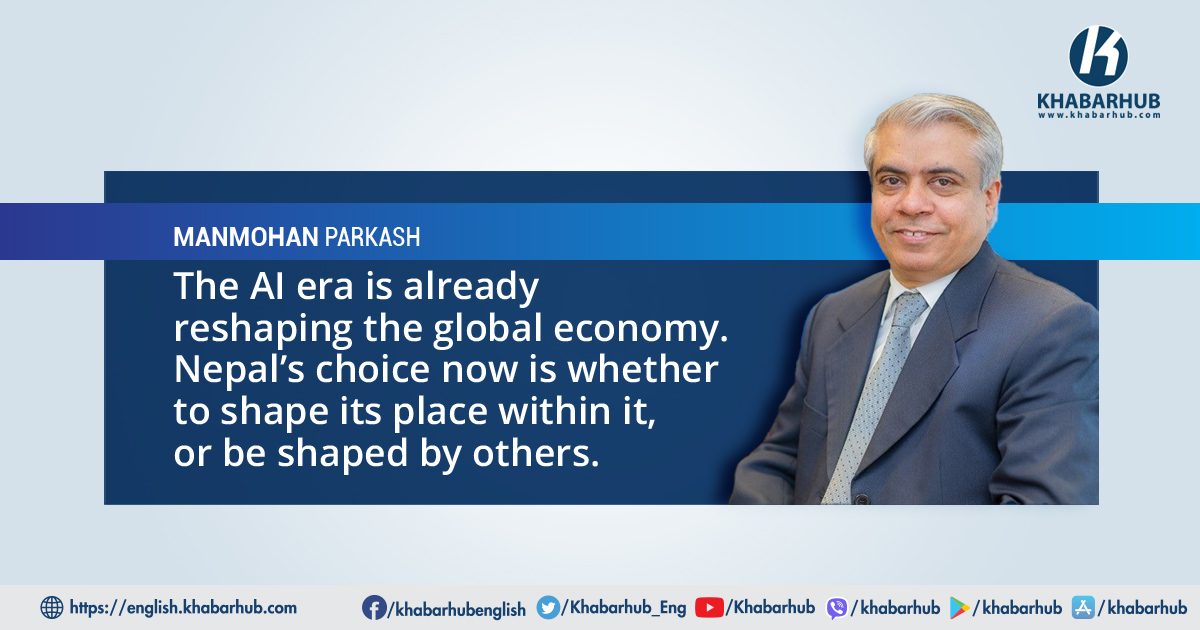
Nepal still has a narrow window to act before regional AI ecosystems and supply chains harden. With clean energy, a young workforce, and decisive leadership, the country can replace remittance dependence with a knowledge-driven growth model, build industries that did not exist a decade ago, and secure a more prosperous future for its people. The AI era is already reshaping the global economy. Nepal’s choice now is whether to shape its place within it—or be shaped by others.
(Manmohan Parkash is a former Senior Advisor in the Office of the President and former Deputy Director General for South Asia at the Asian Development Bank. He is a global thought leader on economic policy, technology, and development finance. Views expressed are personal.)





Comment