




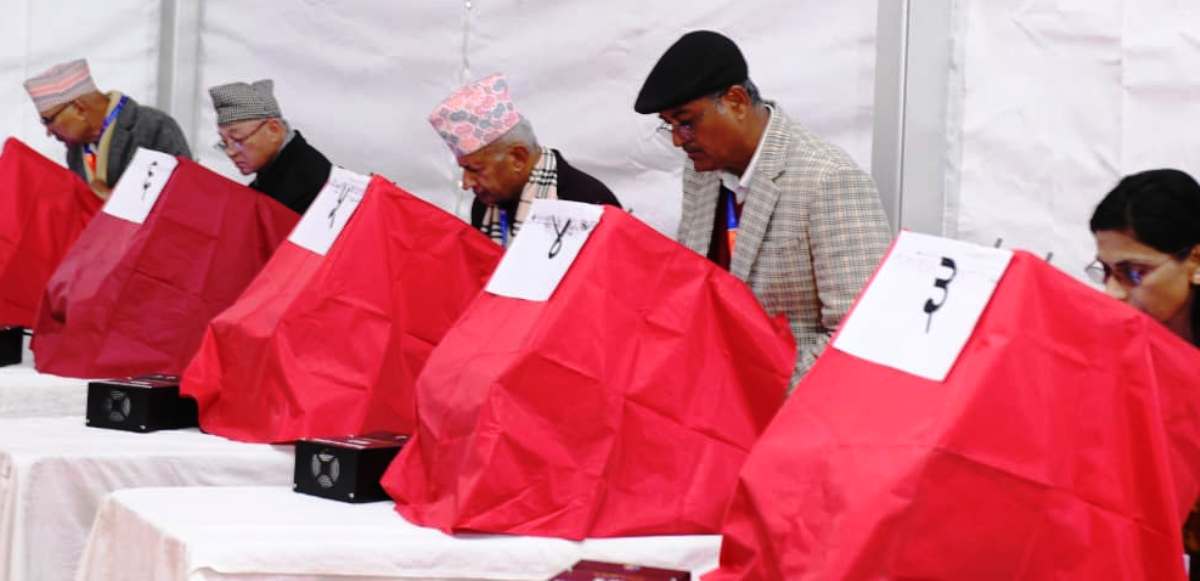
KATHMANDU: Voters at the 11th National Congress of the CPN-UML faced difficulties as voting for the party’s new leadership progressed at a very slow pace on Wednesday.
Although a total of 80 electronic voting machines were in use, the process remained sluggish. While electronic voting was expected to be faster than paper ballots, the large number of candidates caused confusion among delegates.
Speaking to the media at the Congress Media Centre, Election Commission Vice-Chairperson Sanuraja Pokharel said many delegates struggled to identify candidates on their panel.
Voting, which began at 9:12 am, had recorded only 802 votes by 5:02 pm. “Some voters were unable to cast their votes and fainted due to exhaustion. Medical teams provided immediate first aid,” he said, adding that the exact number of people who fainted could not be confirmed.
According to Pokharel, the long list of candidates made it difficult for delegates to identify their own panel and distinguish it from the other panel.
“We had expected a voter to take 25–30 minutes on average, but in reality, it took between nine minutes and two hours 12 minutes for some. Even senior leaders took one hour four minutes to one hour 12 minutes,” he said. “With 80 voters in line at a time, at this pace, voting would continue all night. The process cannot be stopped now.”
He added that since all remaining voters have already received tokens, they no longer need to stand in line. “Delegates just need to come according to the token system. All voters must enter through the main gate by 8 pm; no entry will be allowed afterward,” Pokharel said.
He noted that the problem arose because voters were unfamiliar with electronic voting and could not be properly trained. “Choosing candidates from two panels is also complicated, and technical difficulties have contributed to delays,” he explained.






Comment