




The GenZ Revolution, one of the most defining youth uprisings in Nepal’s modern history, was born out of frustration with corruption, injustice, and decades of political syndicate rule. It was not merely a protest against the government; it was a struggle against a decayed system. Over 76 people sacrificed their lives, and more than 3,300 were left permanently injured—all in the hope of establishing a transparent, just, and accountable political order.
Yet, the government now led by Sushila Karki appears to have drifted far from the very spirit that fueled the GenZ movement. Though it carries the name of the revolution, in essence it represents a continuation of the old power structure. Several developments confirm that the current administration has betrayed the fundamental values of the uprising.
Election postponement: The first betrayal
At no stage during the GenZ movement was there a demand to postpone the general elections scheduled for 2084 BS. The revolution sought electoral reform and accountability, not delay. However, by deciding to shift the elections to 2082 BS and form an “electoral government,” Karki’s administration effectively weakened the democratic momentum and turned a people’s mandate into a political negotiation. This move stands as the first major blow to the revolution’s moral foundation.
Silence on good governance and transparency
The GenZ movement’s rallying cry was transparency and accountable leadership. Two months into power, however, the Karki-led government has failed to publish the property details of ministers and top officials. Such secrecy undermines the promise of clean governance. In a movement built upon transparency, this act of concealment represents a moral and political failure.
Protection of those responsible for the massacre
The massacres of September 8 and 9 remain one of Nepal’s darkest chapters. The GenZ movement demanded justice for those who were killed, but instead of prosecuting the perpetrators, the current government has shielded them. No special court has been formed, nor has an independent investigation been launched. Under the guise of “political balance,” justice has been deferred, and impunity reinforced.
The return of corruption
Recent events reveal how deeply corruption has resurfaced. Energy Minister Kulman Ghising’s controversial power deal with India’s PTC India is estimated to have cost the state over 43 crore rupees. Meanwhile, the Attorney General has interfered in ongoing investigations, and Finance Minister Rameshwar Khanal has reportedly granted unlawful tax exemptions. Together, these acts expose a government more concerned with managing corruption than eradicating it—a stark contrast to the ideals of the GenZ Revolution.
Exploiting the revolution’s legacy
The GenZ movement called for constitutional reform, institutional restructuring, and justice for victims and martyrs’ families. Instead, the government has ignored these demands. It has arrested activists, sidelined the injured and bereaved, and staged symbolic meetings at Baluwatar with carefully selected loyalists. What was once a revolutionary call for change has been reduced to political theatre—a manipulation of sacrifice for publicity.
Government that betrayed its founders
These five factors clearly demonstrate that the Sushila Karki–led administration is not the true representative of the GenZ Revolution but its hijacker. It has transformed a people’s struggle for justice into a vehicle for political preservation.
The core principles of the GenZ uprising—good governance, transparency, and justice—have been reduced to empty slogans. The government’s leadership, including figures long entrenched in Nepal’s bureaucratic and judicial structures, has instead reinforced the same cycle of corruption and distrust that the youth rose to dismantle.
The revolution demanded accountability from those who had misused power for three decades. Yet the same individuals now preside over the very system they once vowed to reform. History will judge this not as the triumph of reform, but as the betrayal of a generation’s faith.
The road ahead
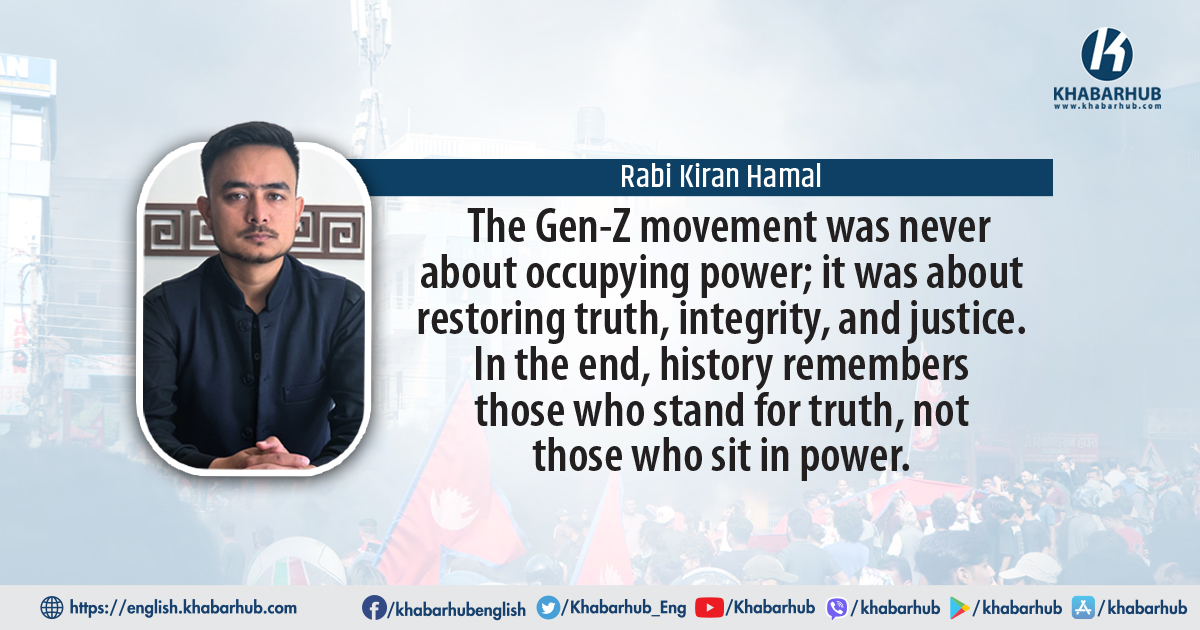
The responsibility once again lies on the shoulders of Nepal’s youth to preserve the true meaning of the revolution and protect the value of sacrifice. The Gen-Z movement was never about occupying power; it was about restoring truth, integrity, and justice. In the end, history remembers those who stand for truth, not those who sit in power.
(Hamal is a Gen-Z leader)





Comment