




KATHMANDU: After abandoning its armed struggle and shifting to mainstream politics, the then CPN-Maoist published a ‘commitment letter’ in Falgun 2064 BS when it entered its first parliamentary election.
The Maoists, under the slogan ‘New ideas and new leadership for a new Nepal’, laid out a detailed explanation of their vision for the country’s new constitution.
It included an independent and people-oriented federal democratic republic, along with provisions for national independence, federalism, republican governance, human rights, civil liberties, non-violence, citizenship, language, proportional representation, and special rights.
The commitment letter also outlined the restructuring of the security sector, the justice system, constitutional bodies, and the administrative machinery, along with new economic policies and the introduction of direct democracy and referendums.
Despite the Maoists’ emphasis on regional and ethnic inclusivity, the committee shows a disproportionate number of leaders from Rukum-Rolpa, the birthplace of the Maoist movement.
The letter emphasized the involvement of the public in the constitution-making process and the ratification of international treaties.
Under the sub-heading ‘Proportional Representation and Special Rights’ in the 11th point of the letter, the Maoists pledged to end class, caste, regional, gender, and other forms of discrimination.
They promised to ensure proportional representation of women, Dalits, marginalized castes, tribes, and minorities (including Muslims), as well as those from remote areas, in all state institutions and people’s representative bodies.
Additionally, the letter mentioned granting special rights for a limited time to compensate for the historical oppression faced by women, Dalits, and Muslims.
However, the structure of the Standing Committee of the Maoist Center, which advocates for proportional representation of oppressed groups, now raises questions about its own adherence to these principles.
The Standing Committee’s composition seems to contradict the party’s electoral promises.
Unbalanced Representation in the Standing Committee
The Maoist Center has a Standing Committee with 43 members, led by former Prime Minister Pushpa Kamal Dahal ‘Prachanda’.
The committee includes a senior vice-chair, a general secretary, a treasurer, three vice-chairs, six deputy general secretaries, nine secretaries, and 21 members.
Furthermore, the Standing Committee’s lack of diversity extends to the lack of Rai-Limbu representation, which is notable given their prominence in the region.
Despite the Maoists’ emphasis on regional and ethnic inclusivity, the committee shows a disproportionate number of leaders from Rukum-Rolpa, the birthplace of the Maoist movement.
Ten members are from this region, while other areas like Koshi Province (comprising 14 districts) have just one representative. Madhesh Province, with six leaders in the Standing Committee, has a more balanced presence, but the Far West, consisting of nine districts, has only one representative.
Six husband-wife Pairs in the Standing Committee
In addition to regional concerns, the composition of the Standing Committee also raises questions about gender diversity and merit.
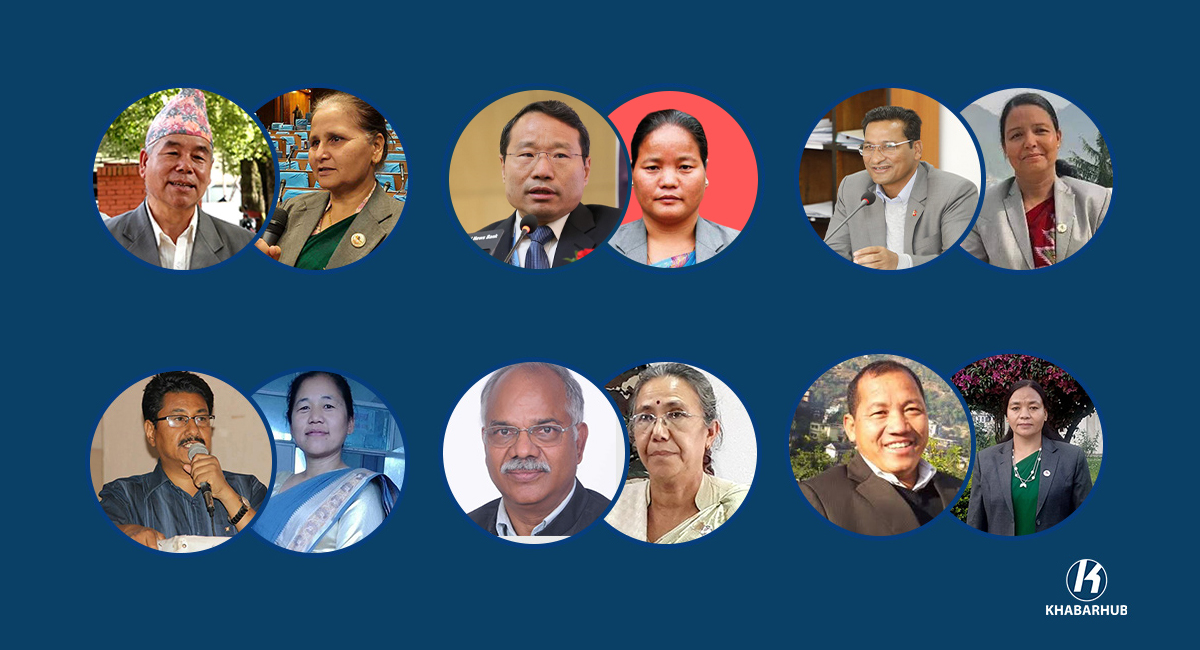
Six husband-wife pairs have been appointed as office bearers and members.
These pairs include:
General Secretary Dev Prasad Gurung and his wife Yasoda Subedi Gurung
Deputy General Secretary Barshaman Pun and Onsari Gharti
Deputy General Secretary Shakti Bahadur Basnet and Satya Pahadi
Secretary Hitman Shakya and Amrita Thapa Magar
Secretary Leelamani Pokharel and Shashi Shrestha
Ganeshman Pun and Kamala Roka
The Standing Committee consists of 12 husbands and wives, alongside 10 members from Rukum-Rolpa, which raises concerns about ethnic and gender balance.
Notably, no one from the Rai-Limbu community has been included in the Standing Committee, and even the in-charge of Province 1 has been appointed from Bagmati.
Lack of Regional and Ethnic Representation
Furthermore, the Standing Committee’s lack of diversity extends to the lack of Rai-Limbu representation, which is notable given their prominence in the region.
Additionally, Girirajmani Pokharel from Mahottari has been assigned as the in-charge of the Far West, despite the region’s distinct political and cultural identity.
This composition has raised questions about whether the CPN (Maoist Center) is truly upholding the principles of proportional representation and inclusivity outlined in their commitment letter.
While Maoist Chairman Prachanda claims that his party will become the leading force in the 2084 elections, the party leadership has yet to reflect any diversity or inclusiveness.
Here is the current Standing Committee of the Maoist Center:
Chairman: Pushpa Kamal Dahal ‘Prachanda’
Senior Vice Chair: Narayan Kaji Shrestha
Vice Chairs: Krishna Bahadur Mahara, Agni Prasad Sapkota, and Pampha Bhusal
General Secretary: Dev Prasad Gurung
Deputy General Secretaries: Giriraj Mani Pokharel, Barshaman Pun, Haribol Prasad Gajurel, Janardan Sharma, Shakti Bahadur Basnet, and Matrika Prasad Yadav
Secretaries: Dinanath Sharma, Chakrapani Khanal, Devendra Poudel, Leelamani Pokharel, Ganesh Sah, Hitman Shakya, Hitraj Pandey, Dilaram Acharya, and Surendra Kumar (Ram) Karki
Treasurer: Shriram Dhakal
Standing Committee Members: Anjana Bishankhe, Amrita Thapa Magar, Onsari Gharti, Urmila Aryal, Kamala Roka, Kali Bahadur Malla, Kul Prasad KC, Khagraj Bhatta, Ganeshman Pun, Jaipuri Gharti, Jokh Bahadur Mahara, Parashuram Tamang, Purna Kumari Subedi, Prahlad Kumar Budhathoki, Maheshwar Jung Gahatraj, Yasoda Gurung Subedi, Rekha Sharma, Bishwanath Sah, Shashi Shrestha, Satya Pahadi, and Hakikullah Musalman.




Comment