




Nepal is not undergoing a normal political transition. The country is trapped in a deep political, constitutional, and moral crisis. This crisis did not arise suddenly; it is the outcome of decades of unstable governance, entrenched misrule, and irresponsible political practices.
On September 8, our generation took to the streets with a clear and principled purpose. The objective of the youth was not to seize power, but to transform the very character of governance. The state, however, chose to respond not through dialogue but through brute force. Dozens of innocent citizens were shot dead, many were permanently disabled, and even children became victims of state violence. From that moment onward, the state lost its moral legitimacy.
Following the repression of September 8, the entire country erupted in revolt on September 9. Singha Durbar, Shital Niwas, the Parliament building, government offices, and private properties were set ablaze. This was not mere vandalism; it was a clear signal that the social contract between the state and its citizens had completely collapsed.
The full truth will gradually emerge. What is already clear, however, is that this government was formed neither through broad political consensus nor in accordance with the spirit of the Gen Z uprising.
When the President and the Prime Minister surrendered, and when security agencies failed to control the uprising, the country entered a state of near-statelessness. Nepal paid a heavy price for this breakdown.
Instead of addressing the root causes of the uprising, this grave situation was exploited to preserve the old political order through the formation of an interim government. This government was not formed to resolve the uprising, but to hijack it.
The core demands—constitutional rewriting, transformation of the system of governance, and deep institutional reform—were deliberately sidelined, and the country was forcefully pushed toward mid-term elections. From this point onward, the spirit of the uprising began to be systematically diluted.
Nepali youth demanded an end to an unstable system that produced more than thirty governments in three decades. They called for genuinely autonomous anti-corruption institutions and for public bodies to function as service-oriented institutions, not as ceremonial or partisan recruitment centers. Instead, the old structures were left intact, and elections were presented as the only solution. This has pushed the country deeper into political and constitutional crisis.
Today, there is serious debate as to whether the government led by Sushila Karki is a product of the September 8 uprising or the outcome of a planned disorder on September 9. The mobilization of her group on September 9 and the events that followed appear to have contributed to the creation of a condition of statelessness.
The full truth will gradually emerge. What is already clear, however, is that this government was formed neither through broad political consensus nor in accordance with the spirit of the Gen Z uprising.
The actions taken since the formation of this government confirm the continuation of the same old misgovernance. These include the abuse of power by the Attorney General to grant impunity in grave crimes involving the drugging of minors for egg trafficking; the institutionalization of nepotism through the creation of posts within security agencies; an energy agreement causing NPR 430 million in losses to the nation; illegal tax exemptions granted to Dolma; and the continued failure to disclose the assets of cabinet members.
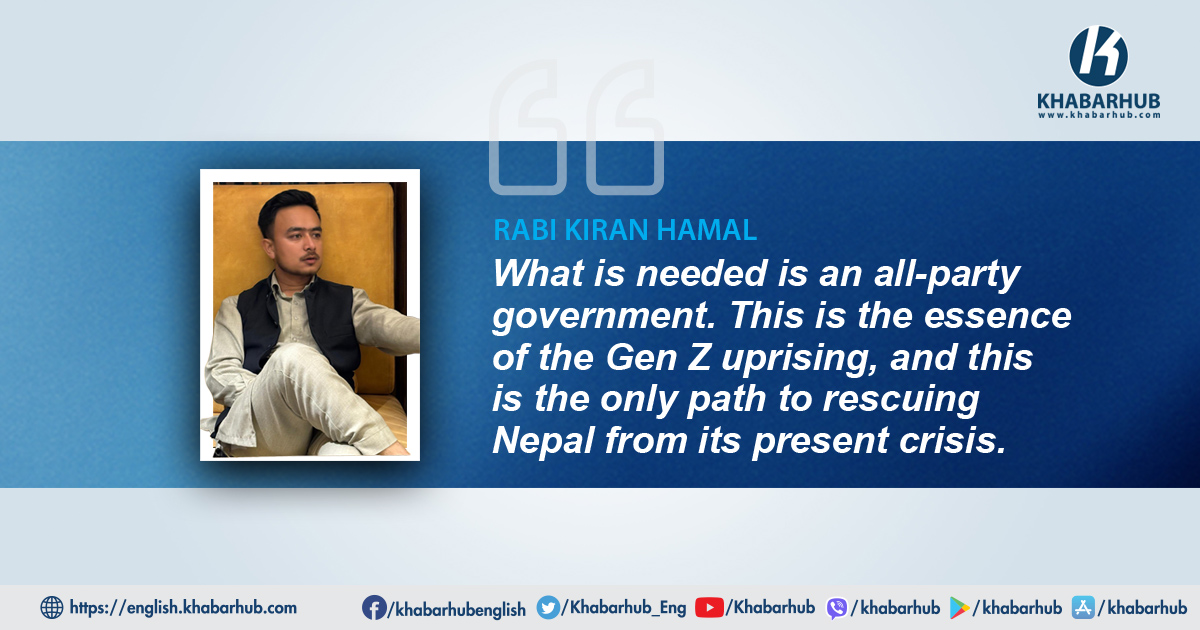
What is needed is an all-party government. This is the essence of the Gen Z uprising, and this is the only path to rescuing Nepal from its present crisis.
Taken together, these actions demonstrate that the government’s political and moral legitimacy has already been exhausted. Nepal’s history shows that meaningful change has always emerged from popular movements. The 1951 movement brought democracy, the 1990 movement laid the foundation for pluralism, and the 2006 movement opened the path toward inclusion.
The 2025 Gen Z uprising has demanded good governance and political stability. Each of these movements involved immense sacrifice. Without institutionalizing those sacrifices, the country cannot move forward.
At present, some argue for the restoration of the House of Representatives. This would only create further complications. We must remember that when the House failed to reflect the will of the people, and when a government formed from it sought to preserve power by shooting unarmed citizens, the country suffered a catastrophe of this magnitude. Under such circumstances, the restoration of the House is not even conceivable.
On the other hand, there is pressure to force the country toward elections scheduled for March 5, 2026. This too offers no real exit. Holding elections atop an unstable constitution and distorted structures merely prolongs the crisis. The real solution lies in forming an all-party government and rewriting the constitution. Without restructuring the system of governance, constitutional bodies, universities, the civil service, security agencies, diplomatic institutions, and the judiciary, political stability in Nepal is impossible.
The current government cannot lead the country out of this crisis. What Nepal needs today is a government capable of carrying the weight of history—one that internalizes the spirit of the popular uprising and institutionalizes it through constitutional transformation. What is needed is an all-party government. This is the essence of the Gen Z uprising, and this is the only path to rescuing Nepal from its present crisis.




Comment