




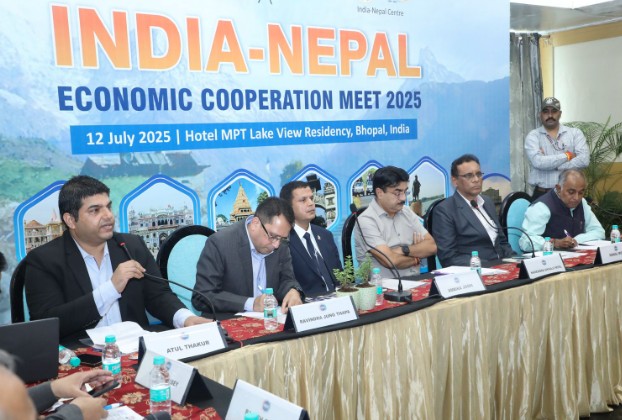
KATHMANDU: In collaboration with the Embassy of Nepal in India, the India-Nepal Centre of the PHD Chamber of Commerce and Industry (PHDCCI) organized the “India-Nepal Economic Cooperation Meet 2025” recently in Bhopal, Madhya Pradesh.
The event brought together senior diplomats from Nepal, government officials, and leading industry representatives from both countries to discuss deepening economic ties and promoting mutual growth.
Addressing the gathering, Narendra Shivaji Patel, Minister of Public Health and Medical Education, Government of Madhya Pradesh, emphasized the significance of the event in further strengthening bilateral economic cooperation.
He noted that the meet would play a pivotal role in building a strong foundation for Nepali businesses in Madhya Pradesh and Central India, while also contributing to an improved ease of doing business between the two nations. Highlighting the deep cultural bonds between Madhya Pradesh and Nepal, Minister Patel reaffirmed the state’s commitment to enhancing this relationship in every possible way.
In his opening remarks, Atul K. Thakur, Secretary of the India-Nepal Centre, PHDCCI, spoke about the substantial progress made in recent years in key areas of bilateral cooperation, particularly in connectivity—physical, digital, energy, and people-to-people linkages.
He pointed out the steady implementation of critical infrastructure projects such as roads, bridges, cross-border railways, integrated check posts, and petroleum pipelines.
Thakur noted the inauguration of a freight train service between India and Nepal, the advancement of railway lines such as Kurtha–Bijalpura and Raxaul–Kathmandu, and progress on the second phase of the Motihari–Amlekhgunj pipeline. He also mentioned upcoming projects, including new petroleum pipelines from Siliguri to Jhapa and Amlekhgunj to Chitwan.
He further emphasized landmark developments in the power sector, including the finalization of the Long-Term Power Trade Agreement between the two countries, a trilateral power trade agreement involving Nepal, India, and Bangladesh, and agreements for Indian developers to construct major hydropower projects in Nepal, such as the 480 MW Phukot Karnali and the 669 MW Lower Arun.
In digital financial connectivity, he highlighted Nepal’s adoption of India’s UPI system through interoperability with Nepal’s FonePay QR since March 2024, made possible through the collaboration between India’s National Payments Corporation (NPCIL) and Nepal Clearing House Limited (NCHL).
Thakur also underlined India’s dominant economic presence in Nepal, stating that Indian companies account for 35 percent of total FDI in Nepal, amounting to nearly USD 777 million.
India is now Nepal’s 17th largest export destination, up from 28th position in 2014. Bilateral trade between the two countries stood at USD 7.87 billion in the Indian fiscal year 2023–24, with Indian exports to Nepal valued at USD 7.041 billion and Nepalese exports to India reaching USD 829.71 million.
India remains Nepal’s largest export destination, receiving nearly 68 percent of its total exports. Nepal’s key exports to India include edible oil, coffee, tea, and jute, while its major imports from India are petroleum products, iron and steel, cereals, vehicles and parts, and machinery.
The event also highlighted the operation of around 150 Indian ventures in Nepal, spanning sectors such as manufacturing, services (banking, insurance, education, dry ports, and telecom), power, and tourism. Thakur reiterated that the India-Nepal partnership would continue to grow stronger across all major domains—economic, cultural, and people-to-people.
Representing the Embassy of Nepal in India, Minister Counsellor Ambika Joshi and Counsellor (Economic) Rabindra Jung Thapa emphasized the longstanding historical and cultural ties between Madhya Pradesh and Nepal.
As an example, they referenced the famous Janaki Temple in Janakpur, built by the Queen of Tikamgarh (in present-day Madhya Pradesh), which symbolizes the enduring relationship between the two regions.
The diplomats reaffirmed the Embassy’s commitment to supporting greater engagement between the business communities of Nepal and India and encouraged Indian investors, particularly from Madhya Pradesh, to explore emerging opportunities in Nepal.
The “India-Nepal Economic Cooperation Meet 2025” also featured in-depth discussions on several key issues, including promoting sustainable industrial development in both countries, revisiting bilateral trade policies, expanding regional and sub-regional cooperation, and improving development and connectivity across border areas through road, rail, and air infrastructure.





Comment