




KATHMANDU: The Nepali political landscape in 2081 B.S. (2024/25) was marked by instability, shifting alliances, and internal party crises.
During the tenure of the government led by Prime Minister Pushpa Kamal Dahal ‘Prachanda’, a session of Parliament was convened on May 10, 2024.
Backed by the CPN-UML, his government introduced the budget on Jestha 15 (May 28). However, it collapsed midway through Ashar (July) without being able to implement the fiscal plan.
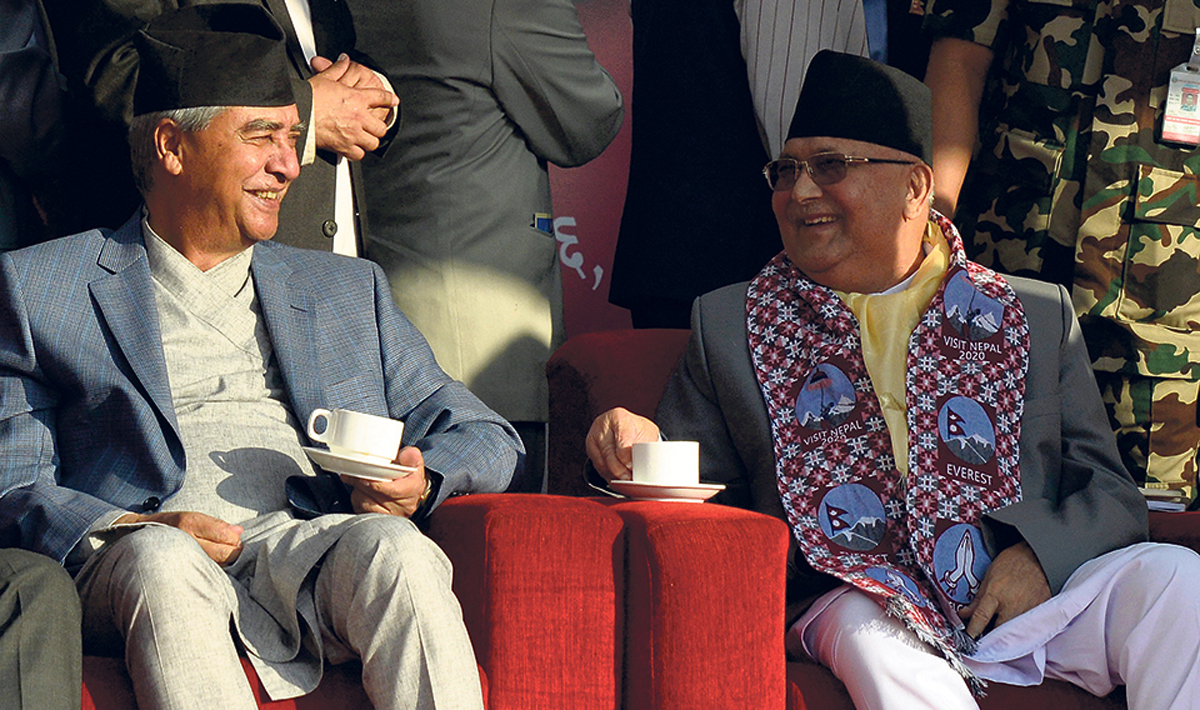
Subsequently, KP Sharma Oli assumed office as Prime Minister following a seven-point power-sharing agreement with the Nepali Congress.
As per this deal, PM Oli is expected to remain in office for 14 months—until July 2026—after which the leadership will rotate to Nepali Congress (NC) President Sher Bahadur Deuba.
Despite the dramatic political realignments, both major parties—the Nepali Congress and the CPN-UML—struggled to demonstrate substantial progress throughout the year.
This episode revealed the vulnerability of the ruling alliance. Despite having a two-thirds majority in the lower house, the coalition of the Congress and UML lacks control over the National Assembly—raising questions about the feasibility of its plans to amend the electoral system and raise the electoral threshold.
The upcoming budget, scheduled for Jestha 15, will serve as the first real test of Oli’s third term as Prime Minister.
With political dynamics both within and outside the parties in flux, the next 14 months are expected to be a challenging period for Oli. Successfully implementing the coalition’s power-sharing agreement may prove as difficult as “chewing iron,” given the fragile alliance.
A year of instability
The year 2081 B.S. (2024/25) brought little reassurance to the public. The country saw two prime ministers—Prachanda and Oli—assume office within a span of months.
Leaders from both the Nepali Congress and CPN-UML claimed that their unexpected alliance was a last resort to address political instability, public frustration, and economic decline. However, much of the year was lost in confusion and lack of direction.
Nepali Congress and UML in the spotlight
Following the 2079 BS (2022) general elections, Maoist Centre Chairman Pushpa Kamal Dahal Prachanda rose to power by alternatively aligning with the Nepali Congress, UML, and the Rastriya Swatantra Party. His coalition held until July 2024.
In June 2024, UML Chairman Oli discreetly reached a deal with Nepali Congress President Sher Bahadur Deuba and Dr. Arzu Rana, leading to the formation of a new government that included the Nepali Congress, CPN-UML, Janamat Party, Janata Samajwadi Party, Loktantrik Samajwadi Party, and others.
Oli officially took office on July 14, 2024 under an agreement to later transfer power to Deuba.
Provincial governments also saw frequent changes mirroring federal politics. While the Janamat Party now leads the government in Madhesh Province, the Congress and UML have formed joint governments in six other provinces, sharing leadership positions.
Despite being the largest party in the country, the Nepali Congress has been unable to lead the federal government since the 2022 elections.
The party has faced criticism, both internally and externally, for partnering with the UML. Meanwhile, the UML, in its continued push for power, has managed to reposition itself as a dominant political force, though not without controversy.
Controversies and declining popularity
UML Chairman Oli came under fire after it was revealed that Min Bahadur Gurung, the owner of Bhatbhateni Supermarket and an accused in the Lalita Niwas land grab case, donated land to the party in October 2024 to build a new office.
The donation—10 ropanis and 14 annas of land in Dhunge Adda, Kirtipur—sparked criticism and led to intra-party conflict.
Two UML central committee members, Binda Pandey and Usha Kiran Timilsina, were suspended for six months for speaking out against Oli.
Vice Chairman Bhim Rawal was also expelled by Oli and has since launched the Matribhumi Jagaran campaign.
During a public event at Dasharath Stadium, slogans were raised against Prime Minister Oli, and individuals involved were reportedly assaulted by UML cadres after being identified via CCTV footage.
Public sentiment toward Prime Minister Oli and the UML has taken a hit, especially on social media, where his popularity has seen a steep decline.
This dissatisfaction has been reflected in recent by-elections and Free Students’ Union (FSU) elections, where the party underperformed.
Speculation is also growing about former President Bidya Devi Bhandari re-entering active UML politics, while former Vice President Nanda Kishor Pun has assumed a leadership role within the Maoist Centre.
Despite occasional tensions between coalition partners, major disputes have been avoided so far.
However, recent dissatisfaction emerged within Congress ranks after Prime Minister Oli and Energy Minister Deepak Khadka removed Kulman Ghising from his role as Managing Director of the Nepal Electricity Authority.
Meanwhile, Prime Minister Oli, Deputy Prime Minister Prakash Man Singh, and Home Minister Ramesh Lekhak came under heavy criticism for their lack of urgency and indifference during the unseasonal floods and landslides that struck in the third week of September 2024.
Additionally, Nepali Congress President Deuba recently acknowledged that the government has failed to meet public expectations.
Senior party leaders including General Secretary Gagan Thapa, Bishwaprakash Sharma, and Shekhar Koirala have also openly criticized the government’s performance.
A year of trials for major parties
The year 2081 B.S. proved to be a severe test for both the Nepali Congress and the UML. Despite declaring constitutional amendment as a key agenda, the government has not taken any significant steps in that direction.
Similarly, promises of curbing corruption, ending economic recession, ensuring good governance, and delivering political stability have largely remained rhetorical.
If this trend continues, the Congress-UML alliance risks paying a heavy political price in the upcoming 2027 general elections.
Rise in royalist protests and street movements
Last year was also marked by widespread street agitation. From ordinary citizens to ruling and opposition parties, various groups hit the streets in protest. What began as political movements quickly evolved into broader expressions of public dissatisfaction.
As winter protests are a recurring trend in Nepal, many are now questioning whether the Oli-led government can withstand mounting street pressure until the next monsoon season.
Opposition leader Prachanda has already predicted the formation of a new government in 2082 BS (2025/26), while royalist factions are pushing for the restoration of the monarchy within the same timeline.
Although Prime Minister Oli continues to enjoy the backing of the Nepali Congress in Parliament, internal discontent over his leadership style is simmering. However, it has yet to reach a breaking point that could collapse the coalition.
Protests across the political spectrum
Leaders of the ruling coalition themselves have organized street campaigns. The UML held rallies in Madhesh and Jhapa’s Damak, while affiliated youth organizations protested against rising royalist sentiments in several districts. Congress leaders are also active in nationwide political tours.
The Rastriya Janamorcha, led by Chitra Bahadur KC, joined the street movements, alleging that the government was targeting Rabi Lamichhane, president of the Rastriya Swatantra Party (RSP), for political revenge. The party is holding vigilance meetings in different locations.
Meanwhile, opposition parties including the Maoist Centre, Unified Socialist, and Nepal Samajwadi Party formed a Socialist Front and took to the streets in coordinated protests.
Notably, medical entrepreneur Durga Prasai, along with others, organized mass protests following former King Gyanendra Shah’s video message on March 28.
The pro-monarchy protest turned violent, leading to the deaths of two people, including a journalist. Several incidents of looting were reported in places like Bhatbhateni Superstore in Koteswor.
Maoist Centre Chairman Pushpa Kamal Dahal ‘Prachanda’ spent most of the year attempting to balance relationships between the Congress and UML.
RPP leaders Dhawal Shumsher Rana and Rabindra Mishra were arrested for participating in the protests.
Durga Prasai was also detained. Amid these arrests, the RPP held a protest rally in Balkhu on April 8, 2025. Other parties like the Aam Janata Party, led by Prabhu Shah, also staged demonstrations.
Controversial ordinances spark outrage
The government’s decision to issue six ordinances by bypassing the winter session of Parliament sparked major controversy.
One of these—the land ordinance—was withdrawn after the Janata Samajwadi Party (JSP), which holds three seats in the National Assembly, refused to support it.
This episode revealed the vulnerability of the ruling alliance. Despite having a two-thirds majority in the lower house, the coalition of the Congress and UML lacks control over the National Assembly—raising questions about the feasibility of its plans to amend the electoral system and raise the electoral threshold.
The land ordinance incident also highlighted the possibility that future key legislation, including the budget, could be blocked if JSP support wavers.
By-elections send mixed signals
On Apil 27, 2024, by-elections were held in 42 local units, including the high-profile Ilam-2 constituency.
UML candidate Suhang Nembang, son of the late Subash Nembang, won the seat. In Bajhang’s Provincial Assembly-1 by-election, UML’s Daman Bahadur Bhandari defeated the Congress, breaking its long-held dominance.
Of the 42 local-level seats up for grabs, the Nepali Congress came first, winning 16 wards and the mayorship of Kirtipur Municipality.
The Maoist Centre secured second place, winning seven ward chairs, one rural municipality chair, two vice-chairs, and one municipal vice-chair.
Following a two-month obstruction in the House of Representatives, a special committee led by UML MP Surya Thapa was formed to probe problematic cooperatives.
The UML came in third, followed by the JSP which won two ward chair seats in Madhesh Province.
Other parties, including the Rastriya Swatantra Party, Unified Socialist, Nepal Workers and Peasants Party, and Swatantra Party, won one seat each.
Prachanda’s political maneuvering
Maoist Centre Chairman Pushpa Kamal Dahal ‘Prachanda’ spent most of the year attempting to balance relationships between the Congress and UML.
Deputy General Secretary Janardan Sharma toured all seven provinces and presented a bold report during the party’s Standing Committee meeting from August 2024 onwards, calling for new leadership and proposing Prachanda take a guardian role.
This sparked rumors of an imminent party split, but Prachanda ultimately retained control of the party, quelling internal dissent for the time being.
Power struggles, protests, and political turmoil
Despite earlier claims of staying out of government until 2084 BS (2027) to focus on the people, Maoist Centre Chairman Pushpa Kamal Dahal ‘Prachanda’ began hinting at a return to power by the end of 2081 (by mid-April).
His recent remark that a “new government will be formed in 2082 BS” has been widely interpreted as a sign of his continued political ambition—contradicting his previous stance.
Teachers take to the streets
Since April 2, 2025, teachers from across Nepal have been staging protests in Kathmandu, demanding the enactment of a new education law, salary hikes, and job security for long-term temporary teachers.
While the demonstrations have remained peaceful—with participants singing and dancing—they have raised concerns over the disruption to students’ education.
Despite multiple rounds of dialogue, the government has yet to address the teachers’ core demands, prompting continued demonstrations.
Cooperative issue: GB Rai still at large
Cooperative fraud victims staged protests throughout 2081 BS, demanding justice. Although the government formed a parliamentary committee to investigate, many victims are still awaiting restitution.
Raut and Shrestha’s husband, Resham Chaudhary—a key figure in the Naupa movement—have publicly supported party unification. Talks are reportedly in their final stages, with a merger anticipated soon.
Following a two-month obstruction in the House of Representatives, a special committee led by UML MP Surya Thapa was formed to probe problematic cooperatives.
The committee submitted its findings after a three-month investigation. Based on the report, Rastriya Swatantra Party (RSP) President Rabi Lamichhane was arrested and remains in custody, with his parliamentary membership suspended.
However, the government has yet to apprehend Lamichhane’s alleged associate, GB Rai, who is accused of operating a nationwide cooperative fraud network.
While some suspects are behind bars, the broader crisis remains unresolved—leaving many to question whether the victims will receive justice in 2082.
Rastriya Swatantra Party faces major setbacks
The Rastriya Swatantra Party, Nepal’s fourth-largest party, faced significant political and organizational turmoil in 2081 BS.
Following the arrest of its president Rabi Lamichhane in the cooperative scam, the party’s momentum stalled.
Although the RSP organized street protests, they failed to gain traction. The party’s performance in the by-elections was underwhelming—it won only one ward chair position (Kathmandu-16) out of 26 contested seats.
It also failed to field a mayoral candidate in Kirtipur and lost its deposit in the Ilam-2 by-election.
The party’s upcoming general convention is now uncertain due to Lamichhane’s imprisonment.
Political instability in Madhesh
Politics in Madhesh remained volatile throughout 2081 BS, marked by frequent party splits and attempts at realignment. The Janata Samajbadi Party (JSP), which emerged as the sixth-largest party in the 2022 elections, faced internal conflict.
Political parties began to take Balen more seriously after he fined UML NPR 100,000 for littering on Durbar Marg and RPP the same amount for a demonstration near the airport.
Disagreements between Chairman Upendra Yadav and Co-Chair Ashok Rai led to a party split, even while Rai remained in the government.
In May 2024, Rai officially broke away from JSP. Currently, Rai commands the support of 7 MPs in the House of Representatives, while Yadav is backed by 5. As a result of the split, Yadav also lost control of the Madhesh provincial government.
Meanwhile, discussions of a merger between the Janamat Party (led by Dr. CK Raut) and the Nagarik Unmukti Party (led by Ranjita Shrestha) gained momentum throughout the year.
Raut and Shrestha’s husband, Resham Chaudhary—a key figure in the Naupa movement—have publicly supported party unification. Talks are reportedly in their final stages, with a merger anticipated soon.
Small parties stay in the spotlight
The Nepal Workers and Peasants Party (NWPP) held its general convention this year, re-electing veteran leader Narayanman Bijukchhe as party chair, continuing his longstanding leadership.
The Loktantrik Samajwadi Party (LSP), which holds four seats in the House of Representatives, also made headlines after party Chairman Mahant Thakur strongly opposed the government’s land ordinance—drawing attention to the party’s stance on land rights.
Prabhu Shah’s party gained public attention through consistent criticism of Prime Minister KP Sharma Oli in Parliament, as well as through ongoing street protests.
A tense exchange between Shah and Oli during the Prime Minister’s Q&A session in Parliament further raised the party’s profile.
The Nepal Samajwadi Party (Naya Shakti) led by Dr. Baburam Bhattarai held its first general convention this year, re-electing Dr. Bhattarai as party president.
Yearlong tensions between Mayor Balen and the Federal Government
Throughout 2081 BS, the conflict between Kathmandu Metropolitan City and the federal government intensified. Disputes over Kathmandu Tower, Dharahara, New Road, and the Chief Administrative Officer escalated tensions between Mayor Balendra Shah and federal authorities.
On March 28, Mayor Balen fined former King Gyanendra Shah over NPR 700,000 for littering at Tinkune. While royalists had previously praised Balen, this action triggered backlash, with RPP Chairman Rajendra Lingden criticizing him during a rally in Balkhu.
Although the government appointed Hitendra Shakya as his replacement, protests—though now sporadic—have persisted. The decision to remove Ghising has significantly dented the public approval of both the UML and the Nepali Congress, fueling further dissatisfaction with the coalition government.
Political parties began to take Balen more seriously after he fined UML NPR 100,000 for littering on Durbar Marg and RPP the same amount for a demonstration near the airport.
Similarly, RPP cadres cleaned the streets following their Balkhu meeting, and teachers protesting in Kathmandu ensured they left no trash behind—indicating a cultural shift initiated by Balen in 2081.
However, Balen now appears increasingly isolated in the functioning of the Kathmandu Metropolitan City.
After city police barred the Chief Administrative Officer from entering the office, tensions rose between Balen and other officials. He has reportedly lost the trust of Deputy Mayor Sunita Dangol, ward chairpersons, and municipal staff.
Officials claim his tendency to make unilateral decisions and communicate via Facebook posts rather than engaging with the city team has distanced him from both allies and employees—contrasting with the broad support he enjoyed in 2079 BS and 2080 BS.
Protests at religious and cultural sites
A movement against the cable car construction at the sacred site of Pathibhara-Mukkulung in eastern Nepal continued throughout the year, with protests held in both Taplejung and Kathmandu. Although construction is ongoing, the outcome of the movement remains uncertain.
In Dang, tenants of the Swargadwari Guthi in Pyuthan protested at Maitighar Mandala, demanding land ownership rights.
Meanwhile, residents in Madhesh Province participated in a symbolic water conservation movement, carrying buckets to highlight the water crisis and accuse the government of neglect.
Public outcry over Kulman Ghising’s removal
The government’s dismissal of Kulman Ghising, the Executive Director of the Nepal Electricity Authority (NEA), sparked widespread public outrage. His removal led to street demonstrations and repeated debates in the House of Representatives.
Although the government appointed Hitendra Shakya as his replacement, protests—though now sporadic—have persisted. The decision to remove Ghising has significantly dented the public approval of both the UML and the Nepali Congress, fueling further dissatisfaction with the coalition government.


Comment