




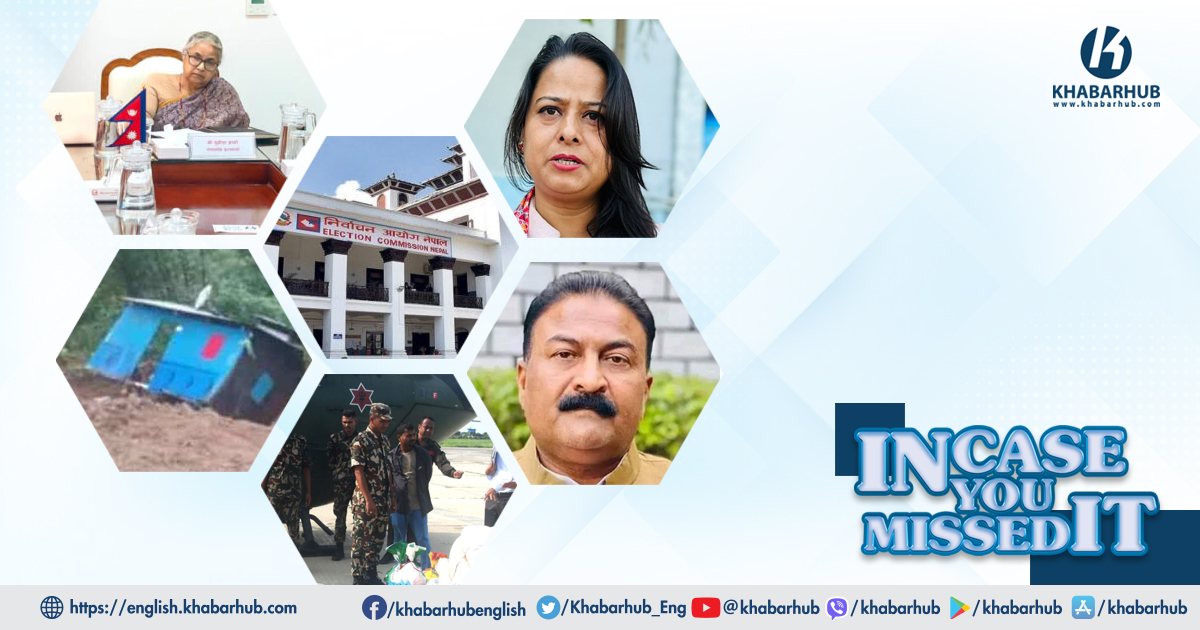
KATHMANDU: Last week marked a pivotal moment in Nepal’s unfolding political crisis, with President Ram Chandra Paudel making an urgent appeal to political parties to prioritize national elections scheduled for March 5, 2026. In a high-level all-party meeting at Sheetal Niwas, he underscored that polls are the only legitimate path to preserve the Constitution, democracy, and public trust.
His remarks, delivered amid growing national discontent, a youth-led uprising, and deteriorating public institutions, are not merely procedural guidance—they represent a warning against sliding into deeper political chaos.
The electoral call
At first glance, the President’s call to “head to the polls” might appear to be a routine affirmation of constitutional obligation. However, the statement must be interpreted within a broader, more fragile context. The Gen-Z movement—driven by a disillusioned generation of youth—has reignited long-standing frustrations with governance, corruption, and institutional inefficacy.
Their protests, which have taken symbolic and violent turns (such as the burning of government buildings including parts of Singha Durbar), signal that public faith in the existing political order is at a breaking point.
The President’s insistence on dialogue and unity, and his caution against exploring alternatives to elections, hints at growing murmurs among political factions about delaying or bypassing the electoral process—perhaps under the pretext of instability or national security. In this context, Paudel’s message serves not just as guidance but as a constitutional alarm bell.
Fragmented political leadership and partisan blame games
The all-party meeting at Sheetal Niwas was perhaps most notable for who attended and how little consensus seemed to emerge. Leaders from nearly every major and mid-sized party were present, signaling a rare convergence—yet no unified roadmap was presented to address the Gen-Z demands, the rising insecurity, or the erosion of public trust.
Instead, the discourse quickly devolved into partisan finger-pointing. Maoist Centre leader Pushpa Kamal Dahal (Prachanda) lambasted former coalition partners, particularly KP Sharma Oli of the CPN-UML, accusing them of arrogance and failure to heed public discontent. In return, Oli and others have remained silent or evasive, highlighting the political elite’s disconnection from both the youth movement and the urgency of constitutional preservation.
This mutual recrimination underscores a dangerous paralysis within Nepal’s leadership. While the President calls for dialogue, unity, and elections, the parties appear more interested in scoring political points than engaging in collective problem-solving. If this continues, the election—should it occur—may be seen as merely procedural, not transformational.
Institutional fragility and crisis of legitimacy
What underpins this moment is a deeper erosion of trust in Nepal’s institutions. The CIAA—the country’s foremost anti-corruption agency—is embroiled in a moral crisis, with Gen-Z protestors demanding the resignation of all sitting commissioners, including its chief, citing appointments that bypassed due parliamentary procedure and allegations of political bias and corruption.
At the same time, prominent figures, including former ministers, are being charged in high-profile bribery and corruption scandals. The filing of a case by the CIAA against ex-ministers Rajkumar Gupta and Ranjita Shrestha further reinforces public suspicion that corruption is endemic and cross-party in nature. The CIAA, intended to be a guardian of integrity, is now seen as part of the rot it was designed to address.
In parallel, security institutions like the Nepal Army have been forced to step in with public assurances that they are prepared to maintain peace and stability, suggesting a level of instability that borders on civil breakdown. The fact that the army had to make such a statement speaks volumes about the depth of the crisis.
The Gen-Z movement: Nepal’s democratic reckoning
Arguably the most transformative force shaping this political moment is the Gen-Z movement. What began as protest has evolved into a generational reckoning with the failures of Nepal’s political class. Prime Minister Sushila Karki’s acknowledgement that past governments failed to listen to the youth is a striking admission of systemic neglect.
Her symbolic gesture of setting up a new mechanism for Gen-Z participation is a step toward inclusion—but whether it will be transformative or performative remains to be seen.
The Gen-Z protesters have emerged not as a fringe element but as a national conscience. Their critiques—of corruption, nepotism, lack of economic opportunity, and authoritarian tendencies—have resonated beyond Kathmandu’s streets, touching a nerve across the country.
Their demand for the resignation of CIAA commissioners, for instance, represents a new mode of political engagement—youth asserting not just their voice, but their moral authority.
Security and humanitarian challenges compound the crisis
Compounding political instability is a series of disasters and humanitarian crises. The landslides and floods in Ilam and other regions have killed at least 39 people, damaged hydropower infrastructure in 10 districts, and displaced hundreds. The government’s decision to provide Rs 2 lakh in immediate relief and dispatch essential supplies via Nepali Army helicopters indicates an appropriate, though reactive, response.
However, as multiple hydropower projects were damaged—undermining energy security and economic productivity—the World Bank has projected a significant slowdown in GDP growth to just 2.1%. Political unrest, coupled with environmental vulnerability, has put Nepal’s economic aspirations under serious threat.
Moreover, the Election Commission, while moving ahead with preparations for the March 5 election, faces logistical and legitimacy challenges. Its invitation to political parties for consultations on October 16 is a positive step, but doubts remain about whether the environment can be stabilized in time for credible elections.
President’s constitutional role
In parliamentary systems, presidents often serve as symbolic guardians of the Constitution. President Paudel’s active engagement in this moment—urging calm, unity, and elections—suggests he is attempting to go beyond ceremonial duties. His message was unambiguous: democracy is not an abstraction—it is safeguarded only through direct public engagement, i.e., elections.
Yet, his call also raises questions: does he possess the institutional authority to ensure that elections proceed on schedule? Can he compel parties to genuinely address Gen-Z grievances and govern in the national interest? In a system where executive power rests with the Prime Minister and party coalitions, his influence may ultimately depend more on moral authority than legal prerogative.
Conclusion: A test of constitutional resilience
Nepal today finds itself at a dangerous inflection point. The President’s plea for electoral focus and constitutional fidelity represents a sober recognition of the stakes. The youth are demanding transformative change. Institutions are under scrutiny. Political parties are fragmented and often self-interested. Economic and humanitarian crises add to the volatility.
The real question is whether Nepal’s leadership will rise to meet this moment—or allow the erosion of public trust to evolve into full-blown institutional collapse. Elections, while critical, are not a panacea. Without meaningful reforms, dialogue with youth movements, and a renewed commitment to justice and transparency, the ballot may merely legitimize a broken status quo.
In the weeks ahead, the response of political parties, the efficiency of the Election Commission, and the government’s ability to stabilize the country will determine whether Nepal emerges stronger—or slips further into uncertainty. The clock is ticking, and the youth are watching.




Comment