




September 8, 2025, will be remembered as a black day in Nepal’s recent history: at least 19 young people, including students in college uniforms, were shot and killed while protesting against corruption. The next day, grief turned to revolt.
Despite curfews, Gen Z returned to the streets, and a wave of chaos washed over Kathmandu. At that point, every citizen’s blood boiled. Anger, frustration, and a thirst for justice took over the youth—it was “now or never.”
Politicians were dragged from their homes and assaulted. Within a day, most major politicians’ residences, ministerial quarters, party offices, and official buildings—including Parliament, Singha Durbar, the Supreme Court, banks, and police stations—had been reduced to ashes.
Prominent businesses like Bhatbhateni supermarkets, Kantipur Media, and even educational institutions were vandalized and set on fire. Many criminals escaped from prisons and are now openly roaming the streets. These events unfolded one after another, as if orchestrated. It appears that Gen Z’s protest against corruption was hijacked.
The Social Media Ban: The Last Straw
Nepal’s recently proposed Social Media Regulation Bill requires platforms such as Facebook, Instagram, WhatsApp, YouTube, X (formerly Twitter), and LinkedIn to register locally, appoint a Nepali liaison officer, and comply with government oversight.
In August 2025, the Supreme Court issued an order mandating that no social media platform could operate in Nepal without registration. That judicial directive provided the legal justification for the Ministry of Communications and Information Technology’s subsequent demand that 26 platforms comply. When they failed to do so, the government enforced a ban on September 4.
This move, intended to assert control, instead triggered a backlash that reverberated across the nation.
The ban struck at the core of Gen Z’s identity, expression, and livelihood. Content creators, online businesses, influencers, and students—many of whom relied on these digital platforms—found their incomes, learning opportunities, and global connections abruptly severed. Just as jobs like “social media officer” were gaining popularity, individuals had begun building their personal brands.
Previously, digital creators had already experienced the TikTok ban and its aftermath. They noticed that after registration, most content critical of the government was deleted, and TikTok’s algorithm no longer promoted posts that questioned the system. For many, the ban wasn’t just an inconvenience—it was censorship.
Frustration also stemmed from rising unemployment and a lack of opportunity. Meanwhile, elite families’ children—often referred to as nepokids—enjoyed privilege and comfort. Social media revealed their lives of affluence: designer clothes, luxurious weddings, and foreign degrees. In contrast, children of ordinary citizens struggled to secure decent jobs and were often forced to migrate abroad.
Despite an increase in graduates, the job market failed to absorb them. Youth unemployment exceeded 20 percent, with overall unemployment at 10.7 percent in 2024, according to the International Labour Organization (ILO). Just when the youth began holding the government accountable, the social media ban was imposed.
Nepal abolished the monarchy in 2008 and became a Federal Democratic Republic, hoping to expand freedoms like the right to free speech. However, to many, the federal republic now resembles George Orwell’s Animal Farm, where equality is promised but not practiced.
A Generation Ignited
As frustrations mounted, the social media ban became the tipping point. Gen Z—digitally fluent, globally connected, and deeply aware of their rights—interpreted the shutdown as a direct attack on their voices. Deprived of their platforms, they flooded the streets, sparking a protest born of frustration and driven by urgency.
What began peacefully on the morning of September 8 descended into tragedy by evening. As rumors spread of outsiders infiltrating and manipulating the demonstration, Gen Z protesters began to wonder whether the state’s violent response was truly defensive—or a calculated suppression of dissent.
On September 9, a much larger protest encircled Parliament and politicians’ residences, demanding resignations. Prime Minister K.P. Sharma Oli and key ministers from the ruling coalition stepped down, creating a power vacuum. Simultaneously, prison riots across Kathmandu and other cities led to mass breakouts, looting, and widespread disorder.
At the height of civil unrest, the Nepal Army intervened at 10 p.m. on the second day, restoring a semblance of order. Yet the chaos raised troubling questions: Why was there no structured protest leadership? Without a guiding voice, Gen Z’s genuine demands were diluted—or hijacked entirely.
A Moment Like No Other
Gen Z’s protests have drawn comparisons to Bangladesh’s 2024 “Monsoon Uprising” against government job quotas, which evolved into a broader pro-democracy movement. Similar parallels have been drawn with Pakistan’s Azadi March, Indonesia’s cost-of-living protests, and even France’s “Block Everything” youth-led demonstrations.
But Nepal’s context is unique. It is a small yet diverse country in terms of geography, caste, and culture. Its proximity to both India and China makes it strategically important—and vulnerable.
The Road Ahead
With the appointment of former Chief Justice Sushila Karki as Nepal’s first female Prime Minister, the bigger challenge lies in the uncertainty and lawlessness looming over the country.
To confront this, Nepal urgently needs an interim leadership committee—five to ten members from diverse geographic and social backgrounds, unaffiliated with traditional politics but committed to policy and national consultation.
Nepal’s current democratic framework allows parties to nominate the Prime Minister, but citizens deserve the right to elect their leaders directly—based on merit, empathy, accountability, and the ability to listen and deliver.
Inclusive dialogue must follow. Citizens, experts, and civil society organizations must be included. Gen Z’s struggle intersects with the pain of many others—marginalized communities, senior citizens, working-class families, rural laborers, and women—whose wisdom and experience are vital to rebuilding the nation.
Can Gen Z Rewrite Nepal’s Future?
As Gen Z poured into the streets, they gave voice to collective despair. But for momentum to translate into reform, Nepal needs structure—leadership that listens as much as it acts. The question is no longer whether Gen Z can demand change, but whether they and the nation can sustain it.
Will Nepal seize this moment to rewrite its social contract—or will hope fade into yet another cycle of political stagnation?
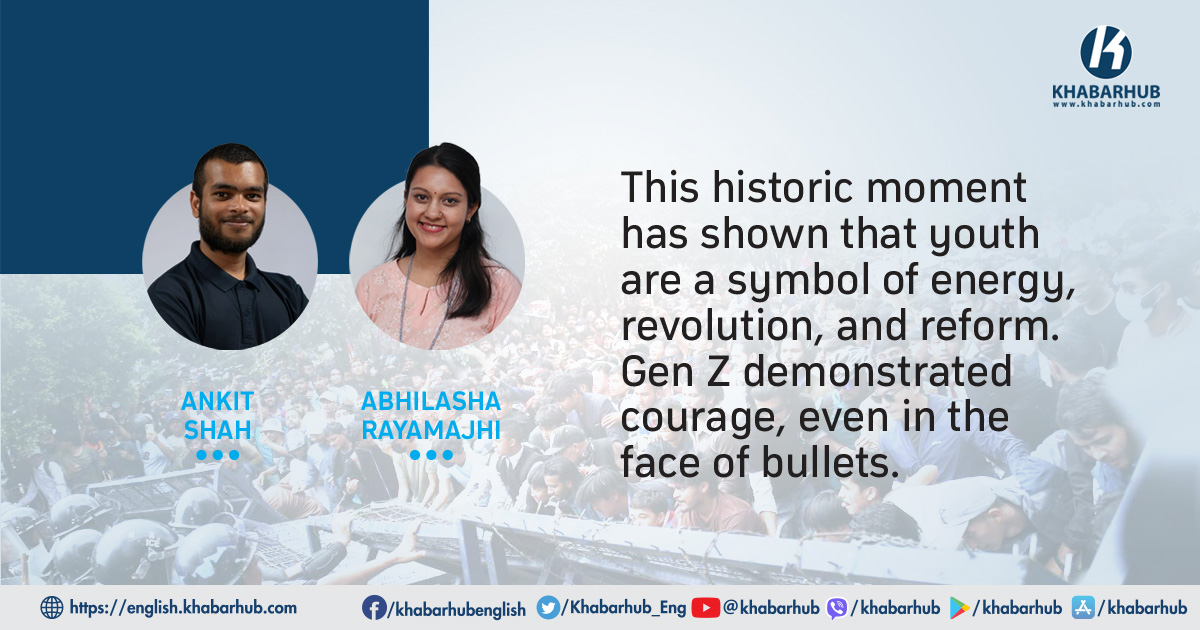
This historic moment has shown that youth are a symbol of energy, revolution, and reform. Gen Z demonstrated courage, even in the face of bullets. They helped the injured, documented state atrocities, raised their voices, and did whatever they could from wherever they were.
But the problem with a leaderless protest is its lack of clear direction and long-term strategy. What Nepal now faces is lawlessness and anarchy.
Gen Z must now think strategically—not react emotionally. The older generations must step in not to dominate, but to guide, collaborate, and help channel this energy to reset the political landscape and build a more just future.
(Ankit Shah is an undergraduate student, debate tutor, and a member of Gen Z. Abhilasha Rayamajhi is a passionate teacher, writer, and a Millennial.)




Comment