




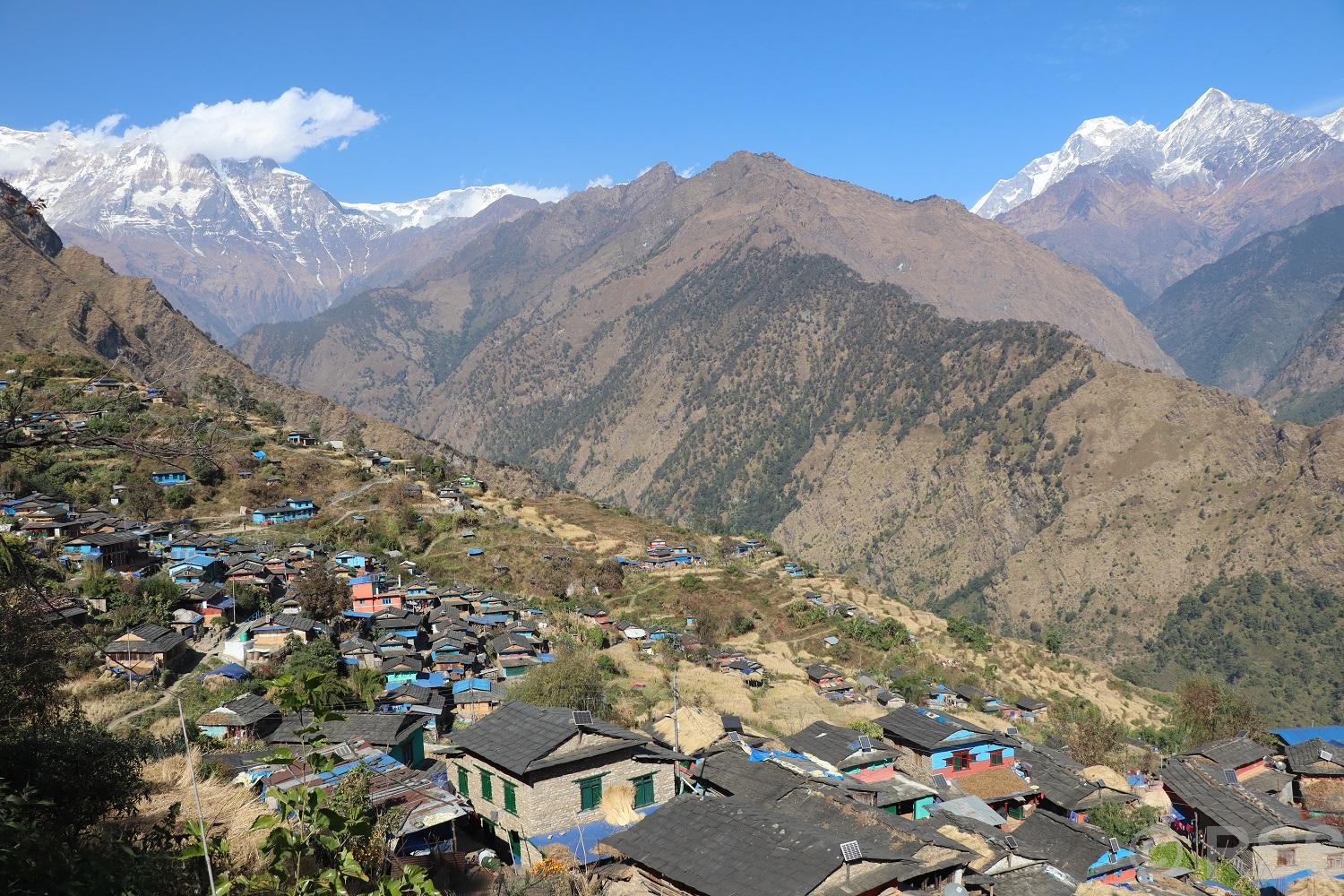
MYAGDI: With Gurja and Dhaulagiri peaks towering in the backdrop, stone houses set on terraced slopes, and a rural lifestyle marked by seasonal cattle sheds that shift between valleys and lakes, Mudigaun in Dhaulagiri Rural Municipality–4 offers a rare blend of nature and culture.
Neat stone-paved streets, traditional homes adorned with hanging corn, and the warm hospitality of the Magar-majority community make the village both picturesque and inviting.
Ward Chairman Yam Bahadur Gharti said Mudigaun is ready to welcome visitors seeking mountain scenery, hilly landscapes, and authentic rural life. “The 8,167-meter-high Dhaulagiri lies within the geography of this ward, including Mudigaun,” he said. “We are expanding tourism infrastructure in an area that has long been overlooked due to limited publicity.”
A study by the Nepal Ornithologists’ Association found that Mudigaun and nearby Dara provide habitat for the rare ‘Chirkali’ bird. Research participant Birat Rajak reported that three pairs were recorded in Mudigaun and seven in Dara during last year’s survey.
Inside the settlement, streets have been cleaned and improved with stonework and proper drainage. A viewpoint has been built on the hill near the ward office, complete with railings along the hiking trail.
From Thaldada, just a 30-minute walk, visitors can enjoy sweeping views of the mountains, neighboring villages, the Myagdi, Gurja, and Darkhola rivers winding through the Nagbeli landscape, and the dramatic terrain.
Located at 2,500 meters above sea level, Mudi comprises mostly traditional stone houses. Of roughly 250 households, 20 are Dalit and three are Gurung. The Magar community’s cultural heritage, Purkhryauli, Madale, Maruni dance, Yanimaya, and Salaijo songs, forms a key attraction for guests.
Mudi serves as a gateway to the Dhaulagiri Circuit and Gurja Himal trekking routes. The area offers a chance to observe the pastoral lifestyle of shepherds who herd cattle and buffalo in a semi-nomadic system.
From Beni, the district headquarters, Mudi is accessible via a three-hour drive followed by two hours on a motorcycle. Jeeps commonly travel the 47-kilometer stretch.
A homestay has been established to accommodate visitors. Owner Gau Bahadur Ramjali said tourist numbers have increased with improved road access and ongoing hydropower projects on the Gurja and Myagdi rivers.
“We renovated an unused house and added basic facilities to create a homestay environment,” he said. “Guests enjoy local chicken, goat meat, mushrooms, sprouted vegetables, bean lentils, millet dishes, and phapar porridge.” The homestay can host 20–30 guests per day.
Dhaulagiri Rural Municipality Chairman Prem Prasad Pun noted that the presence of rare wildlife such as red pandas and Chirkali birds in Mudi and Muna adds significant ecotourism potential.
He added that the municipality, along with the Nepal Tourism Board and partner organizations, has proposed celebrating Dhaulagiri Climbing Day in Mudi, the ward where the mountain itself stands.



Comment