




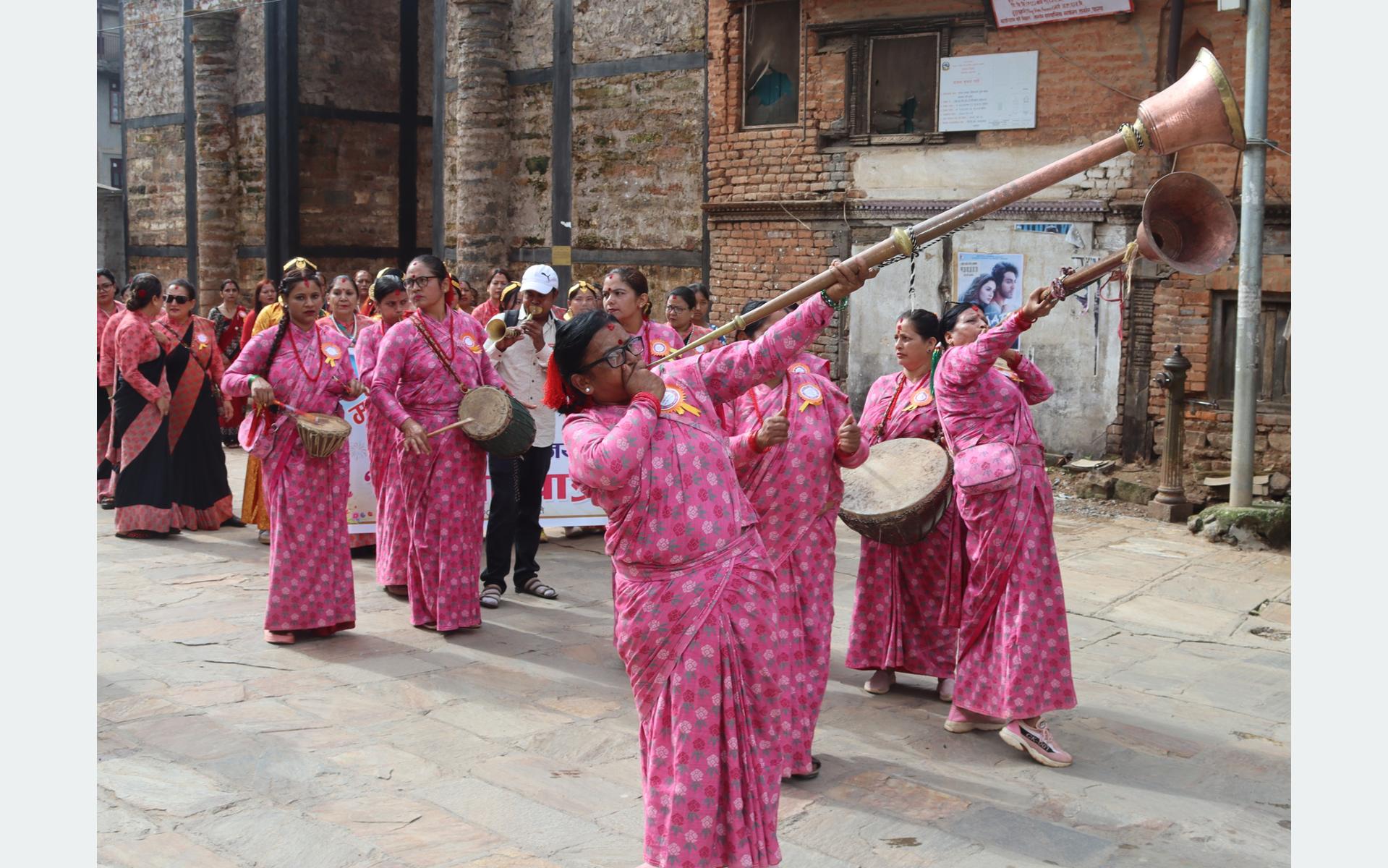
PALPA: Taradevi Basyal, 60, from Telgha, Tansen Municipality-10, is busy playing traditional ‘panchebaja’. Her involvement has increased at village events such as weddings, pujas, family rituals, and festivals.
Three years ago, when no one was available to play the ‘panchebaja’ at these auspicious occasions, Basyal learned to play the traditional ‘naumati’ and ‘panchebaja’ alongside her sisters.
As the president of the group she formed, she turned this skill into a professional source of income. Basyal explains that playing the ‘panchebaja’ not only helps preserve the village’s cultural heritage but also supports religious functions like weddings and pujas.
She shared that a single musician can earn up to Rs 3 lakh annually. The women of the village took up playing the baja as it became difficult to sustain livelihoods through household chores alone.
Basyal said, “Before we learned to play the ‘panchebaja’, there was often no one available in the village for weddings and pujas. Hiring musicians from outside increased costs. Now, auspicious functions are easier to organize locally.”
Women from the Brahman community have been playing together for three years. The group charges between Rs 15,000 and Rs 60,000 per event, according to vice-chairman Kamala Basyal.
The 12-member group includes Manju Panthi, Mankumari Neupane, Bhagwati Bhusal, Tara Bhattarai, Sushma Basyal, Savita Adhikari, Khuma Pangeni, Manju Kandel, Mira Neupane, and Nirala Sharma.
They are in demand for weddings, festivals, anniversaries, and fairs across Palpa. The women wear a single uniform outfit and play instruments captivating audiences.
They travel to neighboring districts including Gulmi, Arghakhanchi, Rupandehi, and Syangja to perform. “Playing these instruments has not only earned us good income but also received great encouragement from the community,” said Basyal.
Similarly, women from Ribdikot Rural Municipality-3 have undergone training in playing the panjaibaja and now perform at religious festivals, weddings, and other gatherings.
Aruna Chhahari, coordinator of the indigenous peoples’ group, said the training, supported by the rural municipality and local ward, helps preserve the panjaibaja tradition while providing an income source. This group includes 16 women aged between 40 and 55.
“Since there were no young people in the village to play the instruments, they had to be brought in from neighboring villages. If local talent does not develop, the culture may vanish. That is why women have begun learning these instruments and earning from them,” she explained.
Ward Chairman Narayan Bahadur KC confirmed that women have started playing professionally. Mani Prasad Khanal, Chief Administrative Officer of the rural municipality, added that Rs 50,000 was allocated last year to purchase instruments for the ward, with another Rs 50,000 budgeted this year for training in playing them.






Comment