




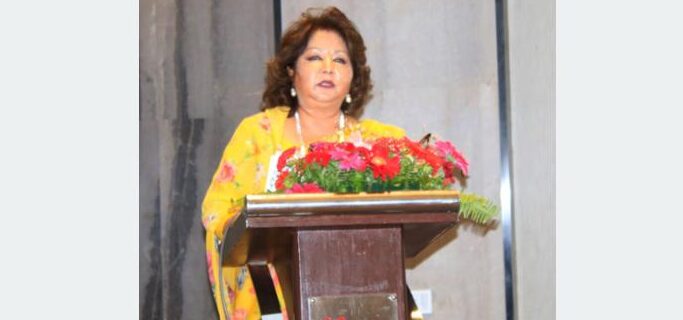
KATHMANDU: Foreign Minister Dr. Arzu Rana has emphasized that shared prosperity between Nepal and India can only be realized through robust partnerships and enhanced connectivity across multiple sectors.
Speaking at the inauguration of the Nepal-India Strategic Dialogue organized in Kathmandu today, Minister Dr. Rana underscored the importance of accelerating collaboration in trade, transit, and investment.
She highlighted the need to strengthen economic ties through comprehensive connectivity initiatives.
“The time has come for Nepal and India to translate connectivity into prosperity across various platforms,” she stated.
“I envision a future where ginger from Nepali farmers reaches Mumbai markets within 24 hours, and an Indian tourist attends a morning meeting in Delhi and arrives in Pokhara by evening. This proximity must serve as the foundation for economic prosperity for citizens of both countries.”
Referring to the historical and civilizational roots of Nepal-India relations, Dr. Rana noted that the lives of people in both countries are interwoven through shared values, culture, and sentiments.
She stressed that enhancing people-to-people ties, cooperation, and connectivity will pave the way for a prosperous future.
She called for increased investment in physical and digital infrastructure—roads, railways, waterways, airways, and digital networks—to deepen mutual connectivity.
“Seamless integration between our two countries will not only boost regional and global supply chains but also upgrade transit trade and border economies, directly benefiting our citizens,” she added.
Acknowledging the global shift toward a knowledge-based economy, Minister Dr. Rana urged both nations to focus on emerging sectors such as the digital economy, technology and innovation, modern education, skills development, and the creative economy.
She also highlighted the energy sector as a key example of successful bilateral cooperation, stating that Nepal’s vast hydropower potential offers a clean, renewable energy source for future generations.
Referring to India’s commitment to import 10,000 MW of electricity from Nepal over the next decade, she noted that the two countries have strengthened energy ties through initiatives such as transmission interconnections, grid connectivity, power exchange, and cross-border electricity trade.
Pointing to India’s strong base in digital innovation and Nepal’s growing population of young, tech-savvy professionals, she advocated for joint promotion of technology hubs, startups, and digital platforms.
“Our youth should collaborate, leverage technology, and work together toward shared prosperity,” she said.
In light of rapid technological advancements, shifting global geopolitics, and the growing threat of climate change, Dr. Rana stressed the need for collaborative efforts to tackle shared challenges.
She also expressed appreciation for India’s support in the recently concluded first edition of the Sagarmatha Dialogue held in Nepal.
Looking ahead, she expressed hope for a future marked by peace, stability, and prosperity, driven by strong partnerships with neighbors and international friends.
She affirmed that platforms like the Nepal-India Strategic Dialogue will deepen bilateral relations, foster idea exchange, and strengthen people-to-people engagement.



Comment