




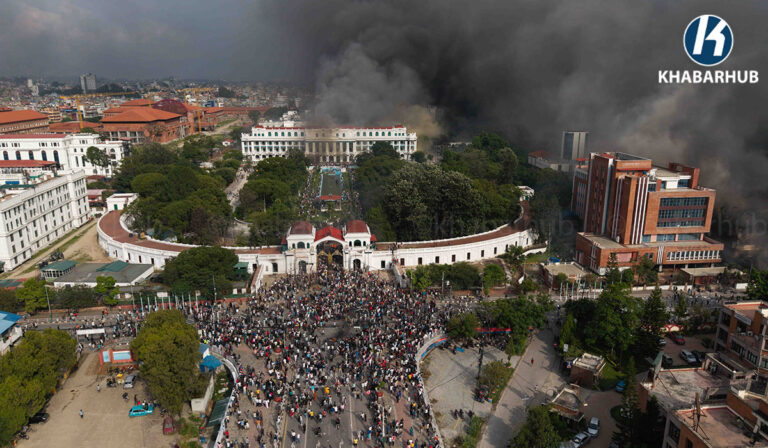
KATHMANDU: The two-day Gen-Z protests earlier this week have left behind devastation across Nepal, with government officials estimating that public infrastructure worth more than Rs 200 billion has been destroyed.
Alongside the loss of buildings, invaluable historical documents and records have also been reduced to ashes.
According to officials at the Ministry of Urban Development, landmark structures such as Singha Durbar, the Parliament building, and the Supreme Court, each worth billions to construct, have suffered extensive fire damage.
“Most of these structures are beyond retrofitting; they cannot simply be repaired and reused like after an earthquake. Rebuilding them will cost upwards of Rs 200 billion,” a ministry source said, adding that the estimate only accounts for the buildings themselves, not the additional billions required for office setup and management.
The destruction extends far beyond Kathmandu Valley. In provinces, assembly halls, chief minister’s offices, prisons, police stations, land revenue offices, and dozens of municipal ward buildings have been gutted. “Thinking about when, how, and with what resources these structures can be rebuilt is overwhelming,” one ministry engineer remarked.
The ministry noted that the largest damage occurred in the capital, though major cities such as Pokhara, Itahari, Janakpur, Dhangadhi, and Biratnagar also saw government offices torched. Anarchic groups that infiltrated Tuesday’s Gen-Z demonstrations were particularly destructive, targeting not just state institutions but also private and community assets. Residences of political leaders, business complexes, tourist infrastructure, automobile showrooms, media houses, and local facilities were vandalized and set ablaze.
The protests turned violent after police firing during Monday’s rally left 19 people dead. On Tuesday, groups of agitators exploited the demonstrations, torching government and community structures from early morning. Total death toll has reached 34, with thousands injured.
The destruction has left Nepal’s state machinery crippled. All three organs of the federal government are struggling to function as the Supreme Court is attempting to operate from tents.
Singha Durbar, the executive hub, has seen most of its offices destroyed by fire, while the Parliament building in New Baneshwor has been gutted, raising questions about where lawmakers will convene once calm is restored.
Even as talk of forming an interim government circulates, officials note that there is no intact venue left to hold a cabinet meeting.
The Ministry of Urban Development stressed that the Rs 200 billion estimate is preliminary, and the true cost of replacing destroyed infrastructure and restoring governance capacity could be significantly higher.





Comment