




As Nepal approaches its scheduled elections on 5th March 2026, a critical question looms: will the vote proceed amid security challenges and demands for electoral justice, or will constitutional complications, extruded by stakeholders, force postponement and invite a constitutional crisis?
The answer will determine not merely who governs, but whether Nepal’s democratic institutions survive the test—and whose vision of political system and governance will prevail.
These are not theoretical possibilities. Nepal’s political landscape now encompasses three fundamentally incompatible stakeholder visions, each with distinct interests in whether and how elections proceed.
Understanding their competing stakes illuminates why Nepal’s electoral moment is genuinely indeterminate. At the same time, the international community—particularly the immediate neighbors, China and India—is watching closely.
The state is in the midst of societal polarization intensified by an “us vs. them” divide, fueled by intra-party and self-centred national politics, ethnic identities, and cultural characteristics. The time-honoured political parties, including the Nepali Congress (NC), Nepali Communist Party, CPN-UML, and the Nepal Communist Party Maoist Center, the Rastriya Prajatantra Party (RPP), the contemporary Nepal Swatantra Party (RSP), Madhesh-based political forces, and the recent political forces numbering 118, are preparing to run in the elections. Generation Z’s appeal also prevails as a strength to consider.
Three stakeholders, three Visions
Youth movements demanding constitutional transformation have emerged as the most consequential force. The September 2025 civic mobilizations, driven by Nepali youth aged 18–35, have explicitly rejected both the 2015 Constitution’s institutional architecture and the governance models it permits.
Youth movements and reform coalitions have more ambiguous calculations—postponement might enable pressure tactics unavailable through electoral competition, but international support for democratic elections enhances their legitimacy.
These movements demand not merely policy changes but fundamental restructuring: strengthened parliamentary oversight, a directly elected head of government, devolved local authority, explicit anti-corruption constitutional provisions, and potentially revisited questions regarding the federal–monarchical balance.
For this constituency, elections represent opportunity only if they produce majorities genuinely committed to constitutional amendment. Postponement, paradoxically, might suit their interests—it could enable extra-constitutional pressure for change or force broader national dialogue on institutional reform.
Time-honoured political parties, particularly those represented in recent coalitions, prioritize constitutional continuity. These parties—rooted in Nepal’s post-2006 transition and shaped by the constituent assembly process—view the 2015 Constitution as a hard-won compromise deserving preservation.
They advocate incremental reforms within political parties and existing constitutional frameworks, not fundamental restructuring. For this constituency, elections are valuable precisely because they are likely to preserve current power distributions and constitutional arrangements.
They have the strongest interest in elections proceeding smoothly and quickly, delegitimizing calls for constitutional overhaul. Postponement threatens their preferred timeline; protracted deliberation on constitutional change threatens their institutional dominance.
Emerging political forces and reform movements occupy a third position: they seek governance model transformation while stopping short of constitutional dissolution. This includes anti-corruption civic organizations, technocratic reform advocates, and newer political parties arguing for meritocratic leadership selection, transparent institutional procedures, and accountability mechanisms absent from current governance.
Unlike youth movements, these actors do not necessarily demand constitutional amendment; rather, they demand that existing constitutional provisions be enforced rigorously and that governance practices shift fundamentally. For this constituency, elections are valuable only if they produce governments genuinely committed to accountability-driven governance.
They may view postponement as an opportunity to organize pressure for governance reform outside electoral cycles, or as a threat if it enables the entrenchment of existing power structures.
Scenario one: Elections under duress
The first scenario assumes elections proceed despite mounting political-security pressures. Nepal has experience with this. The April 2008 Constituent Assembly election and the subsequent election in 2013 were conducted while Maoist splinter groups maintained active capabilities in remote districts, communal tensions simmered in the Terai region, and cross-border trafficking networks exploited institutional vulnerabilities. Turnout reached 60 percent of the 17.6 million eligible voters—respectable by regional standards—and the outcome achieved broad acceptance.
Yet circumstances have shifted. Intelligence reports document resurgent militant activity in specific zones. Cyber-security concerns regarding electoral systems have intensified. Regional powers—China and India—maintain vested interests in electoral outcomes, creating potential for external manipulation of voting patterns or post-election contestation. The Election Commission has publicly acknowledged logistical constraints in managing nationwide polling under concurrent security pressure.
For the three stakeholder groups, elections under duress produce divergent outcomes. Traditional parties likely benefit: elections proceed quickly, outcomes stabilize existing coalitional arrangements, and constitutional questions remain deferred. Youth movements face a dilemma: elections validate democratic procedure but may produce governments unresponsive to reform demands, necessitating post-electoral pressure campaigns that lack the immediacy of current mobilization.
Emerging reform movements encounter opportunity if elections produce accountability-focused majorities but risk marginalization if security constraints narrow the political space for governance reform advocacy.
Still, proceeding carries institutional advantages. Elections produce democratic legitimacy that postponement cannot replicate. A vote held under difficult conditions—imperfect but genuine—maintains the principle that governmental authority derives from popular consent. Comparative experience suggests this matters.
Sri Lanka’s 2015 presidential election, conducted amid post-civil-war tensions, provided institutional renewal that postponement likely would have prevented. Afghanistan’s 2004 elections, despite Taliban violence, established a baseline of popular participation that lent subsequent governance claims at least residual legitimacy.
The cost of elections under duress is measurable but containable: some voters deterred by insecurity, some constituencies underrepresented, and credibility of outcomes questioned by elements of the international community. These are serious problems, not fatal ones. Democratic systems accommodate imperfect legitimacy; they rarely survive the institutionalization of illegitimacy through postponement.
Scenario two: Constitutional crisis and postponement
The second scenario is qualitatively different. It posits that constitutional ambiguities—specifically regarding emergency powers, voting rights for all citizenship holders, and the Election Commission’s legal authority—become the pretext for election postponement.
Nepal’s 2015 Constitution contains provisions permitting extraordinary measures under national emergency. Articles 282–285 authorize the government to invoke emergency protocols, theoretically enabling postponement justified on grounds of security impossibility or institutional breakdown. The language is vague—deliberately so, as a compromise between competing political perspectives during constitution drafting. That vagueness is now a vulnerability.
For the three stakeholder groups, postponement produces radically different strategic positions. Traditional parties initially benefit: electoral uncertainty is deferred, current power distributions remain frozen in place, and pressure for constitutional amendment dissipates temporarily.
Yet long-term costs emerge: youth mobilization, deprived of electoral outlet, likely intensifies through non-institutional channels; reform movements gain legitimacy by claiming government unwillingness to face popular judgment; the constitutional framework itself becomes delegitimized through association with postponement.
Youth movements and reform coalitions may initially view postponement as an opportunity. Postponement signals governmental vulnerability; it creates space for extra-constitutional pressure; it potentially forces national dialogue on institutional change. Yet this advantage evaporates rapidly. Postponement normalizes political emergency; it accustoms civil society to governance outside constitutional procedures; it enables institutional actors to claim postponement is permanent.
The Bangladesh precedent is instructive: the 2013 postponement, framed as temporary, persisted through military-backed governance that utilized postponement justifications to marginalize electoral democracy for extended periods.
If postponement occurs through constitutional invocation, several consequences follow. First, it establishes precedent. Once postponement is normalized—justified as temporary, emergency-driven, unavoidable—the institutional barrier to future postponement collapses.
Thailand demonstrates this pattern. Military interventions in 2006 and 2014, each initially framed as temporary emergency measures, were rationalized through constitutional provisions permitting extraordinary governance. Each postponement made the next one easier, until regular elections became subordinate to institutional actors’ assessments of acceptable outcomes.
Second, postponement creates accountability vacuums. If scheduled elections do not occur, on what basis does the government’s legitimacy rest? Coalition agreements expire; constitutional deadlines pass; and competing claims to authority proliferate. For youth movements and reform coalitions, this vacuum becomes unmanageable: they possess no institutional channel through which to pursue their visions.
For traditional parties, the vacuum is initially advantageous but ultimately catastrophic—when postponement ends, the party system they dominated may have fragmented or been superseded by non-institutional actors.
Third, postponement invites external intervention. Nepal’s geopolitical position makes this acute. Postponement signals institutional weakness; both China and India would likely interpret it as opportunity. India might increase pressure on Nepal’s government regarding border and security issues. China might accelerate strategic initiatives. Neither outcome serves Nepal’s interests or any stakeholder group’s long-term interests.
The geopolitical dimension: External powers and electoral contestation
A critical complicating factor now enters the analysis: Nepal’s elections are not isolated domestic events. They occur within a geopolitical context in which major powers possess competing interests in electoral outcomes and legitimacy itself.
China’s strategic position appears to favor traditional political parties, particularly those aligned with left-oriented formations. Beijing has invested substantially in Nepal through infrastructure projects, cross-border economic arrangements, and security relationships. Traditional left-oriented UML and NCPMC parties have historically maintained closer relationships with Chinese institutional actors; China perceives these parties as more reliable partners for long-term strategic positioning.
From Beijing’s perspective, electoral victory by traditional left parties provides continuity, predictable governance relationships, and reduced likelihood of policy volatility. A government arising from youth-driven constitutional reform movements or internationally oriented reform coalitions might introduce governance unpredictability or question Belt and Road project modalities.
India’s interests, by contrast, favor outcomes that strengthen democratic legitimacy and empower reform-oriented forces. India’s official position emphasizes support for Nepal’s democratic institutions, but substantively, New Delhi prefers governments perceived as more transparent, institutionally accountable, and less subject to factional manipulation.
Reform-oriented political forces and those responsive to youth movements align more closely with India’s stated preference for stable, rules-based governance in Nepal. Additionally, democratic legitimacy strengthens Nepal’s institutional resilience against external interference—paradoxically, by strengthening Nepal’s internal institutions, India indirectly strengthens its own position by reducing governance uncertainty on its border.
The US and Western democracies have explicitly supported Nepal’s democratic transition and consistently emphasize commitment to free and fair elections. American policy preferences align substantially with India’s: electoral legitimacy, democratic renewal, and governance accountability are stated priorities.
However, American interest in Nepal’s elections is primarily principled rather than strategically urgent—the US has limited direct interests in Nepal’s specific political configurations compared to China or India.
How these preferences manifest in electoral competition: first, external powers will likely engage in sophisticated information operations and diplomatic positioning. China may subtly signal support for left-oriented parties through media outlets, Belt and Road–aligned organizations, and diplomatic channels; India and the US may amplify messaging around democratic reform through international media and official statements. These operations typically fall short of direct interference but create information environments favoring particular stakeholder groups.
Second, geopolitical preferences may indirectly influence Nepal’s three stakeholder groups. Youth movements and reform coalitions, aware of international support for democratic legitimacy, may interpret external backing as validation of their reform agenda.
Traditional parties, aware of Chinese strategic interest in their continuity, may gain organizational confidence or resource access. Conversely, traditional parties may view international scrutiny of Nepal’s elections as externally imposed pressure threatening Nepal’s sovereignty.
Third, geopolitical competition creates stakes regarding electoral credibility itself. If elections proceed and produce reform-oriented governments, India and the West will likely declare them legitimate and beneficial for Nepal’s democratic development.
If elections produce left-oriented governments maintaining traditional power structures, China will likely declare outcomes legitimate; India and the West may express concerns regarding institutional accountability. If postponement occurs, China might tacitly accept it as security-justified; India and the West would likely criticize it as democratic backsliding.
Fourth, and most significantly, geopolitical positioning affects whether elections proceed at all. India and the US have stronger interest in elections occurring—postponement creates governance uncertainty and regional instability that benefits neither power. China has more ambiguous interest—elections produce uncertain outcomes; postponement maintains current arrangements and traditional party prominence.
If India and the West signal diplomatic pressure in favor of elections while China remains ambivalent, traditional political parties (China’s preferred outcome) may face genuine incentive to proceed with elections despite security risks, in order to prevent the international isolation that postponement might produce.
This creates a paradoxical situation: traditional parties, despite potential Chinese support for postponement-enabled continuity, may find electoral competition preferable to the international diplomatic isolation postponement would generate. Elections provide traditional parties at least a pathway to legitimacy through democratic procedure, even if outcomes disappoint them.
The critical variable: Political will, stakeholder coordination, and geopolitical pressure
The difference between these scenarios ultimately reflects political leadership choice, not circumstance. Nepal’s security situation is challenging but not unprecedented. The Election Commission possesses sufficient technical capacity to manage elections under pressure, as it has demonstrated before. Constitutional provisions permitting postponement exist, but they are not mandatory—they permit discretionary action.
Postponement means accepting institutional corrosion that ultimately disadvantages all three stakeholders. Once constitutionally justified, postponement becomes precedent. Future governments—facing future crises, real or invented—will invoke identical provisions.
The question is whether Nepal’s political class will prioritize immediate partisan advantage or institutional integrity, and whether the three stakeholder groups can recognize shared interest in proceeding despite divergent ultimate visions of governance change. Geopolitical considerations add another variable: traditional parties must weigh potential Chinese strategic support against near-certain international criticism of postponement.
This is where the analysis becomes genuinely uncertain. Traditional parties have the strongest interest in elections proceeding; they face existential threat from postponement-enabled institutional fragmentation and international isolation.
Youth movements and reform coalitions have more ambiguous calculations—postponement might enable pressure tactics unavailable through electoral competition, but international support for democratic elections enhances their legitimacy.
Yet protracted postponement would likely disadvantage all three groups and trigger significant international concern: it would freeze institutional arrangements, prevent the governance change reformers seek, deprive youth movements of an electoral outlet, and ultimately erode the traditional parties’ institutional legitimacy while inviting international criticism.
Recent history is not reassuring. Nepal’s government transitions averaged eighteen months between 2015 and 2024, often driven by coalition calculations rather than electoral verdicts. Institutional short-termism is endemic. Yet the Gen Z mobilizations of recent years suggest genuine public demand for accountable governance and democratic renewal.
This creates pressure—both institutional and popular—for elections to proceed. International emphasis on electoral legitimacy and democratic procedure adds institutional pressure favoring elections, even if geopolitical powers’ ultimate strategic interests diverge.
What Nepal’s leadership should consider
Proceeding with elections means accepting imperfection and acknowledging that outcomes may not satisfy any stakeholder group completely. Security challenges will likely deter some voters; outcomes may be contested; turnout may decline; and constitutional questions will remain unresolved beyond the electoral process. These are real costs, and they will produce frustration across all three stakeholder constituencies. Yet they are tolerable within democratic systems.
What it cannot easily survive is the normalization of electoral postponement justified through constitutional emergency provisions. That path leads toward the Thailand–Pakistan trajectory: institutional decay masked by constitutional formalism.
Postponement means accepting institutional corrosion that ultimately disadvantages all three stakeholders. Once constitutionally justified, postponement becomes precedent. Future governments—facing future crises, real or invented—will invoke identical provisions.
Democratic legitimacy, weakened by postponement, becomes permanently vulnerable to institutional actors’ calculations of convenience. Youth movements lose electoral outlets for grievance; reform coalitions lose institutional space for accountability advocacy; traditional parties lose the legitimacy elections provide.
For traditional parties specifically, elections offer a paradoxical advantage: electoral outcomes may disappoint reform constituencies, but they validate procedural legitimacy that enables governance continuity.
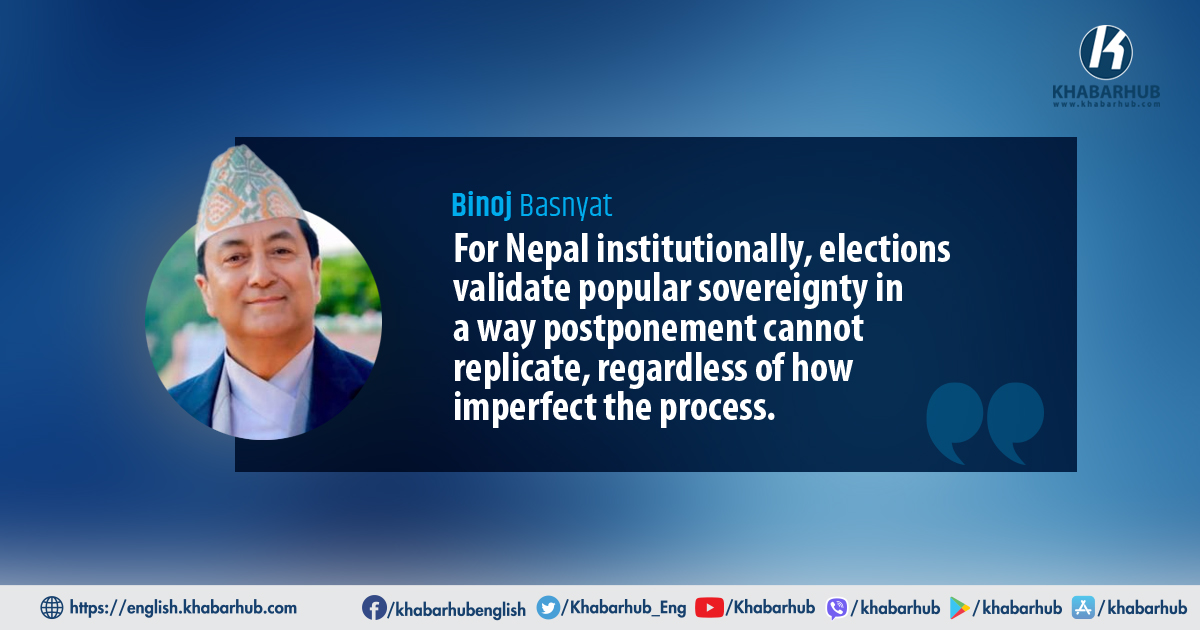
For youth movements and reform coalitions, elections offer an opportunity to pressure victorious governments through mobilization and accountability mechanisms unavailable under postponement. For Nepal institutionally, elections validate popular sovereignty in a way postponement cannot replicate, regardless of how imperfect the process.
Nepal has survived conflicts, constitutional experiments, and generational transitions. It can survive imperfect elections. What it cannot easily survive is the normalization of electoral postponement justified through constitutional emergency provisions. That path leads toward the Thailand–Pakistan trajectory: institutional decay masked by constitutional formalism.
The choice before Nepal’s leadership is not between perfect governance and crisis. It is between messy democracy accommodating competing stakeholder visions and institutional authoritarianism dressed in constitutional language—authoritarianism that would ultimately disadvantage all three stakeholder groups by freezing existing arrangements and preventing the change each, in different ways, seeks.
Elections should proceed. Security challenges are manageable. Constitutional crises are not.
(Basnyat is Maj. Gen. (Retd.) and a strategic affairs analyst based in Kathmandu. He writes on South Asian geopolitics, national security, and the intersection of governance, diplomacy, and stability.)





Comment