




As COP30 convenes in Belém, Brazil, in 2025, the global climate conversation returns to a familiar paradox: clean energy has never been cheaper, yet the pace of deployment remains painfully uneven.
In Europe and North America, renewables dominate new capacity additions. In much of Asia, Africa, and Latin America—regions that will determine the planet’s carbon trajectory—the investment flow is trickling when it should be roaring.
The reason is not technological inertia; it is economic geography. Disparities in capital costs, policy stability, and grid readiness continue to lock emerging markets out of affordable clean energy finance.
COP30, hosted for the first time in the Amazon basin, must be the moment the world moves beyond pledges and confronts the architecture of inequity that shapes the cost of the energy transition itself.
The cost-of-capital divide is where the transition is won or lost. Every solar farm or wind project is essentially a financing instrument attached to physical infrastructure. Because there is no fuel cost, up to 90% of lifetime expenditure occurs upfront.
The decisive factor is therefore the weighted average cost of capital (WACC)—and this is where the global playing field is deeply tilted.
In OECD countries, clean energy projects can secure debt at 3–6%, with 20-year tenors and predictable policy frameworks. In parts of South Asia, Southeast Asia, and Sub-Saharan Africa, those same projects face WACCs exceeding 10–15%, with loan terms often capped at seven years. The physical technology is identical; the price of money is not.
The host nation, Brazil, offers a fitting example. Its recent experience integrating biofuels, hydro, and emerging solar sectors into coherent national planning shows that industrial ambition and deployment scale can coexist—if guided by transparency and credible sequencing.
Why the gap? Currency risk, political uncertainty, and underdeveloped domestic capital markets. Most renewable equipment is imported and denominated in dollars or euros, while revenues are earned in local currency from state utilities that often struggle with solvency.
Devaluation risk alone can wipe out returns overnight. Without deep hedging markets, investors either demand higher premiums or retreat altogether.
The outcome is self-perpetuating. High capital costs slow deployment, which limits the build-out of supply chains and grids, which in turn keeps risk perceptions high.
At COP30, negotiators cannot ignore this arithmetic. Discussions of a “New Collective Quantified Goal on Climate Finance” (NCQG)—the successor to the $100 billion promise—must explicitly include cost-of-capital equalization as a metric of success. The climate transition isn’t just about how much money flows, but at what cost and to whom.
Policy stability is the hidden currency of trust. Capital flees uncertainty faster than it flees risk. In emerging markets, policy volatility is a hidden tax on clean energy. Sudden shifts in auction schedules, local-content rules, or tariff regimes introduce ambiguity that financiers cannot price. Retroactive changes—like tariff renegotiations or delayed payments by utilities—scar investor memory for decades.
The irony is that even well-intentioned interventions, such as local manufacturing mandates, can backfire when introduced abruptly. Developers face project delays and higher costs, while financiers reprice risk upwards. A measured, transparent glide path toward domestic value creation—supported by predictable procurement pipelines—would achieve far more.
As COP30 approaches, the credibility of policy signals will be central. The summit’s focus on “implementation and equity” provides an opportunity to elevate policy predictability as a form of climate finance in itself. After all, the cheapest way to cut capital costs in emerging markets isn’t always subsidies—it’s confidence.
Grid readiness is the silent constraint. Even where financing and policy align, weak transmission and distribution networks throttle progress. Across Asia and other emerging regions, grids built for centralized, fossil-based generation struggle to integrate intermittent renewables.
Interconnection queues can stretch for years. Curtailment rates—projects producing power but unable to dispatch—can exceed 10–15% in some markets.
This is not a technical issue; it is a macroeconomic bottleneck. Investors factor in curtailment risk, further inflating tariffs. Without transparent data on grid capacity, developers “build blind,” amplifying inefficiencies. Meanwhile, system operators lack incentives to modernize, and storage policies remain underdeveloped.
COP30’s discussions around just transitions and adaptation finance must expand to include grid transformation as a core pillar of climate justice. Transmission is climate infrastructure. Yet today, less than 10% of concessional finance earmarked for energy transitions goes to grid investment.
A credible “Global Grid Partnership,” anchored by multilateral development banks (MDBs) and regional utilities, could prioritize high-impact corridors linking renewables to demand centers. Think of it as clean energy focused on electrons, not asphalt.
A systemic loop, where risk begets risk: the interplay between high capital costs, unstable policy, and weak grids forms a feedback loop that traps emerging markets in a cycle of underinvestment. Policy uncertainty raises the WACC; expensive money discourages competition; weak grids magnify operational risk; and every failure reinforces the perception that these markets are “too risky” for large-scale renewables.
This is not a natural state—it’s a policy choice. COP30 offers a platform to rewrite that narrative by aligning climate finance mechanisms with structural reform. If the summit merely restates old promises in new numbers, it will fail. What emerging markets need is risk transformation, not just fund transfers.
So, what can COP30 deliver? First, a global mechanism to lower capital costs. COP30 should champion a Clean Energy Investment Guarantee Platform—a pooled facility backed by MDBs, sovereign funds, and credit agencies—to de-risk private capital flows. This would underwrite currency, political, and offtaker risks across multiple jurisdictions, compressing risk premiums at scale.
The principle is simple: blended finance should move from boutique pilots to mass production. Standardized templates, regional guarantee pools, and transparent benchmarking of WACC across countries could slash financing costs faster than any subsidy program.
Second, pursue policy consistency as a condition for finance. Donors and development banks should anchor concessional support to policy consistency metrics—clear auction pipelines, non-retroactivity clauses, and transparent grid access rules. Countries that meet these benchmarks could access lower-cost guarantees or accelerated disbursement windows.
This reframes policy stability not as a domestic administrative virtue but as an internationally recognized asset class—one that commands cheaper capital.
Third, a global grid and flexibility compact. A flagship outcome from COP30 could be a Global South Grid Compact—a coordinated push to expand transmission, invest in digitalization, and create cross-border interconnections. MDBs could finance regional power pools, while G20 economies provide concessional loans for grid upgrades that unlock renewable zones.
At the same time, governments should implement flexibility markets—compensating storage, demand response, and fast-ramping generation for the reliability services they provide. This ensures that renewables integrate smoothly rather than overwhelm fragile systems.
Fourth, coax MDBs for scale. The World Bank and regional development banks must become risk transformers, not just lenders. COP30 is the venue to encourage MDBs to expand their ability to take first-loss positions, guarantee currency convertibility, and leverage private investment fivefold or higher.
Emerging market delegates should push for a measurable target: halve the WACC gap between OECD and developing economies by 2030. That’s a tangible, time-bound objective that connects finance with fairness.
That contradiction cannot stand if the world is serious about net zero. The next phase of climate diplomacy must move from burden-sharing to investment-sharing. Equal access to low-cost capital should be treated as a universal right of the energy transition, just as much as access to vaccines was during a pandemic.
Fifth, link industrial policy with deployment stability. As countries pursue clean-tech manufacturing—especially in Asia—COP30 should promote an Industrial-Deployment Compact: predictable content rules phased over five to ten years, co-designed with industry and financiers. This ensures industrialization complements rather than competes with deployment goals.
The host nation, Brazil, offers a fitting example. Its recent experience integrating biofuels, hydro, and emerging solar sectors into coherent national planning shows that industrial ambition and deployment scale can coexist—if guided by transparency and credible sequencing.
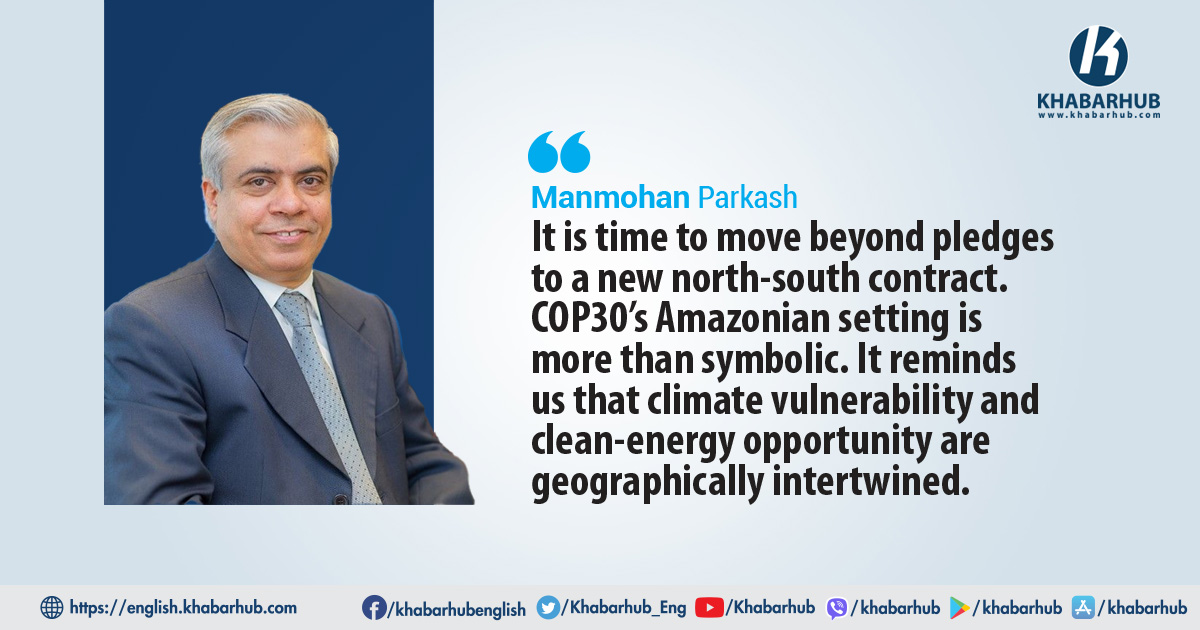
It is time to move beyond pledges to a new north-south contract. COP30’s Amazonian setting is more than symbolic. It reminds us that climate vulnerability and clean-energy opportunity are geographically intertwined. The regions that hold the sun, wind, rivers, and minerals needed for the global transition are also those paying the highest financing premiums.
That contradiction cannot stand if the world is serious about net zero. The next phase of climate diplomacy must move from burden-sharing to investment-sharing. Equal access to low-cost capital should be treated as a universal right of the energy transition, just as much as access to vaccines was during a pandemic.
If negotiators in Belém can link finance, policy, and infrastructure into a single, coherent framework for emerging markets, COP30 could mark the pivot from aspiration to acceleration.
If they cannot, then the Amazon—our planet’s greatest carbon sink—will host a summit that talked about saving the world while ignoring the math that makes saving it possible.
(Former Senior Advisor, Office of the President and Deputy Director General, South Asia, Asian Development Bank. Global thought leader on economic policy, infrastructure, and development finance, with a focus on inclusive growth and reimagining global institutions. Views are personal.)





Comment