




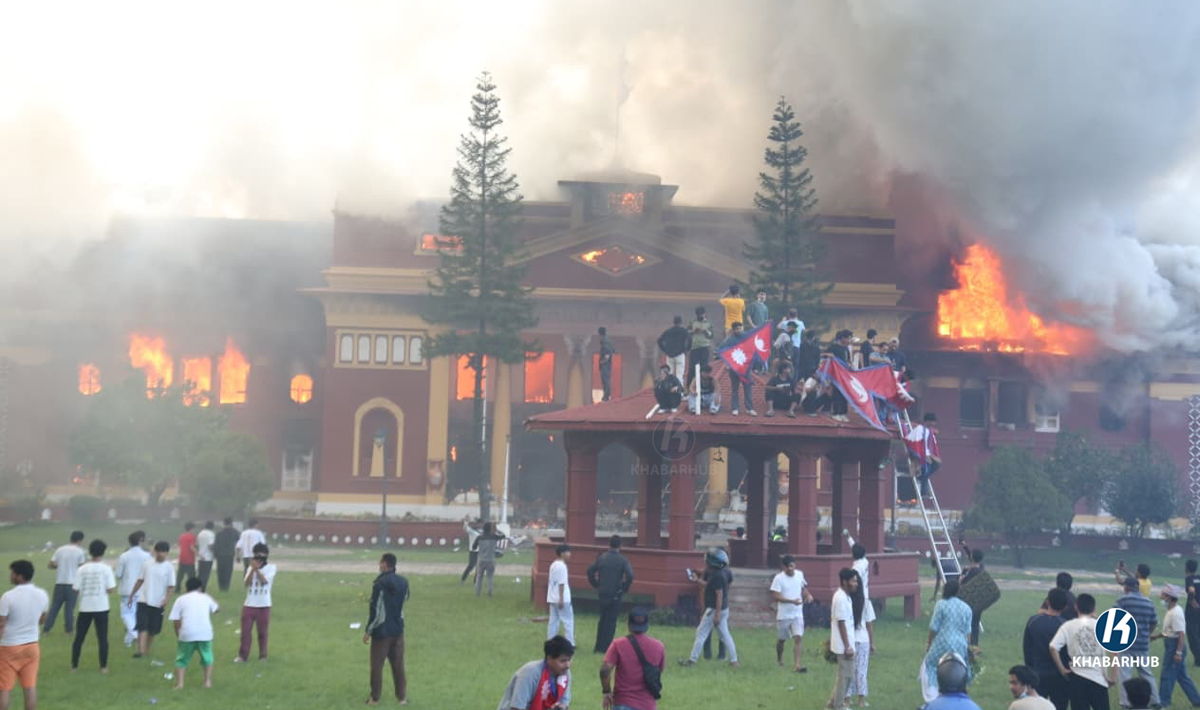
KATHMANDU: On Tuesday, Nepal’s streets became the stage for an extraordinary upheaval—nearly cinematic in its intensity and devastating in its implications.
Simultaneously, Singha Durbar, the Supreme Court, Parliament, and even the President’s Office went up in flames. These were not symbolic acts but visceral testaments to a generation’s frustration with institutions that failed them for so long.
Flames lit the sky over Nepal’s power centers, and with the smoke came a clear signal: the old order was burning, and must be rebuilt from its embers.
This uprising, led by Gen Z, began as a stand against a draconian social media ban, targeting platforms like Facebook, X, and YouTube. But it quickly evolved into a rebellion against decades of corruption, stagnation, and elite privilege.
Youth unemployment had hovered around 22%, half the population lived in poverty, and a sense of exclusion had metastasized. The digital shutdown wasn’t merely censorship—it was the spark in a tinderbox of suppressed rage. (reuters.com, politico.com, economictimes.com).
What we saw next was a catastrophe: smoke billowed from halls of power; fire trucks stood idle and overwhelmed; archives—temporal anchors to national memory—went up in flames.
Authorities admitted on Tuesday that without full mobilization, it might take days to stem the flames. Meanwhile, arsonists extended their assault to media houses, police stations, and even homes of influential political families.
Prime Minister KP Sharma Oli’s resignation came in the afternoon—an admission of defeat by a “political survivor” who had once seemed unshakeable. In a brief letter invoking Article 77 of the constitution, Oli bowed to public will, signaling that the moral foundation of his rule had eroded. The moment underscores how protests, sparked by digital repression, can culminate in a revolution that topples a government.
Yet resignation alone won’t reignite national hope. President Ram Chandra Paudel has called for dialogue, stitching urgency with civility. But the call lands on a landscape scorched by fear and disillusionment. Nepalese youth want structures rebuilt, not political recycling.
The Nepali Army’s appeal to protect cultural heritage while extending a hand to calm is commendable, but a society that watches its Supreme Court burn won’t be soothed by rhetoric alone.
This protest’s scale is unprecedented. In a nation where protests already numbered nearly 4,000 over ten months, the normalization of dissent has bred a volatile citizenry conditioned to escalation. But this is different. It’s not just rage—it’s a structure-shaking revolution that burned icons of state power.
At the movement’s heart lies a new energy: social media-savvy, leaderless, insurgent, and digital-first. Slogans like #NepoBabies and videos exposing elite lifestyles went viral. The protest was decentralized, fueled by solidarity, not party lines or ideology.
Even former King Gyanendra urged peace, calling for the movement to remain peaceful and authentic, a rare moment of royal moderation in a crisis of republican legitimacy.
As protests turned destructive, the need for justice, accountability, and democratic reinvention became apparent. Police killed at least 19 protesters, shocking the nation into moral reckoning. Three officers were later killed after surrendering—evidence of total institutional breakdown, as was the mass jail escape in Jaleshwar amid chaos.
Adding to this turmoil, protests spread into rural outposts, social movements grew beyond Kathmandu, and protests intersected with broader societal currents—from anti-Israel rallies to teacher strikes. Nepal’s protest culture had been simmering; now it is volcanic.
Meanwhile, as buildings burned, the real battle became clear—between a future enslaved by nepotism and one drawn by democratic renewal. Balendra (Balen) Shah, Kathmandu’s young mayor, became a fleeting symbol of hope. Protesters carried the anime flag of One Piece’s Straw Hat Pirates—a banner for freedom, not just chaos.
Now Nepal teeters: will it rebuild institutions that ignore its youth, or will it refashion the state into something inclusive and forward-looking? Dialogue must go beyond convening. It must root in constitutional reform, youth inclusion, anti-corruption action, and rejuvenated civil liberties.
Nepalis deserve stability, but not stability of suppression. Rebuilding isn’t slowing down protests—it’s giving them purpose. If future generations can say their voice mattered, then perhaps this uprising will yield not a burnt state, but a reborn republic.


Comment