




We all have a general sense of the country’s economic condition. Today, I want to speak more broadly about the economy rather than focus strictly on monetary policy. Let’s talk about the problems we’re facing, the role of monetary policy, and what the future might hold.
I’ve served not only at the Central Bank, but also in the National Planning Commission, and I’ve taught at Kathmandu University. As an economist, I often ask: Where is our country headed? What kind of future awaits an economy sustained primarily by remittances?
This year has been particularly dynamic on the global stage. It’s not just about former U.S. President Donald Trump’s trade policies — rapid developments in artificial intelligence are also reshaping capital flows (a kind of capital shock).
A while ago, The New York Times reported that humans now have significant control over low-Earth orbit satellites. Why are these satellites important? They enable the control of drones, autonomous vehicles, and even advanced weaponry. Elon Musk alone owns 8,000 of the 11,000 satellites in orbit. Such developments are having a profound impact on the global economy.
Growing gap between government revenue and debt
There are immediate concerns within our economy. One of the most pressing is the widening gap between government revenue and debt. Revenue growth has slowed significantly. Between fiscal years 2064 and 2074 BS, government revenue increased from NPR 100 billion to NPR 640 billion. However, in the eight years since then, it has only reached NPR 1,178 billion — it hasn’t even doubled.
Globally, many developed countries are facing demographic challenges. Fertility rates are at historic lows. In our own country, the fertility rate has fallen to just 0.9 percent — not enough to replace the current population.
Meanwhile, public debt has surged, especially due to pandemic-related expenditures and other financial obligations. It has ballooned from NPR 700 billion to NPR 2.7 trillion. Several factors are at play here, including fluctuations in foreign exchange rates. The composition of foreign and domestic debt is also shifting.
Back in 2060/62 BS, foreign debt accounted for 80 percent, and domestic debt just 20 percent. Now, increasing government borrowing is contributing to a prolonged liquidity crunch in the economy.
Lack of sustainable and quality infrastructure
While government debt has reached NPR 2.7 trillion, revenue isn’t rising at the same pace. This mismatch has become a serious issue. Worse still, much of the borrowing hasn’t generated adequate returns. We’ve built large structures like meeting halls, but many of them remain underutilized. The same can be said of many airports and road networks.
I recently drove from Pokhara to Dadeldhura via the Mid-Hill Highway. After leaving a hotel in Baglung, I didn’t see a single decent hotel that seemed to contribute tax revenue to the state — not even in Burtiwang. This is a vast stretch of the country.
Despite significant investment in the 1,700–1,800 km Mid-Hill Highway, revenue generation remains absent. We still don’t know when we’ll begin to see a return on that investment.
That’s not to say roads aren’t important. But the growing gap between revenue and debt is compounded by issues in infrastructure quality. Four years ago, we had around 70,000 km of roads that still needed to be paved.
Even now, many roads are in poor condition — just look at the state of roads leaving Kathmandu. During last year’s monsoon, it felt like the capital was cut off from the rest of the country.
While we are spending heavily on infrastructure, the quality remains deeply unsatisfactory. It may look impressive in isolated cases, but overall, substandard infrastructure is a recurring problem.
Infrastructure should be built to last. Consider the U.S., where infrastructure projects from the 1960s continue to connect regions. In China, megacities are reshaping the economic landscape. Urban economists say that “cities are the primary engines of economic growth”.
That’s because around 96 percent of global economic activity occurs in cities. Cities foster information sharing, specialization, and innovation. You can gather 40 to 50 experts in a room to discuss a new technology — something that’s much harder to do in rural areas.
When populations concentrate, they create critical mass and drive the economy forward. That’s why countries around the world are building large urban centers.
A certain minimum population is needed for economic viability — to run a metro system, manage waste, and generate electricity from waste. Experts say a city needs at least 5 million people to make such systems economically sustainable.
But in Nepal, we’ve failed to develop such cities. According to the 2011 BS census, we had barely identified five cities. Areas with high population density didn’t evolve into functioning urban centers. Urban planning has lagged behind, and the infrastructure needed to connect cities has not been adequately developed.
Compare this to the U.S., where the city of Dallas stretches 70–80 miles across. Or India and China, where cities are not only expanding, but also being efficiently connected through high-speed rail. Today, you can travel from Hong Kong to South Korea by electric train, and from Shanghai to Beijing in just four hours.
New concepts like the Hyperloop are emerging in the field of transportation. In the United States, there are plans to connect San Francisco and Los Angeles using this technology. Once completed, the Hyperloop could reduce travel time between the two cities to under two hours. Developments like this show how rapidly other parts of the world are advancing in infrastructure connectivity.
In contrast, our own infrastructure is still lacking in quality. It’s not that we haven’t built roads or airports — we have — but we haven’t been able to connect cities in a way that drives economic growth.
We still treat roads primarily as pathways to homes, not as tools for unlocking economic potential. We haven’t created the kind of connected urban population that would attract large companies or justify major investments.
Roads haven’t delivered the economic returns they should have. Until we improve their quality and use them strategically to build economic hubs, infrastructure will continue to be a weak link in our development.
Population shortage
The third major issue is a growing population gap. We are now facing a shortage of people — especially those of working and spending age. In many areas, businesses report declining sales and a lack of consumers. This means people are leaving the country.
There are two main reasons for this. First, better opportunities abroad. Recently, some Russian bankers visited me. They told me about “green zones” and “red zones” in their country — areas where hardly anyone lives, even in peaceful regions. They’re planning to bring in three million people from countries like Nepal and India to populate those areas. China is also reportedly trying to bring in foreign workers, including from Nepal, to address its growing elderly population.
At one point, loans were distributed so freely that even those without business plans were given credit. But lending without purpose or planning leads to defaults and, ultimately, the risk of asset seizures — including land being auctioned.
Globally, many developed countries are facing demographic challenges. Fertility rates are at historic lows. In our own country, the fertility rate has fallen to just 0.9 percent — not enough to replace the current population.
As wealth increases, fewer people are choosing to have children. This trend is shrinking the global labor force and increasing the demand for young workers from developing countries.
We’re already seeing the impact here. Even though remittance inflows are higher than ever, consumer activity is weak. Where are the people to spend this money?
Capital is flowing out, and domestic consumption is low. One key reason is the wage gap: salaries abroad are far higher than what we can offer here. This imbalance continues to drive migration, creating a hollowed-out economy with limited spending power.
Wages increased due to imbalance between demand and supply
The fourth issue we face is rising wages — not due to productivity, but because of a supply-demand imbalance in the labor market. In other countries, wages increase when productivity rises — when workers contribute more to output.
But in Nepal, wages have increased simply because there are fewer workers. The demand for labor is constant, but with reduced supply, wages have been artificially pushed up.
This type of wage inflation is unsustainable. Our manufacturing sector — which traditionally employs large numbers of unskilled or semi-skilled workers — has failed to grow. Instead, the financial sector has become the main driver of GDP growth. But this sector mainly provides jobs for college graduates, not the wider population.
Because of this imbalance, many young people have sought employment abroad. The lack of a robust manufacturing base has denied us the chance to provide domestic employment on a large scale. Sustainable development requires a strong, job-creating industrial base — something we have not prioritized.
Alongside this, credit growth has stalled. Currently, around 132,000 individuals are blacklisted by financial institutions. Out of the estimated 800,000 to 1 million people engaged in business in Nepal, this is a significant proportion.
At one point, loans were distributed so freely that even those without business plans were given credit. But lending without purpose or planning leads to defaults and, ultimately, the risk of asset seizures — including land being auctioned.
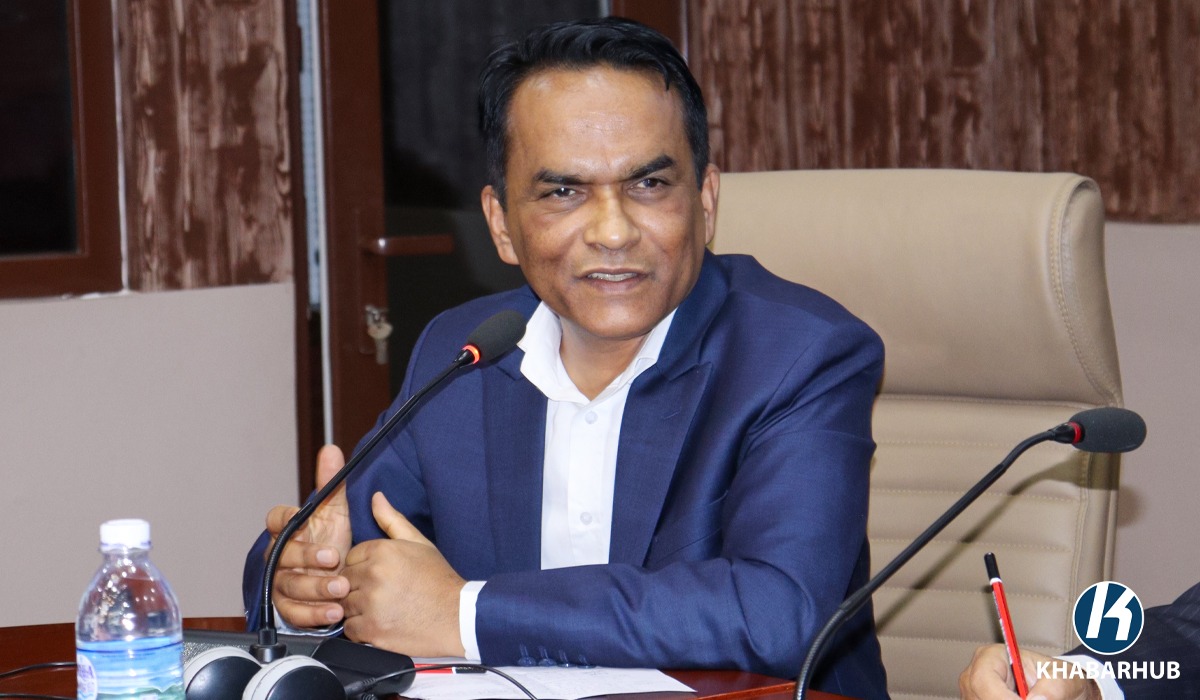
(Excerpts from remarks by Governor Dr. Poudel during a policy dialogue on ‘The Role of Nepal Rastra Bank in Revitalizing Nepal’s Economy,’ organized by the Institute for Strategic and Socio-Economic Research (ISSR) on Friday at Pavilion Hall, Durbarmarg.)






Comment