




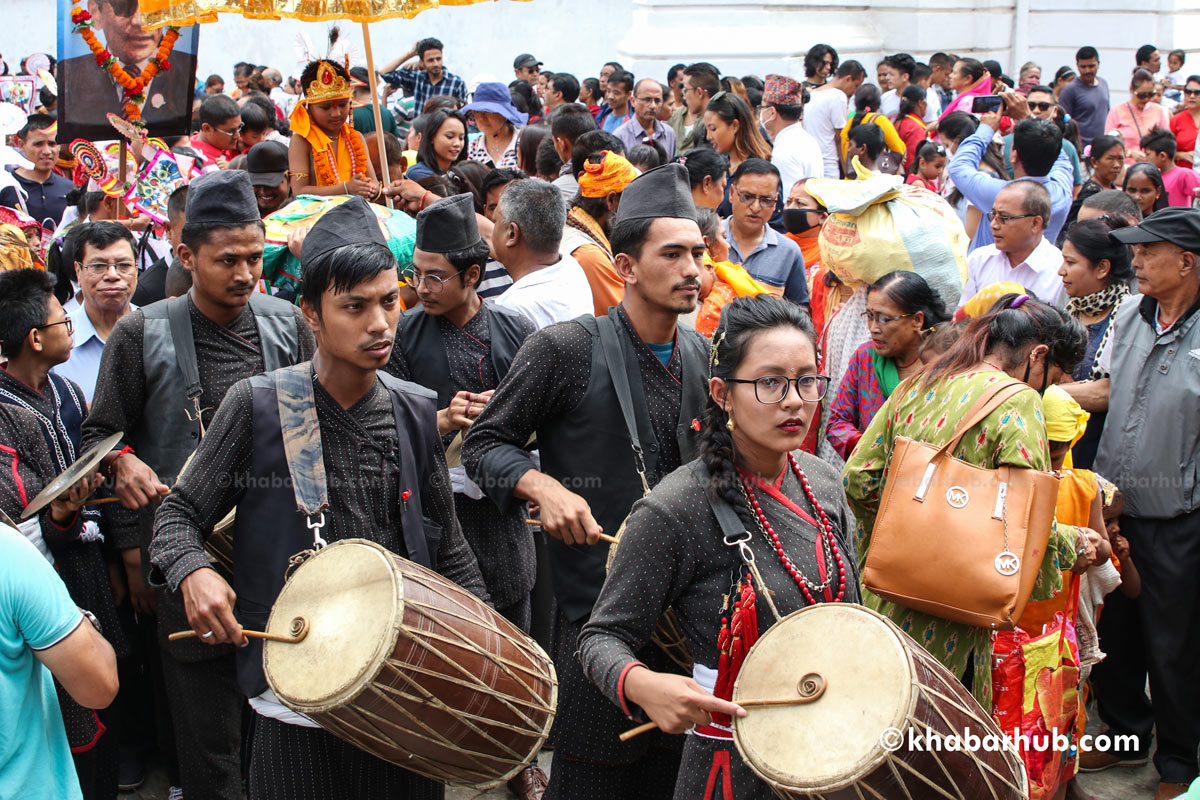
KATHMANDU: Gaijatra, a cultural festival celebrated in the Kathmandu Valley and other parts of the country, is being observed today with various programs marked by fun, humor, and satire.
The eight-day festival begins on the first day of the waning moon in the month of Bhadra (Bhadra Krishna Pratipada) and concludes on Ashtami, according to the lunar calendar. Gaijatra is observed to commemorate those who have passed away within the past year.
Traditionally, cows—or people dressed as cows—parade through the streets, and observers offer them milk, fruits, beaten rice, traditional bread, curd, grains, and money. These offerings are believed to aid the departed souls in their journey to the afterlife.
The festival’s origin dates back to the reign of King Pratap Malla, who introduced it to console his grieving queen after the death of their son during a smallpox epidemic. To ease her sorrow, the king encouraged citizens to perform humorous and satirical acts in public, highlighting that death is a universal human experience.
Over time, Gaijatra evolved into a platform for satirical expression, often used to comment on political and social issues. The festival was banned following the royal coup in 2017 BS but was revived in 2033 BS by the then Nepal Royal Academy (now Nepal Academy).
Besides the Kathmandu Valley, Gaijatra is also celebrated in Banepa, Dhulikhel, Panauti, Barhabise, Trishuli, Dolakha, Khotang, Bhojpur, Chainpur, Dharan, Biratnagar, Birgunj, Hetauda, and Pokhara, especially by the Newar community.
The government has declared a public holiday in the Kathmandu Valley today to mark the occasion.




Comment