




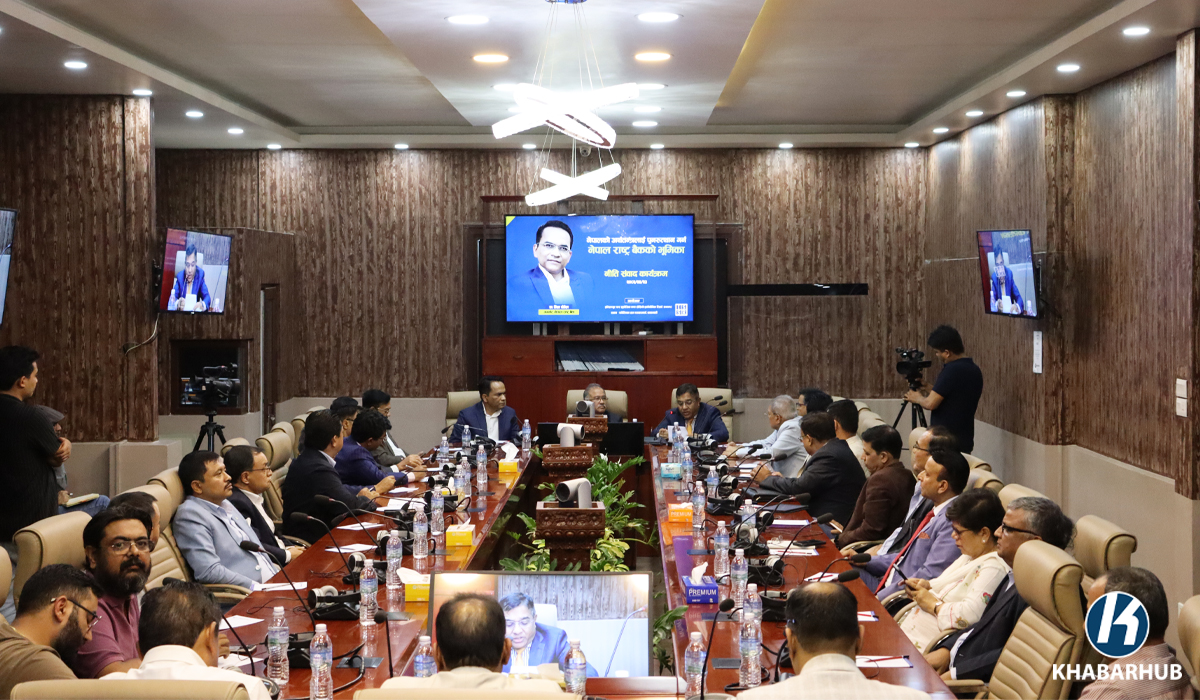
KATHMANDU: Nepal’s economy has yet to show signs of the expected recovery, stakeholders said during a policy dialogue organized by the Institute for Strategic and Socio-Economic Research (ISSR) on Friday.
Speaking at the event, Nepal Rastra Bank Governor Prof. Dr. Biswo Nath Poudel said the global economic environment is currently in an exciting phase.
While noting that he has symbolically taken some steps to stimulate the economy, Poudel stressed that fiscal policy interventions were essential to generate broad economic momentum.
Nepal Chamber of Commerce President Kamlesh Agrawal criticized measures taken after the COVID-19 pandemic for contracting rather than circulating the economy. At a time when investor confidence is low, he urged the central bank to reconsider its plan for international audits of 10 commercial banks.
Anjan Shrestha, senior vice president of the Federation of Nepalese Chambers of Commerce and Industry (FNCCI), noted that while the country’s external economic position remains stable, the number of blacklisted borrowers is high.
He called for better liquidity management in the banking sector, more effective use of foreign currency reserves, and greater operational autonomy for transparent banks. Shrestha also pushed for improvements to the working capital loan guidelines.
Energy entrepreneur Gyanendra Lal Pradhan pointed out that Nepal’s per capita cash circulation appears high but questioned where that cash is actually held. He credited sound government policies for growth in the energy sector.
IT entrepreneur and expert Lokesh Gupta argued that policymakers often overlook the country beyond Kathmandu. Despite the potential for domestic data centers, both the government and private sector rely heavily on foreign infrastructure. Gupta said regulating the freelancing sector could boost state revenues, and urged the creation of an IT hub similar to Silicon Valley.
Rajesh Upadhyaya, vice president of the Nepal Bankers’ Association, said that while credit flow is strong, it has failed to become productive, largely because loans issued under one purpose are diverted elsewhere. He highlighted the need for stronger governance in lending practices.
The dialogue, chaired by former Chief Justice Dr. Kalyan Shrestha and facilitated by ISSR Director Shankar Das Bairagi, concluded with calls for sustainable development, prioritization of agriculture, and borrower-friendly banking practices. Shrestha also suggested reviewing the practice of blacklisting borrowers over bounced checks and stressed that investments must yield productive returns.





Comment