




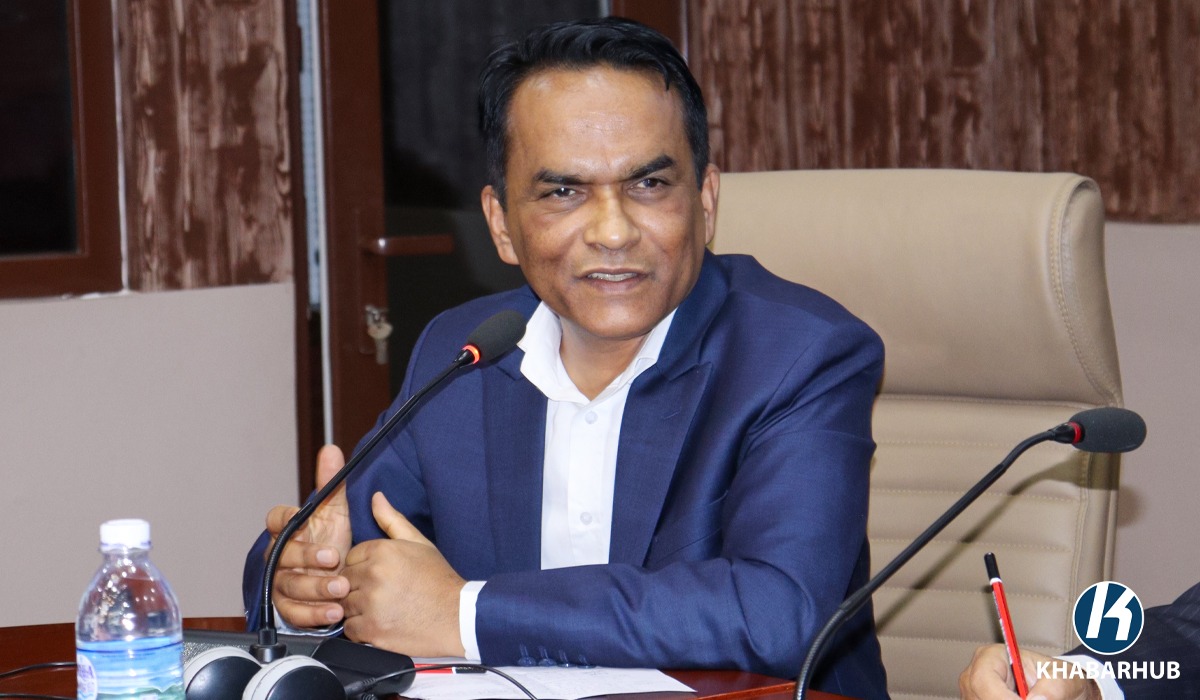
KATHMANDU: Nepal Rastra Bank (NRB) Governor Dr. Bishwo Poudel has said that while monetary policy can offer limited support to economic revival, the responsibility for making the economy dynamic lies primarily with the government and its fiscal policy.
Speaking at a policy dialogue organized by the Institute for Strategic and Socio-Economic Research (ISSR) in Kathmandu, Governor Poudel stated, “I cannot give a big push through monetary policy. The recent policy is merely an attempt to make the economy move a little.”
Addressing the dialogue on “The Role of Nepal Rastra Bank in Reviving the Economy,” Poudel emphasized that the central bank alone cannot tackle the structural challenges Nepal faces. “The government should bear greater responsibility for the current economic problems than the central bank,” he added.
Appointed by a coalition of Nepal’s two major parties—the Nepali Congress and CPN-UML—Governor Poudel said he preferred to speak more broadly about the economy than just monetary policy. “As an economist, I question where our country’s economy, driven largely by remittances, is headed,” he said.
Poudel identified four major challenges stemming from government policies rather than from central bank actions: a failure to raise revenue in proportion to public debt; low returns from infrastructure investments; an accelerating trend of youth outmigration; and rising wages not matched by productivity.
He noted that global economic dynamics—shaped by factors such as U.S. trade policy under Donald Trump and the rise of artificial intelligence—have created new challenges, including capital shifts. However, he stressed that Nepal’s problems are mostly internal. “Opening offices in the name of big projects often seems more about creating jobs for a few individuals than truly developing the project,” he remarked, adding that many government projects suffer from underfunding.
Highlighting issues in fiscal management, he pointed out that Rs 14 billion was allocated in this year’s budget solely for interest payments. “Instead of that, the government could have reduced interest rates on domestic debt to ease the burden. Revenue should rise with economic activity, but efforts to stimulate the economy have been lacking,” he said.
Governor Poudel criticized Nepal’s inability to implement large-scale development projects, citing examples from countries like China that have rapidly expanded infrastructure. “Other countries built highways, dams, and roads, giving their economies a big push. We haven’t done that. All I can do is help the economy move a little,” he said.
He also highlighted worrying trends in revenue and debt. “Between FY 2064 and 2074 BS, our revenue rose from Rs 100 billion to Rs 640 billion. But in the last eight years, it has only reached Rs 1,178 billion—it hasn’t even doubled,” he explained. Meanwhile, debt has risen from Rs 700 billion to Rs 2.7 trillion due to increased spending and the COVID-19 pandemic.
Noting a shift in the structure of public borrowing, Poudel said, “Around 2060/62 BS, 80% of debt was foreign and 20% domestic. That has changed. Rising government borrowing has contributed to liquidity shortages over the past few years.”
He also criticized poor returns from infrastructure projects, saying that investments in facilities like assembly halls and airports have not been effectively utilized for economic activities. Even major road projects like the Mid-Hill Highway, he added, have not brought in basic returns such as tax revenue.
“The gap between revenue and debt is widening. Infrastructure quality is another concern. Four years ago, we had 70,000 km of roads that weren’t even blacktopped. Last monsoon, it felt as if Kathmandu was cut off. We are spending, but the output is poor,” he said.
Poudel concluded that infrastructure should serve long-term development by driving urbanization and population concentration—but in Nepal’s case, much of it lacks the durability and strategic planning needed to achieve that goal.
Governor Poudel emphasized the critical role of population density in urban planning and infrastructure efficiency, stating, “A certain population threshold is necessary to support systems like metro networks, road operations, and waste management. It is said that a city needs at least five million people for waste-to-energy projects to be economically viable.”
He noted that Nepal has historically lagged in urban development. “Back in 2011 BS, only five areas were officially recognized as cities. High population areas did not develop into functional urban centers, and we failed to construct the infrastructure necessary to connect them,” he added.
Commenting on global transportation advancements such as the Hyperloop and rapid infrastructure connectivity in other regions, Poudel remarked, “In contrast, the quality of our infrastructure remains poor. While development efforts have been made, we are still struggling to connect cities effectively.”
He added, “Roads are viewed merely as a means to reach homes, not as drivers of economic activity. We haven’t reached the threshold population needed to attract major companies, and as a result, road infrastructure hasn’t contributed to economic growth as it should have.”
Poudel identified population emigration as another serious challenge. He explained that Nepal is now facing a ‘population gap’—a lack of sufficient working-age population.
“We are hearing more frequently that there are no consumers and no sales in many places, which clearly indicates that people are leaving,” he said. “This outmigration is driven by two factors: the availability of better opportunities abroad, and aging populations in other countries attracting Nepal’s youth.”
Highlighting the demographic crisis, the governor also pointed out a sharp decline in Nepal’s fertility rate. “Our fertility rate has dropped to just 0.9 percent. There is no growth in the new population, which has led to reduced domestic consumption. Although remittance inflow is rising, it is not being matched by trade or productive economic activity,” he concluded.
(Views expressed by Governor Bishwo Poudel at a program organized by the Institute for Strategic and Socio-Economic Research)






Comment