




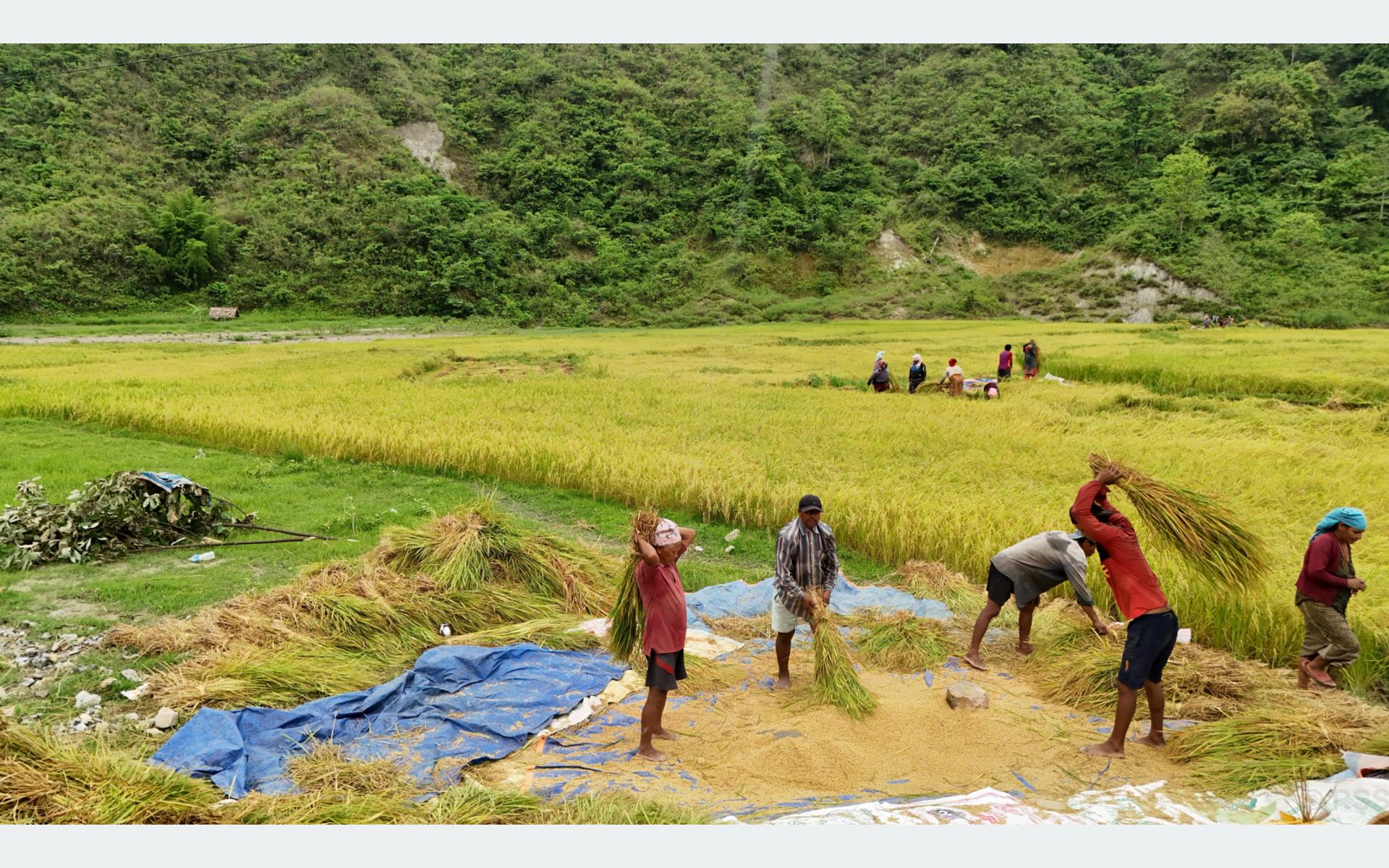
KATHMANDU: The early arrival of the monsoon this year has positively influenced paddy planting throughout Nepal.
According to the Department of Agriculture, Ministry of Agriculture and Livestock Development, 45.03 percent of paddy planting has been completed nationwide as of Tuesday, representing a 1.53 percent increase compared to the same period last year when 43.5 percent had been sown.
Prakash Kumar Sanjel, Director General of the Department, explained that most farmers rely heavily on rainfall for planting, and the earlier onset of the monsoon has contributed to this year’s increased sowing.
However, he noted that planting in Madhes Province remains lower than in other provinces due to reduced rainfall, despite still being higher than last year’s figures. Typically, planting begins earlier in the Far Western Province and later in Madhes.
Out of a total of 1,383,732 hectares designated for paddy cultivation across the country, 623,144 hectares have been sown so far. In Koshi Province, 29.54 percent of the 276,387 hectares has been planted, which is somewhat lower than last year’s 34.4 percent.
Madhes Province has seen 25.08 percent of its 372,645 hectares sown, slightly less than the 25.5 percent recorded last year. Bagmati Province, meanwhile, has achieved 51.9 percent sowing of its 120,545 hectares, showing an increase from last year’s 41 percent.
In Gandaki Province, 55.6 percent of the 94,182 hectares has been sown, up from 49.7 percent during the same period last year. Lumbini Province has completed planting on 52.1 percent of its 157,857 hectares, higher than last year’s 44.4 percent.
Karnali Province reports 71.7 percent sowing of its 40,884 hectares, slightly below last year’s 78 percent. In Sudurpaschim Province, 82.8 percent of 176,151 hectares has been sown, just under last year’s 86 percent.
Nearly half of Nepal’s paddy planting depends on monsoon rains, and the Department of Hydrology and Meteorology has noted uneven rainfall distribution so far this season.
Areas such as Janakpur, Simara, and Biratnagar have received below-average rainfall, while Dhangadhi, Surkhet, Bhairahawa, Lumle, Jumla, Dang, and Kathmandu have experienced above-average precipitation.
According to the Department of Hydrology and Meteorology, Nepal has received 352 millimeters of rain so far this monsoon season, about 23.8 percent of the average 1,400 millimeters.






Comment