




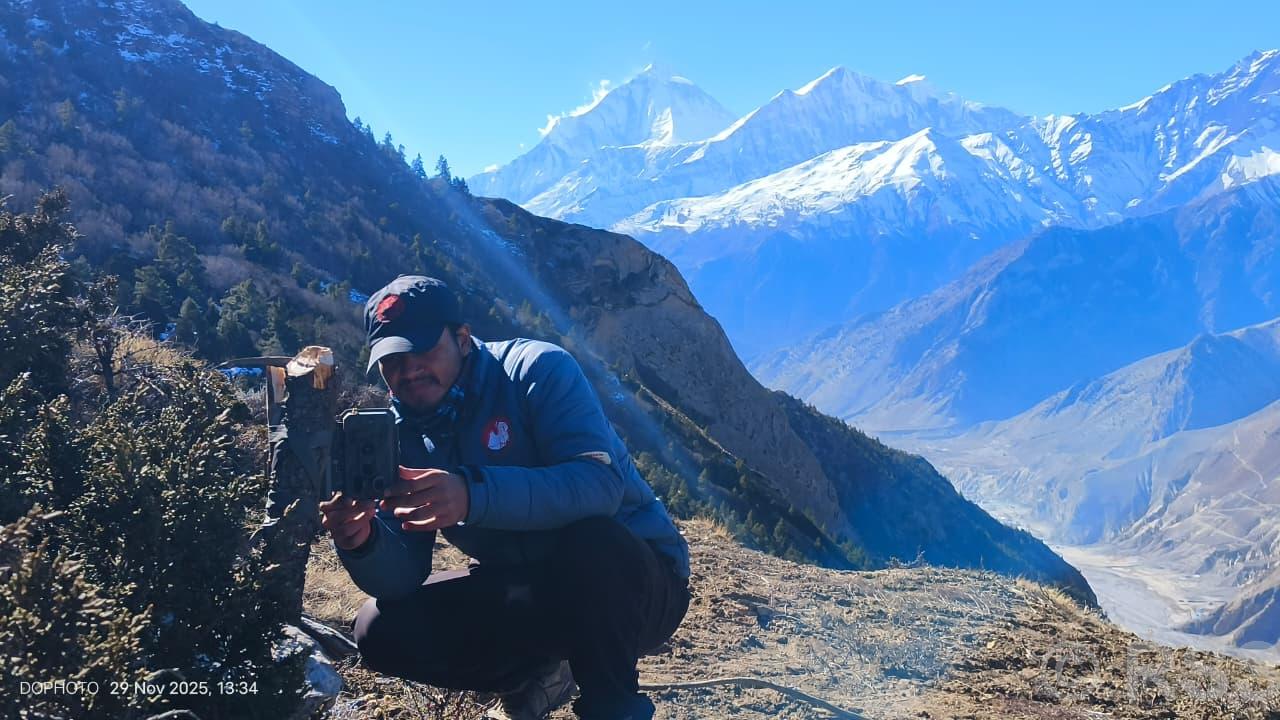
MUSTANG: A study has begun in Mustang to determine the population of the rare snow leopard. The research, which uses camera tapping technology to monitor snow leopards in high-altitude areas, is being carried out jointly by Biocos Nepal and the Annapurna Conservation Area Project (ACAP), Area Conservation Office Jomsom.
According to Buddhi Bahadur Gurung, a field biologist at Biocos Nepal, the project aims to assess snow leopard numbers, study the status of their prey species, understand human–snow leopard conflict, and gather information on habitat conditions affected by climate change.
Fifteen cameras have already been installed in high-altitude zones including Jhong, Pudak, Chengur, Thorangphedi, Phalyak, Dharkajung, and the Mustang–Dolpa road section under the Baragung Muktikshetra Rural Municipality.
Additional cameras will be placed in the high-altitude areas of Syang, Marpha, and Chimang villages within Gharpajhong Rural Municipality starting today, Gurung added. To carry out this detailed study, Biocos Nepal has deployed biologist Gurung and assistant Prabin Lama, while ACAP Jomsom has assigned Natural Resources Conservation Assistant Deepak Oli to the technical team. Together, the team has already reached several potential snow leopard habitats and installed cameras.
The cameras will remain in place for two months to record snow leopard movement and help estimate their population during the winter season. A data survey will be conducted after this period.
“After two months, we will collect the cameras, update the software, and gather detailed information about the snow leopards,” Gurung explained, noting that all captured data will be transferred to ACAP, while Biocos Nepal will focus on population estimation. The organization has been conducting similar camera-based studies in different parts of the Annapurna Conservation Area.
Gurung also shared that continuous camera tapping has been conducted in Manang since 2022, and this marks the first such extensive program in Mustang. In Upper Mustang, a PhD researcher has also started a snow leopard study using camera tapping, according to ACAP Lomanthang chief Umesh Poudel. Despite multiple efforts, however, the exact number of snow leopards in Mustang remains uncertain.
Human–snow leopard conflict has been rising in the district. In recent years, snow leopards have increasingly descended from higher elevations into roads, settlements, and livestock sheds, causing losses to herders.
Climate change has further intensified these issues, as grass in high-altitude pastures has stopped growing and water sources are drying up. As prey species move downward in search of food and water, snow leopards have followed, creating more frequent interactions with humans.
This situation has made snow leopard conservation and the promotion of human–wildlife coexistence more challenging. At the same time, common leopards, typically found at lower altitudes, have begun moving uphill due to rising temperatures, adding another layer of complexity to local wildlife dynamics.




Comment