




After years of political stagnation, abuse of power, rampant corruption, nepotism, and endless power struggles between three so-called top politicians who consider themselves the greatest and completely indispensable, a youth movement and the brutal reaction of the state have put a temporary end to this spectacle of a small oligarchy of high-caste men.
Following the resignation of the KP Oli government, parliament was dissolved, and a transitional government was installed, which does not include any politicians from the parties responsible for the political mismanagement of recent years.
New elections to the House of Representatives are scheduled for 5 March 2026. Questions of legitimacy remain, as does the uncertainty about whether a new beginning is even possible without comprehensive reforms of the 2015 system.
Frustration among the younger generation
Half of Nepal’s population is aged 25 or younger. However, this group is denied an active political role. In 2015, the ageing leaders of the major parties wrote a minimum voting age of 25 for the House of Representatives and the State Assemblies into the constitution. Even within the parties, the younger generation is not allowed to play an active role.
A less-than-democratic Political Parties Act enshrined the partly dictatorial power of party leaders, especially their chairpersons, thus nipping any kind of internal party opposition in the bud. At best, the younger generation is allowed to demonstrate on the streets as cadres for the policies of the older generation and celebrate the long-failed party leaders.
At the same time, the government’s policies are not particularly geared towards the interests of young people. With their ever-increasing labour migration, they contribute a large part of the state’s income. At the same time, none of the governments since 2015 has made any effort to create jobs in the country or provide systematic vocational training.
Although it is mandatory that the PR system ensures that one-third of all members of parliament are women, their selection is ultimately the responsibility of the leaders of the political parties. It is questionable whether this process can be described as democratic and socially inclusive.
What has happened in this regard has been pure propaganda at best. Meanwhile, cases of corruption and nepotism, which are approved and covered up by the ruling elite, are becoming increasingly common. Recent findings even point to the active involvement of top politicians themselves.
The intensive use of social media, in part to criticise the machinations of the ruling oligarchy, was a last resort for free expression, information, and contact with one another.
When the Oli government wanted to introduce censorship here too, it was the spark that caused the frustration of the younger generation to explode. The reaction of KP Oli’s government could hardly have been more brutal. The fact that Oli claims in retrospect that he did not order this action is irrelevant. As prime minister, he bore full responsibility and yet had to be forced to resign.
To this day, he still does not acknowledge any wrongdoing. The youth protests were justified and understandable in every respect, but there were obviously elements that caused the protests to degenerate into anarchy after the police opened fire, during which public and private property was destroyed on a large scale in a completely senseless manner. In doing so, the demonstrators, like the government, abandoned the rule of law and damaged their own future and that of the state.
Legitimacy of the interim solution
The 2015 constitution was intended to form the basis of all law in Nepal. Of course, this constitution did not foresee a youth revolution such as the one that took place in early September 2025, nor did it foresee years of misconduct on the part of the democratically elected political elite.
After Oli’s resignation from the office of prime minister, it was therefore necessary to consider how to pave the way for a new beginning without completely undermining the constitution.
According to Article 77 (3), the constitutionally compliant step after Oli’s resignation would have been for his old government to remain in office until a new one was formed. However, given the seriousness of the Oli government’s misconduct, this would have been an affront to the concerns of the rebelling youth.
A renewed outbreak of riots was a real fear. A solution was therefore needed that would prevent the failed Oli government from continuing and at the same time address Gen Z’s demands for comprehensive change.
With President Ram Chandra Paudel appointing former Chief Justice Sushila Karki as Prime Minister, an option was chosen that excluded the politicians and parties responsible for the failure of the 2015 system over the past ten years.
The decision to dissolve parliament and call new elections for 5 March 2026 took the wind out of the sails of those calling for parliament to form a new government. Neither step was constitutional, but in view of the need to preserve national unity, which the President is obliged to do under Article 61, they were the only viable solutions in this crisis situation.
Significantly, those primarily responsible for the undesirable developments after 2015—who were deprived of their power base by this solution—were now demanding a constitutional approach. They deliberately failed to mention that many of their previous decisions and actions were also not in accordance with the constitution and the law.
What would be the prerequisites for a new beginning?
Sushila Karki’s government is a transitional solution. This government lacks the legitimacy to even begin to implement the numerous demands of the youth movement. The executive branch can neither amend the constitution nor make changes to existing laws or pass new ones.
The latter would only be possible on a temporary basis in the form of ordinances signed by the president. So what good would new elections in just five months do if the same politicians and parties who abused the 2015 system primarily to secure their power and privileges were then up for election again?
On average, constitutions in Nepal have a lifespan of around ten years. This framework would therefore be exhausted under the current constitution. Would it therefore be better to consider creating a new constitution straight away? I do not believe that this can be a solution.
The 2015 constitution was legitimised by the popular movement of 2006, which ended the monarchy’s abuse of power and the Maoist insurgency. At that time, a fundamental change was necessary because the 1990 system had also been abused in many ways.
For some time now, leading politicians from the major parties have been considering changes to the constitution. However, what they occasionally cited was not the elimination of errors and contradictions in the constitution or better control of the executive and the parties in implementing constitutional guidelines; rather, it was clear that they were concerned with further strengthening their power in their oligarchic power struggles.
There are numerous definitions and provisions in the constitution that urgently need to be revised in light of Nepal’s definition as a federal and secular democratic republic and in view of its multi-ethnic and multi-religious society.
For example, there are provisions in various parts of the constitution that are strongly influenced by the patriarchal mindset of the ruling elite. This includes the strange definition of secularism.
Secularism is commonly understood to mean a strict separation of state and religion. In Nepal’s constitution, however, secularism is merely defined as the right to practise and maintain one’s ancestral religion and culture.
In terms of the cultural orientation of the state, however, Nepal continues to be identified with the culture and religion of the ruling elite. This is considered the basis of the entire national identity.
The federalism of today’s political system is also a farce as long as the ruling national elite regards the provinces merely as pawns in their power struggles. The provinces must be independent regional political institutions that focus on their own concerns and interests.
In a federal state, the provinces work largely independently of the political parties and their tasks at the national level in fulfilling their own executive, legislative, and judicial functions. The demarcation, including fiscal demarcation, must be clearly regulated by the constitution and subordinate laws.
The ruling oligarchy has clearly failed to implement this task immediately after the 2015 constitution came into force and, in some cases, has deliberately refused to do so. In their current form, the provincial assemblies primarily serve to allocate posts to the clientele of the national party elites. Changes in national coalitions are immediately replicated in as many provinces as possible. This is not federalism but simply perverse.
There are forces that declare federalism in Nepal to be a failure and unsuitable. These arguments often come from circles that are ideologically not averse to a return to a Hindu state and monarchy. In a country like Nepal, with its enormous ethnic diversity and numerous regional differences, a federal system is an ideal way to include all population groups and regions.
Federalism can be an important factor in securing national unity. It is not this idea that has failed so far, but rather what the ruling elite has made of it.
A lack of social inclusion is another negative aspect of the current political system. In some respects, the constitution provides incentives for better participation by all social groups, but even these are largely disregarded or abused by the ruling oligarchy.
Furthermore, the relevant constitutional provisions are inadequate or even discriminatory. For example, more than half of society is female, but the constitution is written from a strongly patriarchal perspective.
Take citizenship law alone, which clearly expresses that women are second-class citizens at best. The male line of descent is always decisive.
Although the constitution and subordinate laws contain provisions for greater participation by women in the state and its institutions, these are disregarded or deliberately circumvented by the ruling men. The handling of local electoral law, which provides for greater involvement of women, is indicative of this.
Although this has contributed to a larger number of women in local political institutions, there are repeated complaints that they are not fully recognized there. The handling of the rule that the posts of mayor and deputy mayor should be filled by persons of different sexes is striking.
When nominating candidates for election, the parties almost exclusively nominate men for the posts of mayor. The problem is exacerbated when parties form alliances before the elections. If a party running as part of such an alliance is contesting only one of the posts, it can legally nominate only men in such a case.
In terms of adequate ethnic inclusion at the national level, the 2015 Constitution represents a significant step backward compared to the 2007 Interim Constitution. At that time, 60 percent of members of parliament were elected through the proportional representation (PR) system.
When nominating candidates for the first-past-the-post (FPTP) system, political parties were required to apply this system in accordance with Article 63 (4). However, all parties disregarded this provision, with the result that the proportion of members of parliament from the Khas Arya castes remained disproportionately high.
Contrary to the provisions of the Interim Constitution, the members of the Constituent Assembly were forced at the time to rubber-stamp the proposals of the party leaders without resistance. This laid the foundation for their subsequent power games.
In the 2015 constitution, the ruling oligarchy insisted that 60 percent of MPs should now be elected through the direct election system. The obligation to ensure social inclusion was completely removed. As a result, the majority of direct election candidates to this day are men from the Khas Arya castes.
A further 30 percent of the members of parliament elected through the PR system must also be Khas Arya. Their total dominance in the House of Representatives is thus assured. In fact, recently only nine of the 165 directly elected members of parliament were women.
Although it is mandatory that the PR system ensures that one-third of all members of parliament are women, their selection is ultimately the responsibility of the leaders of the political parties. It is questionable whether this process can be described as democratic and socially inclusive.
Dalits and Muslims in particular, but also the Janajati groups, are clearly underrepresented. Not a single woman more than was absolutely necessary was represented in the House of Representatives at the last count.
The exclusion of all people under the age of 25 from direct political participation was already mentioned at the outset. Young people in particular are also excluded from active voting rights. They are heavily involved in labour migration.
The Supreme Court has repeatedly called on the government to ensure that labour migrants can also exercise their right to vote in their host countries, but this has been met with complete disinterest and, at best, empty promises from the ruling oligarchy.
Many young people are also denied the right to vote because they are denied citizenship, especially in the Tarai, which in turn is linked to the patriarchal mindset of the ruling elite.
In the absence of postal voting, all election workers and security forces deployed during the elections are also excluded. Elections based on this foundation cannot possibly be described as universal, free, and fair.
Can the upcoming elections provide the basis for a new beginning?
Many of the urgently needed corrections outlined above cannot possibly be made before the planned new elections to the House of Representatives. A constitutional amendment is necessary as the basis for all further changes, but it requires a two-thirds majority of an elected parliament.
Individual laws or passages of law could be temporarily amended in one form or another by presidential ordinance. Ultimately, however, they would have to be confirmed by parliament after the elections.
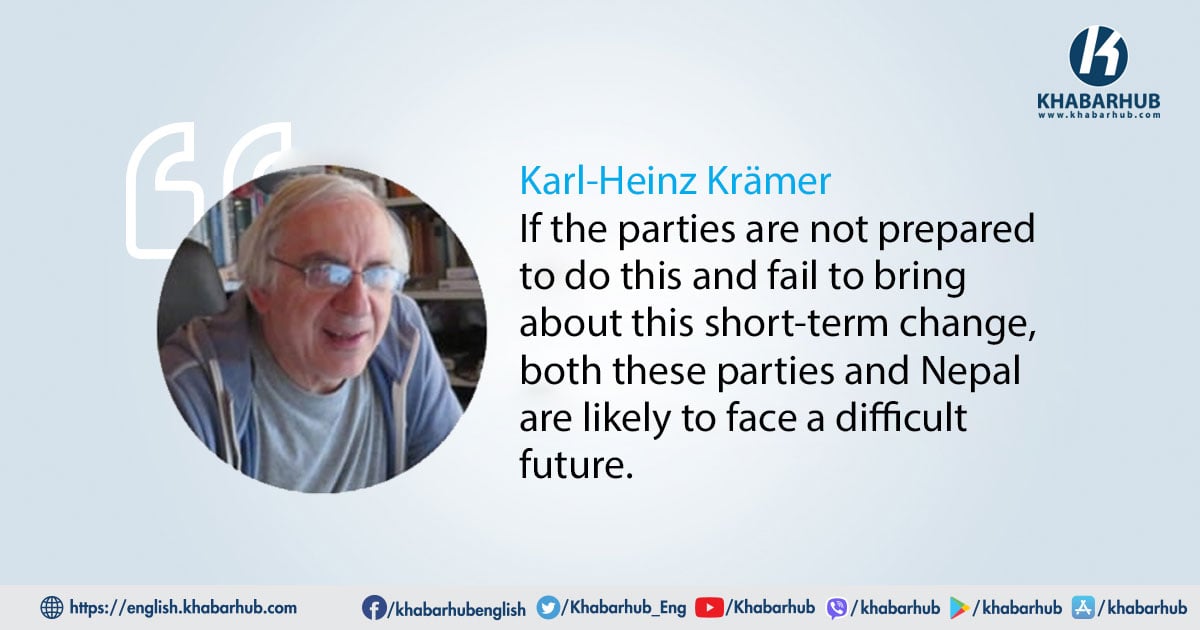
All of this must be clearly reflected in their election manifestos, which should not be utopian again, in the selection of their candidates, and in the democratic election of their party officials. If the parties are not prepared to do this and fail to bring about this short-term change, both these parties and Nepal are likely to face a difficult future.
It is doubtful whether this will be accepted by the members of parliament from today’s parties and their unchanged leadership. This applies in particular to the necessary constitutional amendments. It should be remembered that the 2015 constitution was ultimately written by the very same top politicians who subsequently exploited and interpreted it extensively in their own interests.
Contrary to the provisions of the Interim Constitution, the members of the Constituent Assembly were forced at the time to rubber-stamp the proposals of the party leaders without resistance. This laid the foundation for their subsequent power games.
In this situation, it will be difficult to better involve the younger generation and integrate them into a renewed Nepal. The formation of new parties so shortly before the elections is unlikely to be a solution either.
In the past, new parties have repeatedly emerged under the slogan of representing alternative forces, only to quickly end up back in the degenerate maelstrom of the mainstream.
I see a viable path, if at all, in a fundamental renewal of the existing parties, although this solution still seems unrealistic to me at present. Such a renewal would have to be based on a return to the long-forgotten fundamental values of political parties.
They would have to distance themselves from their old, degenerate leaders, involve the party youth in a responsible manner, democratize their party statutes, and immediately internalize the ethnic and gender diversity and concerns of Nepalese society.
They would have to take a clear stand that they are prepared to support the urgently needed reforms of the political system mentioned above. Under this condition, the old political parties could also be part of the future renewed Nepal.
All of this must be clearly reflected in their election manifestos, which should not be utopian again, in the selection of their candidates, and in the democratic election of their party officials. If the parties are not prepared to do this and fail to bring about this short-term change, both these parties and Nepal are likely to face a difficult future.


Comment