




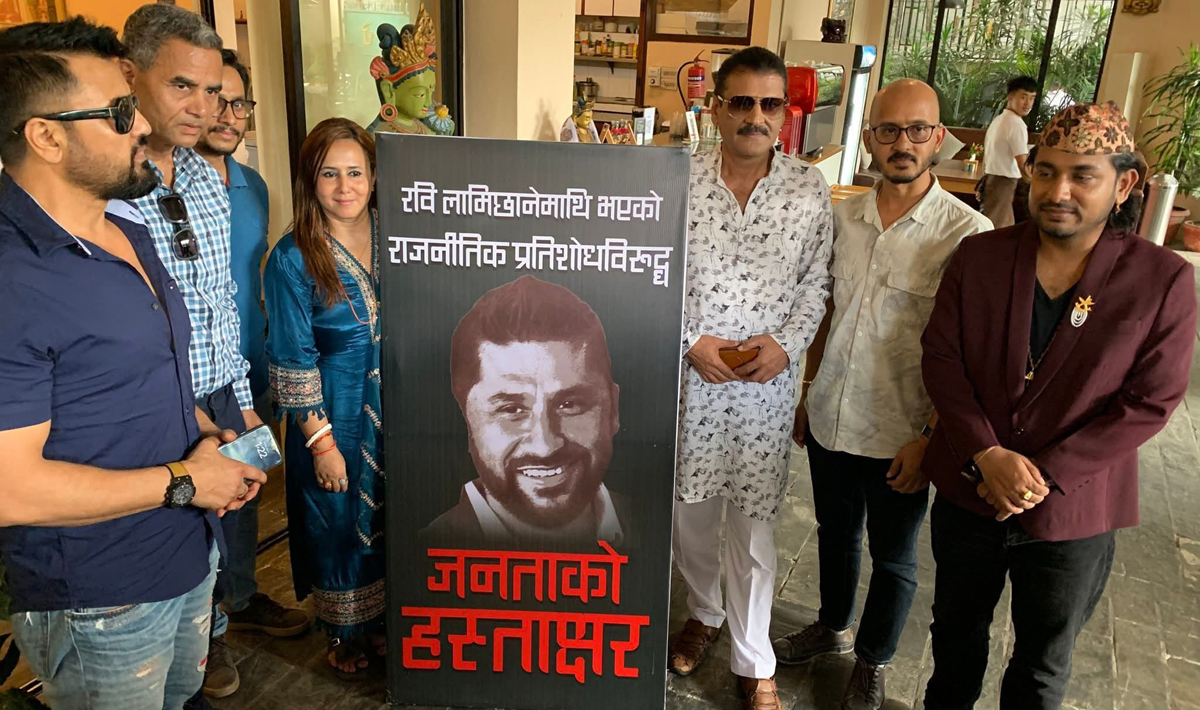
KATHMANDU: Rastriya Swatantra Party (RSP) Chair Rabi Lamichhane is currently in Bhairahawa Prison, facing charges of cooperative fraud.
The Supreme Court, Nepal’s highest judicial authority, upheld the decision of the Tulsipur High Court, ordering his detention. The court stated that there was no sufficient basis to immediately declare Rabi innocent.
Rabi has been accused in a serious financial crime case that has affected thousands of cooperative depositors. Ironically, some of the very artists now supporting him were once victims of similar fraud.
The RSP has labeled the court’s decision a politically motivated attack, claiming that major political parties have influenced the judiciary to suppress a rising force like theirs.
To rally public support, the party has launched a nationwide signature campaign under the narrative of “political vendetta” against its president.
Unlike typical campaigns that support victims, this movement is being conducted in favor of an accused individual, whom the court currently identifies as the perpetrator pending final judgment.
At its core, the debate isn’t just about one signature. It reflects a deeper tension between public responsibility and personal belief—especially when it comes to artists whose work shapes public perception.
This is unprecedented. For the first time, a political party has organized a public campaign—including signature collection booths in city centers, local party offices, and public spaces—to defend a leader entangled in personal financial controversies.
Notably, Rabi’s wife, Nikita Poudel, has set up a signature booth at Imago Cafe, near the north gate of the Royal Palace, targeting VIPs and celebrities.
A group of artistes visited the booth last Friday. According to sources, they came after being personally invited by Nikita.
Many artistes reportedly declined the invitation, reluctant to be drawn into a politically sensitive issue. Still, some participated—likely due to personal ties.
Nikita holds significant influence in the Nepali film industry as the former chair of the Film Development Board, and her father, Uddhav Poudel, owns Gopikrishna Hall.
However, it’s important to note that the RSP’s involvement in Rabi’s legal defense is not backed by legal standing. The court views the case as a personal legal matter, not a political one.
The party’s public campaign thus raises broader questions: To what extent should political parties support their leaders in legal trouble? Is the RSP using this campaign to strategically shape public perception ahead of the 2027 elections?
This brings us to the artistes. Should public figures, especially those with mass appeal, engage in politically charged campaigns involving legal cases? Is it appropriate for artists to endorse a political strategy that frames a court-indicted individual as a victim of political revenge? Some in the cultural community believe this crosses a line.
Popular actor and producer Deepak Raj Giri argues that such involvement undermines the professional integrity of artists. “It’s not right for artists to join campaigns like this directly. It sends the wrong message,” he said.
“Artists should express their views through their craft. Direct political involvement contradicts their professional character.”
Meanwhile, Mohan Niraula, President of the Film Artists Association, offers a more neutral view. “Artists are free to act based on personal belief,” he said. “But such actions should be viewed as personal choices, not as representatives of the artist community.”
However, he too hinted at the complexities of an artist’s identity in a politically charged environment, cautioning that independent professionals should be careful about direct political affiliations.
As the debate unfolds, it raises deeper questions about the role of public figures in legal and political matters—and the boundaries of personal conviction versus professional ethics.
Ultimately, this situation forces both artists and political actors to reflect on their responsibilities in a democracy governed by the rule of law.
Khagendra’s contradiction: Signature support and artistic integrity
A number of well-known figures from Nepal’s art scene—including actor Bipin Karki, singer Khem Century, director Dipendra K Khanal, and veteran actors Rajaram Poudel and Kiran KC (‘Rata Makai’)—have publicly joined the signature campaign in support of Lamichhane.
Among these participants, actor Khagendra Lamichhane has drawn particular attention—largely due to what many are calling a contradictory stance.
Khagendra recently starred in and promoted the recently-released film Mahabhoj. The movie, coincidentally or not, revolves around the very issue of cooperative fraud.
Critics and audiences alike noted striking parallels between the film’s narrative and Lamichhane’s real-life legal troubles. Mahabhoj was even promoted as “the voice of cooperative victims,” aiming to raise awareness of how financial crimes unfold under political protection.
Yet, despite playing a character who stood with the victims of fraud, Khagendra has now signed in favor of an individual widely accused—by both victims and the courts—of the same crime.
His public support for Rabi has triggered criticism on social media, with many accusing him of hypocrisy and questioning whether his artistic persona aligns with his real-world actions. “In the film, he stands with the victims; in real life, he supports the accused,” a common comment goes.
Signature vs. the artist’s character
While several filmmakers and actors have remained silent, avoiding media comments on the matter, the debate is growing louder. Film Development Board Chairman Dinesh DC, when approached for comment, stated, “If we speak on this issue, it will become a political controversy. I prefer not to comment on political matters.”
However, in conversations facilitated by Khabarhub, some artists did agree to offer personal reflections.
Actor and producer Deepak Raj Giri sees this as a matter of democratic freedom. “Artists are also citizens. They have personal rights,” he says. “Signing a petition is part of the beauty of democracy. The accused becomes guilty only through evidence. So, having differing opinions is natural.”
He identifies three prevailing viewpoints in the public discourse around Rabi Lamichhane’s case:
Rabi is innocent and being unjustly targeted.
The matter is sub judice and should not be commented on.
The state is right and Rabi is guilty.
According to Deepak, artists participating in the campaign likely subscribe to the first view—that Rabi is being unfairly treated. Still, while acknowledging the right to choose a side, he says he will not personally participate in the campaign, emphasizing his role as an artist of the people.
Similarly, actor Bijay Baral shares a nuanced perspective. Even if Rabi’s case is indeed driven by political vendetta, Baral believes that an artist’s first responsibility is to remain true to their personal integrity—not to align publicly with any political narrative.
Mohan Niraula, president of the Film Artists Association, believes artists have the right to act according to their conscience. “Artists are part of the public,” he says. “It is natural for them to stand with people or with the causes they believe in.”
He also downplays the controversy, viewing the act of signing as a personal choice rather than a professional statement. “Signing is an individual freedom. No one can dictate where and when someone exercises their rights. But ideally, such actions should be audience-sensitive.”
A wider reflection
At its core, the debate isn’t just about one signature. It reflects a deeper tension between public responsibility and personal belief—especially when it comes to artists whose work shapes public perception.
When artists known for highlighting social injustices publicly support individuals accused of those very wrongs, it invites scrutiny, if not disappointment.
Khagendra Lamichhane’s actions, in particular, have triggered a broader conversation on the integrity of artistic advocacy, the line between performance and principle, and whether the credibility of an artist is undermined by such contradictions. For a profession that often speaks for the voiceless, the silence—or the shift—can be just as loud.
Chairman Mohan Niraula, reflecting on the involvement of some artists in the signature campaign, says he is not surprised. He believes that given their previous affiliations and ideological leanings, their support for Lamichhane aligns with past behavior.
Similarly, actor Bijay Baral shares a nuanced perspective. Even if Rabi’s case is indeed driven by political vendetta, Baral believes that an artist’s first responsibility is to remain true to their personal integrity—not to align publicly with any political narrative.
“It’s not necessary to define how an artist should behave in such matters,” he says. “Neutrality is a valid stance. Just as some may support Rabi and others may oppose him, there are those who choose to stay silent—and that silence should be respected.”
Baral also suggests that some artists may have joined the campaign out of personal loyalty or emotional connection, rather than political conviction.
“Artists have feelings too. They form personal relationships, and those can influence decisions. That seems to be the case here. Their emotional stance deserves acknowledgment, even if we don’t agree with it,” he concludes.


Comment