




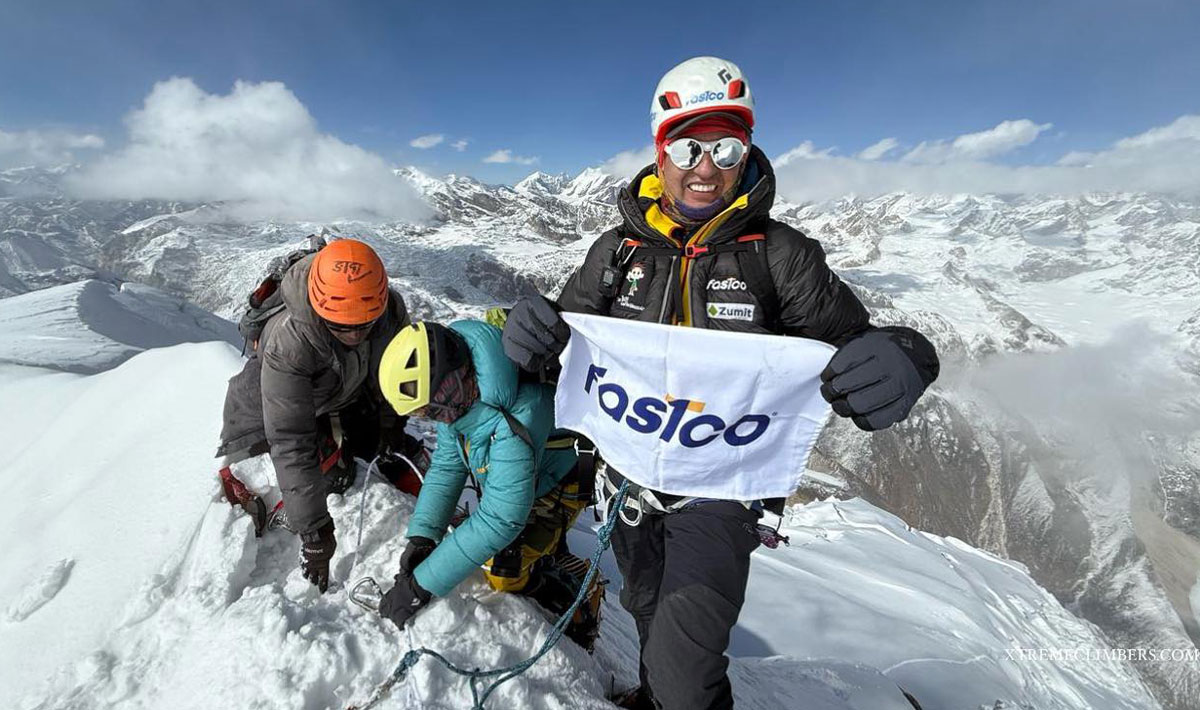
TAPLEJUNG: For the first time in history, a team of climbers has successfully reached the summit of Sharphu IV, a 6,433-meter peak in Taplejung district, marking another milestone in Nepal’s mountaineering records.
The ascent was achieved last week by a team comprising Chilean climber Hernan Leal, Nepali mountaineers Lakpa Tshering Sherpa and Ngada Sherpa, and photojournalist Purnima Shrestha. With this climb, Sharphu IV joins the list of successfully scaled peaks in the remote Himalayan district.
Taplejung, located in eastern Nepal, boasts 48 mountains ranging from 5,000 to 8,586 meters that have been officially opened for climbing.
Among these, the five prominent peaks of the Kanchenjunga range—Kanchenjunga Main (8,586 m), Kanchenjunga West/Yalung Kang (8,505 m), Kanchenjunga Middle (8,482 m), Kanchenjunga South (8,494 m), and Kangbachen (7,903 m)—are now accessible to climbers under government authorization.
In the Olangchungola area of Phaktanglung Rural Municipality-7, two peaks—Lumbasumba (5,740 m) and Lumbumba (6,500 m)—have been opened for expeditions.
Similarly, the Yangma area is home to four climbable peaks: Nangamari-1 (6,547 m), Nangamari-2 (6,209 m), Ohomi Gangka (6,839 m), and Pabuk Kang (Kangta) at 6,244 meters.
The Yamphudin area of Sirijangha Rural Municipality has also seen growing mountaineering activity, with five peaks including Kanchenjunga Main, South Kanchenjunga (8,474 m), Kokthang (6,148 m), Ramthong (6,682 m), and Kabru Central (7,412 m) made available for climbers.
A remarkable 37 peaks in the Ghunsa area of Faktanglung Rural Municipality-6 have been opened for climbing. This region hosts the towering Kanchenjunga—Nepal’s second-highest and the world’s third-highest mountain.
Once believed to be the tallest peak on Earth until 1852, Kanchenjunga (8,586 m) was officially ranked third after the Great Trigonometrical Survey confirmed Everest’s height. The mountain was first summited on May 25, 1955, by British climbers Joe Brown and George Band, who honored local spiritual beliefs by stopping just short of the actual summit—tradition that continues to this day.
Taplejung is also home to Kumbhakarna (Phaktanglung), standing at 7,710 meters. It is the 32nd highest mountain in the world and the 15th highest in Nepal. Revered by followers of the Kirat religion, Kumbhakarna was first climbed in 1962 by a French expedition.
In October last year, Sharphu V (6,328 m) was successfully climbed for the first time by a South Korean team under the leadership of mountaineer Ngada Sherpa. With six peaks under the Sharphu range now opened for climbing, only three remain unclimbed.
Ngada Sherpa, who led the successful ascents of both Sharphu IV and Sharphu V, said preparations are underway to scale the remaining Sharphu peaks.
“I’ve returned to Phungling and will soon head to Kathmandu to gather a new team for the next expedition,” he said.
As exploration in Taplejung’s lesser-known mountains gains momentum, climbers and tourism officials alike are hopeful that these new achievements will draw more attention to the region’s vast mountaineering potential.



Comment