




The education system of Nepal has been facing deep-rooted challenges of inequality, limited availability of subject teachers, and inadequate ICT-based pedagogical practices, particularly in remote or marginalized areas.
Bridging these gaps demands a transformative approach that connects educational equity with leadership development. The structured ‘Fellowship Model’, which trains passionate fresh graduates to serve in under-resourced schools, can serve as a powerful mechanism to advance inclusive, equitable, resilient, and high-quality education across Nepal.
Globally, the fellowship model has demonstrated that young professionals can act as catalysts for change and improve students’ outcomes while developing future education leaders.
In Nepal’s context too, the fellowship model could contribute well to national goals articulated in the School Education Sector Plan (SESP), the National Education Policy, the Act Relating to Free and Compulsory Education, the 16th Periodic Plan, etc., which emphasize inclusivity, innovation, and competencies.
The fellowship model is a cohort-based initiative, typically spanning two years, in which motivated young graduates commit to teaching or supporting education in community schools. Fellows undergo intensive pre-service training that combines theoretical learning with hands-on practice.
This model can cultivate educational leadership, diversity management, quality learning outcomes, community engagement, mitigation of educational disparities, enhancement of soft skills, creation of employment opportunities, and so forth.
While the duration and structure can vary based on institutional design, the overarching objectives could be to strengthen basic literacy and numeracy through innovation in community schools; promote educational equity and inclusion; develop leaders and changemakers in the education sector; and embed practical learning experiences for young graduates.
Fellowship programs are not merely short-term service initiatives; rather, they are leadership pipelines. Alumni should continue to engage through professional networks, continuous peer learning, joint projects, and mentoring of new fellows.
Fellows serve in schools that experience teacher shortages, particularly in English, Mathematics, ICT, Science, or other necessary areas. These placements not only help children gain foundational literacy and numeracy skills but also foster soft skills such as creativity, critical thinking, communication, and collaboration — core competencies for 21st-century learners. The fellowship model’s success depends on robust induction and continuous professional learning opportunities for fellows.
A pre-fellowship or induction program should be intensive, incorporating pedagogical competencies on foundational literacy and numeracy, differentiated (UDL) instruction, formative assessment, project-based learning, educational policies, planning know-how, and understanding of the School Improvement Plan (SIP), Local Education Plans (LEP), national frameworks, or SESP endorsed by the Government of Nepal, along with ICT skills, subject content knowledge, classroom management, child psychology, and so forth.
Fellows must also have the knowledge and skills to translate Gender Equality and Social Inclusion (GESI) policies, plans, and strategies into practice to address social barriers and manage diversity. ICT integration know-how is very important for using digital tools in teaching and monitoring students’ progress.
Knowledge of child rights and safeguarding should be mandatory to ensure child protection, prevent harassment and abuse, and establish safe learning spaces in schools where fellows serve. Most importantly, skills in fostering teamwork, conflict resolution, knowledge dissemination, and community mobilization are necessary.
Such multidimensional induction training develops fellows’ capacity to respond to Nepal’s complex educational realities, particularly in marginalized communities. Moreover, it strengthens resilience, adaptability, and empathy — qualities essential for educators in the resource-constrained environments of Nepal.
It is important to place fellows in community schools identified through collaboration among the host organization, local governments, schools, and School Management Committees (SMCs).
Placement should prioritize schools with teacher shortages, low learning outcomes, receptive leadership, supportive communities, and regions with high educational inequities — particularly remote or marginalized districts.
During their service period, fellows can teach students from Grades 1–12, organize extracurricular activities, and lead community-based learning projects; however, this depends on the needs of particular schools or communities.
They can also engage with parents through school events and home visits or participate in campaigns to promote inclusive, quality, and resilient education, ultimately contributing to zero education poverty.
The fellowship could emphasize community integration, where fellows build trust and co-develop local solutions to issues like early marriage, school dropout, and gender-based violence. This aligns with Nepal’s federal, provincial, and local governments’ educational priorities.
Currently, Nepal does not have a distinct legal framework governing the fellowship model. However, several existing laws provide a foundation for operationalizing such models. For example, the Labour Act, 2074 (2017) mandates that no person can be employed without a formal employment contract. Fellowship programs must therefore ensure that fellows receive appointment letters detailing duties, duration, remuneration, and benefits.
The Act also distinguishes between regular, time-bound, and work-based employment, with fellowships falling under time-bound employment. Likewise, Chapter 4 of the Labour Act specifies provisions for trainees and apprentices, including maximum training periods and minimum labor standards, and prohibits discrimination, child labor, and forced labor.
Similarly, the Civil Code, 2074 (2017) emphasizes fairness in employment contracts, ensuring that any service bond (e.g., a two-year commitment) remains reasonable and non-exploitative.
Thus, the fellowship model in Nepal can operate under a hybrid structure in which fellows are trainees with a stipend and a learning focus, while maintaining compliance with labor and contract laws. Legal clarity ensures both protection for fellows and accountability for institutions.
To ensure transparency, accountability, and impact, there should be independent selection committees where evaluation panels with representation from academia, civil society, and local government ensure impartial recruitment.
A structured selection process with multi-stage assessments — including application reviews, competency-based interviews, and community recommendations — helps achieve diversity and inclusion targets, ensuring representation of women, Dalit, Janajati, Madhesi, and persons with disabilities to promote educational equity.
In the fellowship program, codes of conduct and safeguarding mechanisms are necessary to maintain zero tolerance toward harassment, discrimination, or abuse. Legal MoUs or agreements among the host organization, local governments, and schools specifying roles, responsibilities, and logistical arrangements are essential to this model.
Institutional partnerships between local governments, universities, and the host organization can help sustain and scale fellowship initiatives.
Fellowships should be non-exploitative and provide fair compensation aligned with living standards in assigned areas. Fellows should receive monthly stipends, travel allowances, insurance, accommodation or housing support for rural placements, psychosocial support mechanisms, and opportunities for professional growth through quarterly review workshops, mentorship, and alumni networking.
These provisions not only attract talented youth but also ensure their well-being and motivation throughout the program. Fellows’ reflections, journals, and performance assessments should feed into continuous program improvement to make it more successful.
A clear MEAL framework is also crucial to measure the fellowship model’s effectiveness and social impact. Indicators such as learning outcomes (improvement in foundational literacy and numeracy); leadership growth (fellows’ personal and professional development); community engagement (parent participation and local ownership); and systemic impact (school improvement and alumni contribution to education reform) can be used.
Both quantitative indicators (e.g., test scores, attendance rates) and qualitative tools (e.g., case studies, reflective journals, focus group discussions) should be employed. Annual reviews, independent evaluations, and dissemination of findings can foster transparency and replication across other regions.
In the fellowship model, Gender Equality and Social Inclusion (GESI) mainstreaming is non-negotiable. Fellowship outreach must actively target underrepresented groups and provide scholarships or additional support for fellows from disadvantaged backgrounds; accessible materials and environments for persons with disabilities; gender-responsive communication materials; safe and inclusive living and working spaces; and training on intersectionality, inclusivity, and safeguarding.
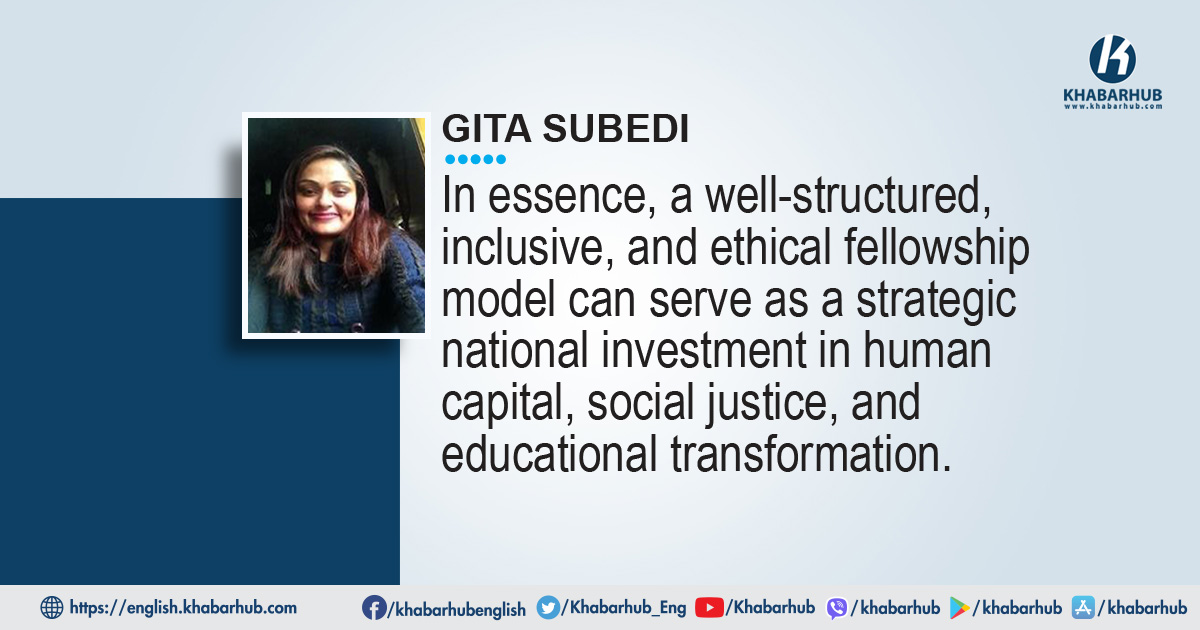
In essence, a well-structured, inclusive, and ethical fellowship model can serve as a strategic national investment in human capital, social justice, and educational transformation.
These measures ensure that the fellowship embodies Nepal’s constitutional commitments to equity, non-discrimination, and inclusive education for all children.
Fellowship programs are not merely short-term service initiatives; rather, they are leadership pipelines. Alumni should continue to engage through professional networks, continuous peer learning, joint projects, and mentoring of new fellows.
There should be seed funding or research grants to encourage alumni-led innovations in educational equity. Representation in governance and participation in advisory boards or decision-making structures at different tiers of government are equally important.
Ongoing capacity-building workshops, leadership retreats, and exposure visits to expand professional horizons are necessary to make this model more successful. This lifelong engagement sustains the momentum for educational transformation and nurtures a community of reform-minded educators and social innovators.
Implementing the fellowship model in Nepal may face several challenges — for example, resource constraints and uneven living conditions in remote areas; ambiguities in legal status between ‘trainee’ and ‘employee’; ensuring host schools’ readiness and community acceptance; and avoiding program elitism by ensuring diversity and local participation.
These challenges can be mitigated through strong institutional partnerships, transparent communication, legal compliance, and contextual adaptability.
In a nutshell, adopting a Fellowship Model in Nepal’s education system is both feasible and transformative. It can address critical gaps in educational quality, leadership development, and equity while inspiring a new generation of education leaders.
With robust legal frameworks, institutional partnerships, and GESI integration, the fellowship model can become a cornerstone for inclusive, equitable, and quality education.
By creating a bridge between academic learning and field practice, the fellowship model can nurture reflective, inclusive, and resilient educators committed to “Education for All”—a vision deeply aligned with Nepal’s constitutional and global commitments to equity and justice.
In essence, a well-structured, inclusive, and ethical fellowship model can serve as a strategic national investment in human capital, social justice, and educational transformation.




Comment