




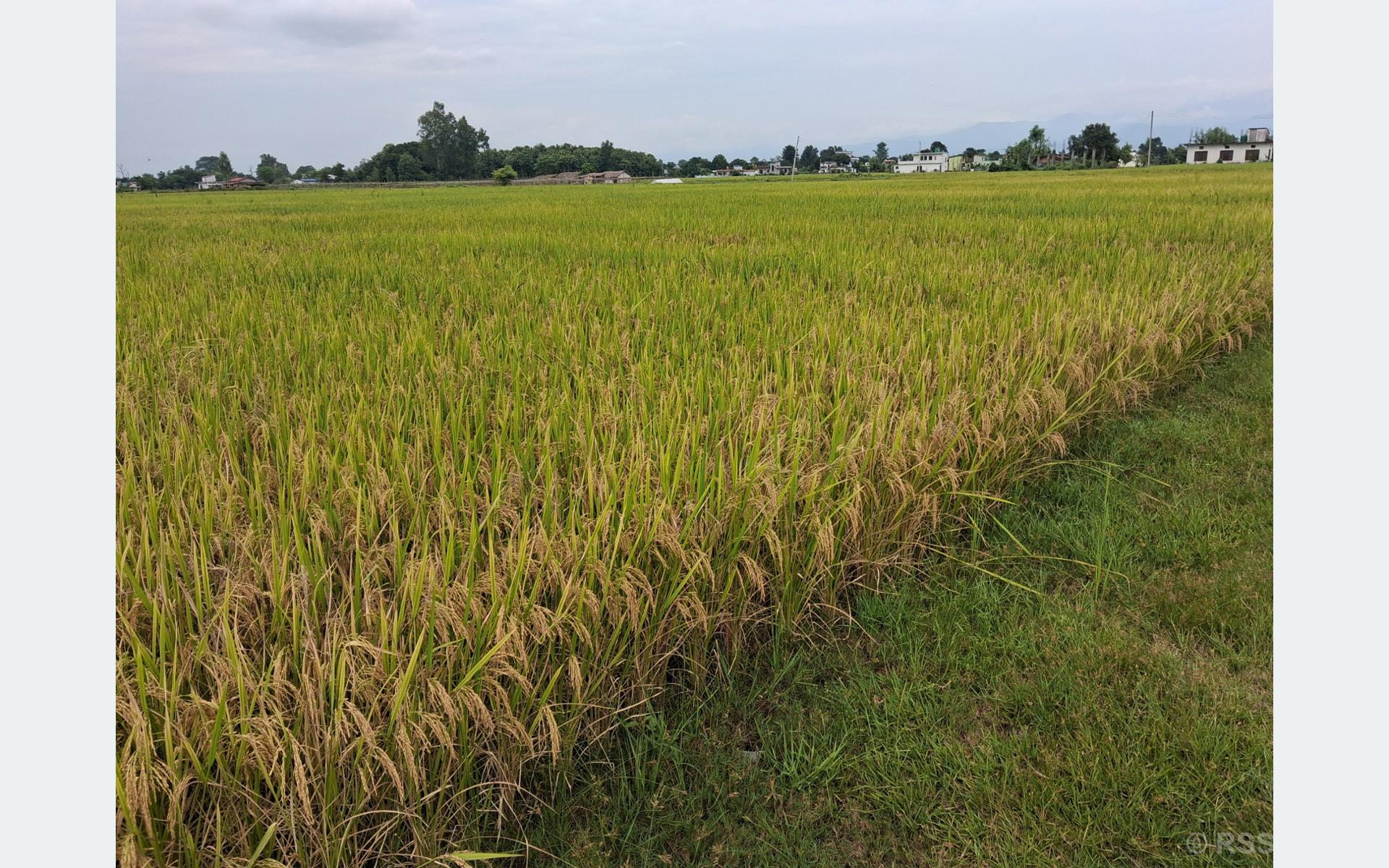
SUDURPASCHIM: Farmers in Sudurpaschm Province are increasingly concerned as ripe and mature paddy remain unharvested in the fields due to adverse weather conditions.
The paddy, planted between the last week of June and July, is now ready for harvest. However, continued rainfall and cloudy skies have prevented timely harvesting.
“The paddy should have been harvested two weeks ago. It’s ripe and hanging in the fields, but due to the risk of rain, we haven’t been able to bring it in,” said Bir Bahadur Rana, a farmer from Dhangadhi. “In some areas, even the paddy that was cut and left to dry has been damaged by rain.”
As the Tihar festival approaches following Dashain, farmers are growing anxious. The unseasonal cloud cover has added uncertainty to an already delayed harvest.
While heavy monsoon rains recently affected central and eastern Nepal, the Sudurpaschim Province remained relatively dry—until last night, when rain fell in parts of Kailali and surrounding districts, raising further alarm among farmers.
Although the monsoon has officially weakened, local weather disturbances are still active. According to the Mahakali Basin Field Office of the Department of Hydrology and Meteorology in Attariya, some areas in the Far West may still experience rainfall in the coming days.
“The paddy we had cut and left to dry was damaged by last night’s rain,” said farmer Laxman Chaudhary. “The sky hasn’t cleared for days, and it’s becoming impossible to harvest the crop.”
This is not the first time that rice harvests have been affected by untimely rains. In recent years, farmers have faced repeated losses due to rainfall during harvest season.
“This year, the crop is healthy overall, although pests are a problem in some areas,” said Man Bahadur Chaudhary, another farmer. “If we cut the rice now, it might get soaked. If we leave it standing, it might rot. We’re stuck in a difficult situation.”
Kailali and Kanchanpur districts in the Tarai region are major paddy producers in the province, supplying rice to seven hill districts. According to the Directorate of Agricultural Development, the Sudurpaschim has 181,396 hectares under rain-fed rice cultivation.
Kailali has the largest rice cultivation area with 72,500 hectares, followed by Kanchanpur with 48,490 hectares. Chaite (spring) rice is also cultivated in both districts.






Comment