




A growing body of democratic theory challenges the assumption that electoral politics alone ensures democratic consolidation. On the surface layer of politics, while periodic elections provide procedural legitimacy, they do not cultivate the deeper institutional and social foundations on which democratic stability depends (Dahl, 1971; Linz & Stepan, 1996).
Let us assume, for example, that electoral processes are frequently celebrated as the hallmark of democracy—held up as the visible proof of a people’s sovereignty. Yet, in practice, such processes often risk degenerating into hollow rituals rather than functioning as genuinely transformative mechanisms.
As a general rule, when conducted under flawed or deeply imbalanced political structures, elections can merely substitute one form of domination for another—effectively preserving entrenched hierarchies and systemic inequalities while cloaking them with the veneer of popular consent.
Nepal exemplifies this contradiction. Despite repeated electoral exercises since the restoration of democracy in 1990, and again after the 2006 People’s Movement, the rule of law remains fragile, liberal politics stifled, and economic governance distorted. The persistence of elite capture and factional patronage networks demonstrates that electoralism without accountability easily becomes a mask for authoritarian tendencies.
It is perfectly true that elections constitute a necessary condition for democracy, yet they remain profoundly insufficient on their own. As Schmitter and Karl (1991) argue, without substantive reforms aimed at addressing structural inequalities, strengthening and professionalizing institutions, and establishing mechanisms of accountability, electoral politics risks devolving into a mere performance.
Reimagining democracy in Nepal requires strengthening institutions that promote transparency, protect minority rights, and encourage participatory governance. It demands a political culture that values integrity over patronage and vision over expediency. Democratic resilience depends less on the pressures of neighbors than on the strength of institutions and the agency of citizens.
In such circumstances, elections provide the appearance of representation but fail to embody its substance, thereby reducing democracy to ritualistic procedures rather than a genuinely participatory and representative system.
The wider literature on democratic theory provides important tools for analyzing this problem. Democracy, as theorized by Tocqueville, Dahl, Habermas, and others, rests on three normative dimensions. The first is freedom, grounded in the principle of collective self-determination that grants citizens agency within the political community.
The second is equality, which obliges the state to treat all citizens with impartiality and fairness. The third is control, realized through vertical and horizontal accountability—checks and balances that limit arbitrary rule and sustain citizen engagement. Without these pillars, elections risk becoming procedural exercises devoid of substance.
Since Aristotle’s Politics in the fourth century BCE—a foundational work analyzing the principles of governance across military, political, economic, and cultural domains—the essential questions of political life have remained remarkably constant. How power is acquired, exercised, and constrained continues to define the difference between liberty and domination. Aristotle’s insistence that politics could serve both constructive and destructive ends foreshadowed modern debates about democracy’s fragility.
Building on this tradition, Stephen Haggard and colleagues (Haggard & Kaufman, 1995; Haggard, 2018) highlight a central paradox in democratizing states: political liberalization and economic reform do not necessarily progress in tandem. Their analysis underscores a critical insight—within contexts of widespread poverty, electorates often gravitate toward leaders who emphasize immediate redistribution rather than long-term structural transformation.
While such redistributive promises may be politically attractive, they risk undermining the very structural reforms essential for sustained economic growth and institutional resilience. As a result, the democratic bargain frequently becomes short-termist, privileging immediate expediency over long-term durability.
Milton Friedman (1962), by contrast, advanced the argument that capitalism and political freedom are intrinsically linked, since both rest on the organizing principle of self-interest. Societies achieve their highest level of efficiency and stability, he argued, when self-interest structures economic and social activity.
Yet Friedman recognized an exception in the democratic act of voting, which transcends narrow individual gain and reflects collective decision-making. For him, democracy represents a precarious balance between institutional design and the constant tension between individual incentives and the common good.
Many leftist scholars reject Friedman’s optimism, contending that democracy cannot be reduced to market logic. For them, redistribution is not inherently problematic; rather, the flaw lies in the assumption that economic policy can be separated from political realities. Democracy must empower marginalized communities to participate meaningfully in shaping the political agenda.
Empowerment requires not just access to the ballot box, but also redistributive policies, fair rules of competition, and a commitment to social justice. Without these, electoral democracy risks reproducing inequality instead of correcting it.
Democratic consolidation is never linear. Liberal democracy’s distinctive strength lies in its capacity to ensure the peaceful transfer of power. Unlike authoritarian systems that emphasize efficiency and decisive action, democracy provides mechanisms for leadership change that legitimize political transitions without destabilizing society. Yet such transitions gain meaning only when they reflect genuine popular consent.
Zakaria (2024) warns that freedom and autonomy often emerge at the expense of authority and tradition, reshaping the fabric of societies. He describes a phenomenon of ‘unlimited democracy,’ wherein individuals come to believe that unrestricted choice is their inherent right.
This illusion risks undermining the very structures that sustain democracy. The liberal state, by contrast, avoids imposing a state-directed ideology of the good life; it entrusts individuals with the freedom to define it for themselves. Such liberty may appear fragile compared to material security or social order, but it remains essential for safeguarding fairness, equality of opportunity, and the rule of law.
Moreover, modern experience demonstrates that centralized decision-making frequently fosters misinformation and inefficiency, whereas participatory, bottom-up engagement often produces more balanced and legitimate outcomes.
Nepal’s democratic journey has never been solely about elections. Its transition from monarchy to federal republic in 2008 was shaped by broader demands for inclusion, equity, and structural change. Movements for federalism, identity recognition, and decentralization were central to democratization.
Yet successive governments have been dominated by unrepresentative elites who prioritize partisan expediency over national interest. Instead of fostering institutions that strengthen civic participation and address inequalities, Nepal’s leaders have frequently manipulated the political system to entrench their own power.
The result has been a widening gap between formal representation and substantive democracy. Decision-making is highly centralized within party hierarchies, where a handful of leaders control candidate selection, legislative agendas, and coalition negotiations. This reduces accountability and deliberation.
Democratic institutions are further undermined by invisible forces—business elites, donor agencies, and the strategic interests of India and China—whose influence often clashes with the priorities of Nepali citizens. Clientelism compounds the problem, as politicians distribute resources as favors rather than as entitlements of citizenship.
Regular elections have therefore failed to build public trust. Citizens observe a democracy where leaders change, but exclusion and inequality persist. The irony is that Nepal fulfills the outward form of democracy while struggling to realize its deeper substance.
Territorial sovereignty adds another layer of fragility. Regions such as Limpiyadhura, Lipulek, and Kalapani are integral to Nepal’s territory, not terra nullius. In particular, unilateral cartographic assertions and competing territorial claims by neighboring states—particularly India—represent both a diplomatic affront and a challenge to Nepal’s national dignity. Since the 1816 Sugauli Treaty, Nepal’s territorial integrity has symbolized sacrifice and struggle, embedding nationalism as a lived political consciousness.
Yet Nepal’s geography ensures vulnerability. Sandwiched between democratic India and communist China, Nepal faces constant external pressure. The principle of peaceful coexistence, attractive in theory, proves elusive when neighbors pursue policies that undermine mutual respect. The absence of genuine cooperation leaves Nepal balancing delicately between two giants, trying to assert sovereignty while avoiding entanglement in their strategic rivalries.
Having never been colonized, Nepal’s evolution has been shaped by internal struggles and external interference. Domestic politics often amplify these pressures. Leaders across the spectrum—Khadga Prasad Oli, Pushpa Kamal Dahal, and Sher Bahadur Deuba among them—have demonstrated a tendency to prioritize personal gain or foreign approval over national interest. Their rhetoric frequently masks a lack of substantive policy.
Oli in particular exemplifies a misologist style of politics: instinctively resistant to reasoned debate, dismissive of critical inquiry, and unwilling to embrace the intellectual discipline that authentic governance demands. His leadership betrays an unease with dissent and a preference for slogans and populist rhetoric in place of substantive dialogue.
In a political environment where evidence-based policymaking is essential, such tendencies diminish Nepal’s capacity to negotiate effectively with powerful neighbors and to confront its own internal complexities. Nepal’s democratic trajectory has been neither revolutionary nor abrupt; rather, it has unfolded as a gradual process of negotiation among competing political, economic, and social forces.
Nepal’s ban on social media—a lifeline for civic expression—exposes the true character of the Khadga-Arzu criminal regime. Having utterly failed to represent the people, their only path to clinging to power is to silence truth and dissent. This cowardly assault on free expression is not merely undemocratic; it is a desperate act of repression that words alone cannot sufficiently condemn.
Moreover, the democratic experiment is tested less by singular upheavals than by the enduring tension between freedom, persistent poverty, and the demand for inclusion. Its survival depends on the ability of institutions to transform self-interest into constructive participation while upholding equity and justice. Without this balance, democracy risks either being captured by elites or collapsing under the weight of popular disillusionment.
Adversity, however, can also be a catalyst. As Temelkuran (2019), echoing Beckett, observes: “Ever tried. Ever failed. No matter. Try again. Fail again. Fail better.” For Nepal, the way forward lies not in ceremonial gestures or diplomatic notes but in robust civic engagement and collective action. A democratic culture must be cultivated in which citizens act as participants rather than passive spectators.
Reimagining democracy in Nepal requires strengthening institutions that promote transparency, protect minority rights, and encourage participatory governance. It demands a political culture that values integrity over patronage and vision over expediency. Democratic resilience depends less on the pressures of neighbors than on the strength of institutions and the agency of citizens.
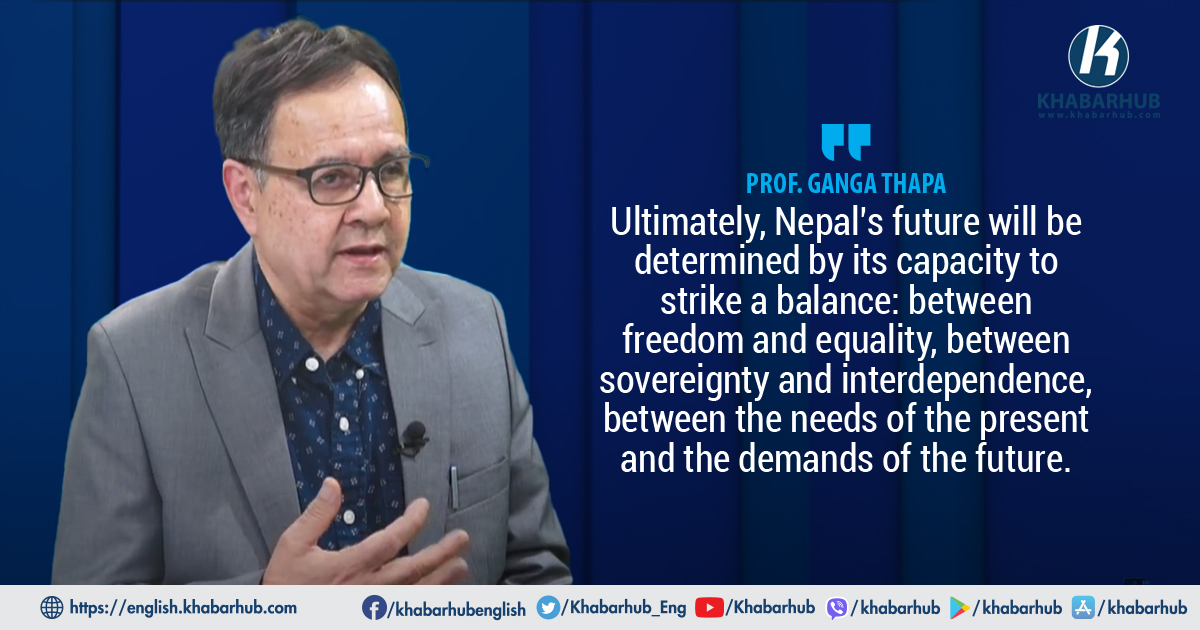
Ultimately, Nepal’s future will be determined by its capacity to strike a balance: between freedom and equality, between sovereignty and interdependence, between the needs of the present and the demands of the future. Strategic vision, combined with moral courage, is essential for charting a just, inclusive, and sovereign democratic order.
Nepal’s ban on social media—a lifeline for civic expression—exposes the true character of the Khadga-Arzu regime. Having utterly failed to represent the people, their only path to clinging to power is to silence truth and dissent. This cowardly assault on free expression is not merely undemocratic; it is a desperate act of repression that words alone cannot sufficiently condemn.
(Views expressed in this opinion are the writer’s and do not necessarily reflect the editorial stance of Khabarhub — Editor)




Comment