





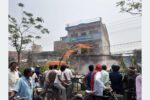
KATHMANDU: A tense standoff erupted in Kathmandu on Sunday when the Metropolitan City attempted to demolish a traffic police post at Thapathali Ram Mandir, prompting police officials to call for better coordination between city authorities and law enforcement.
Police officials said unilateral actions during critical periods only exacerbate difficulties and undermine public safety.
The demolition was part of an ongoing campaign by the Kathmandu Metropolitan City, in collaboration with the Kathmandu Valley Development Authority, to remove illegal structures and encroachments on public land. The city claims that the traffic police building was constructed in violation of municipal regulations and falls within the jurisdiction of municipal land.
However, Deputy Superintendent of Police (DSP) Suniljung Shah highlighted that the building is under police administration, having been allocated by the Guthi in 1975 BS. “The country is going through a difficult situation. Both parties should cooperate, but unilateral actions only create more hardships,” Shah said, stressing the need for consultation before executing such operations.
The Thapathali traffic police post has historical and operational significance, serving as a key hub for the police in Kathmandu. The current clash comes in the wake of the Gen-Z movement in September, during which police offices were attacked, officers were assaulted, uniforms and weapons looted, and the traffic police were forced into precarious situations that endangered their lives. Observers say that this history of unrest has made police particularly sensitive to sudden actions in critical locations.
SSP Pawan Bhattarai, spokesperson for Kathmandu District Police, echoed the concerns, stating that the city’s unilateral decision to bring in a bulldozer without coordination could have escalated tensions. “The country is in a sensitive period. One side acting alone creates unnecessary difficulties for both parties,” he said.
The standoff also highlights a political undercurrent between Kathmandu Mayor Balen Shah and Home Minister Om Prakash Aryal. Sources indicate that differences between the two officials have influenced the timing and execution of city campaigns, including the current demolition initiative. While the Metropolitan City insists the operation is part of routine enforcement of land-use regulations, police view the action as potentially disruptive during a delicate security period.
Dhruvkumar Kafle, assistant spokesperson for Kathmandu Metropolitan City, stated that prior notice had been issued to the police and that the demolition was part of a broader campaign targeting illegal encroachments on public land. “Every structure must be approved on the map. If there is encroachment in a public or communal area, the city has the right to clear it following the law,” Kafle said, noting that the city was acting within its legal mandate.
Despite these assurances, the District Administration Office intervened, issuing a temporary directive to halt the demolition. Chief District Officer Ishwar Raj Paudel noted that the police headquarters and associated barracks were already damaged during the Gen-Z movement, leaving about 100 officers with limited relocation options. “In such circumstances, demolishing a functional police post would create more hardship rather than solving any problem,” Paudel said.
The administration also indicated that long-term management plans for the traffic police office would be developed in coordination with the Home Ministry and Police Headquarters, ensuring that the heritage status of the property is preserved. This approach reflects lessons learned from past unrest, highlighting the need for collaborative planning when handling sensitive sites and operational facilities.
Security analysts suggest that the standoff is a reminder that in periods of political and social tension, unilateral actions by either municipal authorities or law enforcement can worsen situations that require careful negotiation. Coordination, they say, is essential to prevent unnecessary conflicts, protect public resources, and maintain the effective functioning of key services.
The traffic police post itself has endured significant challenges in recent months. During the Gen-Z movement on September 8 and 9, protesters targeted police offices in retaliation for the use of force against students, setting fires, vandalizing offices, and looting equipment and uniforms. Officers were forced to flee or surrender under threat, exposing the vulnerabilities of the city’s security infrastructure. The post at Thapathali remains an essential operational hub, making the timing of the demolition particularly sensitive.
Both DSP Shah and SSP Bhattarai stressed that collaboration and planning are crucial in such periods. “The country is facing complex challenges,” DSP Shah said. “Metropolitan City officials and police forces must coordinate. When actions are taken unilaterally, hardships increase for everyone,including officers, municipal staff, and the public.”
The standoff has already prompted discussions about establishing formal mechanisms for joint decision-making between municipal authorities and law enforcement, particularly in matters involving public property and critical infrastructure. Observers argue that better communication and planning could prevent future confrontations and ensure the smooth execution of municipal projects without compromising security.
For now, the demolition work has been temporarily suspended, pending discussions between Kathmandu Metropolitan City, the Police Headquarters, and the District Administration Office. Both sides have expressed willingness to collaborate to protect public safety, uphold the law, and preserve essential operational infrastructure while continuing the city’s campaign against illegal structures.




Comment