




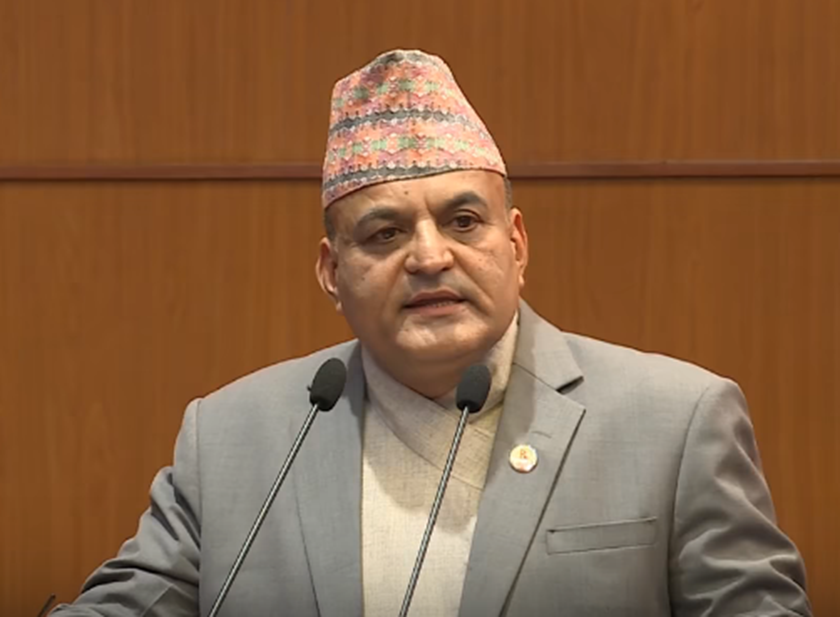
KATHMANDU: Gandaki Province Chief Minister Surendra Pandey has clarified that the newly introduced ride-sharing regulations have not been suspended, but the implementation has been temporarily halted for a month to facilitate further dialogue with transport entrepreneurs.
Speaking at a meeting of the Provincial Public Accounts Committee on Wednesday, CM Pandey said that the regulation remains intact and will be enforced if consensus is not reached during the dialogue period.
According to Pandey, the ride-sharing sector had become unregulated and disorganized, prompting the provincial government to intervene. Apps like Pathao and inDrive are registered with the Office of the Company Registrar, but the operations of vehicles under these platforms lack clear oversight.
The government, he said, introduced the regulation not to hinder ride-sharing but to make it more structured, safe, and accountable.
He said the regulations aim to introduce security features in ride-sharing apps, including real-time ride tracking that can be shared with third parties, such as a family member, to enhance passenger safety—particularly for women.
The regulation also mandates insurance for passengers, even for two-wheelers, and introduces a small registration and annual fee for both vehicles and app-based companies operating in the province.
Under the revenue-sharing model proposed in the regulation, 10 percent of the fare goes to the ride-sharing platform, two percent to a social security fund, and one percent to the provincial government.
Pandey said the province expects to generate Rs 300 million to 400 million annually through this system, noting that ride-sharing is already operating widely without regulation.
He stated that the province had been in talks with transport entrepreneurs for over a year, but despite continuous engagement, a faction of transport operators took to protests, demanding that red-plated (privately owned) vehicles not be allowed to carry passengers.
Pandey countered that the global model of ride-sharing originated from private vehicles offering rides to others going in the same direction, and over time, these informal lifts evolved into paid services, eventually giving rise to platforms like Pathao and inDrive.
In response to concerns from entrepreneurs about identifying ride-sharing vehicles, the province decided that such vehicles must display an “RS” marking. Still, transport operators remained adamant that only black-plated vehicles should be allowed to transport passengers. Pandey noted that their representatives did not participate in final consultations or sign the report on the regulation.
After the regulation was issued, transport entrepreneurs staged a four-day protest, which escalated into a nationwide strike, creating public hardship. This led the federal government to intervene.
Pandey revealed that the Office of the Prime Minister and Council of Ministers sent a letter urging the province to halt implementation to help restore normalcy and enable further talks. However, he stressed that the letter did not interfere with provincial jurisdiction and should be viewed as a cooperative gesture under the constitution’s principles of coordination and coexistence.
Pandey explained that the halt only affects the administrative process—such as registration of ride-sharing companies and vehicles—during the one-month dialogue window. If someone comes to register a ride-sharing vehicle during this period, the application will not be processed until discussions conclude.
He said the province is open to addressing legitimate concerns of transport entrepreneurs but cannot support monopolistic practices or discrimination against private vehicle owners seeking employment through ride-sharing.
He also stated that black-plated taxis currently in operation are eligible to join ride-sharing platforms and will benefit from a 25 percent discount on registration fees compared to other vehicles.
Pandey acknowledged that political factors had delayed the introduction of the regulation, and misinformation, even within the federal leadership, had created confusion—such as the misunderstanding that ride-sharing vehicles would be permitted to operate long-distance routes from Pokhara to far-flung cities like Biratnagar or Dhangadhi.
He clarified that ride-sharing for two-wheelers is restricted to a 20-kilometer radius, and similar limits will apply to four-wheelers as well.
Pandey said that the regulation has not been withdrawn but merely put on hold temporarily for the sake of meaningful dialogue. If consensus cannot be achieved, the province stands ready to move forward with implementation, he said, stating the government’s commitment to fair regulation, public safety, and sustainable innovation in transport.





Comment