





KATHMANDU: Economic Digest offers a concise yet comprehensive overview of significant business happenings in Nepal, presented in easily digestible summaries.
The government and key institutions in Nepal are taking a mix of regulatory, economic, and infrastructural measures to stimulate growth, improve governance, and enhance public services. The Cabinet is set to approve PPAs for hydropower projects up to 10 MW, though industry leaders call for broader policies to support Nepal’s electricity export ambitions.
Meanwhile, the IRD maintains routine full audits for large taxpayers despite concerns about stricter documentation requirements, while the widening gap in tax refund approvals highlights procedural challenges. Economic indicators show gold and silver prices fluctuating, petroleum imports rising slightly, and tea exports to India dropping sharply, signaling mixed trade performance.
Infrastructure and development initiatives are progressing, with Karnali Province implementing spending controls and project transparency measures, the Galchi–Rasuwagadhi road construction eased, and the Morang substation nearing completion to address voltage issues. Social and market developments include declining tourism at Begnas Lake, a rise in foreign tourists in Mustang, agricultural activities such as FMTC paddy procurement, organic sunflower and commercial coconut farming, and continued industrial demands for critical raw materials.
Legal and regulatory updates include the Prabhu Management fraud case, EC deliberations on registering non-compliant political parties, and India lifting restrictions on high-denomination currency notes, while public amenities like Ratna Park will soon provide free WiFi, reflecting ongoing efforts to enhance civic infrastructure and governance.
Govt prepares to allow PPAs for hydropower projects up to 10 MW
The government is set to approve Power Purchase Agreements (PPAs) for hydropower projects of up to 10 megawatts after years of stagnation. The Nepal Electricity Authority (NEA) board has forwarded the proposal for Cabinet approval. IPPAN President Ganesh Karki welcomed the step but urged a broader PPA policy for projects above 10 megawatts, warning that limited PPAs could hinder Nepal’s goal of exporting 10,000 megawatts of electricity to India.
IRD clarifies that full tax audits remain routine
The Inland Revenue Department (IRD) has stated that full tax audits for large taxpayers continue to be a normal practice. The clarification follows concerns arising from Finance Minister Rameshore Khanal’s comment that full audits would only be carried out based on risk. The IRD said comprehensive audits are regularly conducted for banks, financial institutions, multinational companies, and cases approaching the four-year statute of limitations or those requiring additional documentation under Section 83 of the Income Tax Act, 2002.
Gold price drops Rs 800, silver also declines
The local price of gold fell by Rs 800 per tola (11.66 grams) on Thursday to Rs 253,300, down from Rs 254,100 on Wednesday. Silver also declined slightly, dropping Rs 30 per tola to Rs 3,625. The Federation of Nepal Gold and Silver Dealers’ Association noted that both metals experienced price fluctuations, with gold returning to the rate seen two days prior.
Tax refund approval gap widens as only 21 percent of claims pass
The difference between tax refund claims and the amount approved by the government is expanding. In the last fiscal year, taxpayers claimed Rs 23.4 billion in refunds, but only Rs 4.84 billion—about 21 percent—was approved. In previous years, approval rates reached as high as 80 percent. Businesses argue that despite legal improvements, the process has become more difficult, with the IRD demanding excessive documentation, particularly for VAT credits in the construction sector.
EC considers registration of six parties that have not paid fines
The Election Commission (EC) is assessing whether to register six political parties for the March 5, 2026 elections, as they have not paid penalties for failing to submit their income and expenditure reports for fiscal year 2023/24. Parties such as the Akhanda Sudurpaschim Party Nepal and the Rastrabadi Yuwa Morcha have already applied for registration despite outstanding fines. Although the reporting deadline is mid-February 2026, the EC must decide whether to accept these parties’ applications before advancing election preparations.
India removes ban on high-value currency notes in Nepal
The Reserve Bank of India (RBI) has lifted its restriction on the use of Indian banknotes above Rs 100 in Nepal and Bhutan. According to a notice in India’s Central Gazette, travelers may now carry high-denomination notes totaling up to Rs 25,000. This reverses the 2016 demonetization rule that prohibited the circulation of larger notes in Nepal. The move is expected to ease payments for tourists and help Nepalis returning from India exchange their currency, supporting smoother border trade.
Karnali bans meeting allowances during office hours
The Karnali Province government has stopped the payment of meeting allowances during official working hours (10 AM to 5 PM) to curb expenses and promote financial discipline. Under the new “Karnali Province Expenditure Standards, 2082,” meals and snacks are capped at Rs 300 per participant. The rules also set spending limits on vehicle purchases—up to Rs 15 million for the Chief Minister and Speaker—and restrict fuel and communication expenses for provincial officials.
Petroleum imports increase 2.01 percent through Kakarvitta
Petroleum imports through the Kakarvitta border rose by 2.01 percent in the first four months of fiscal year 2025/26. Imports of petrol, diesel, and LPG reached Rs 6.27 billion—an increase of Rs 119.2 million from the same period last year. As a result, revenue from petroleum products climbed 2.90 percent, reaching Rs 2.968 billion.
Karnali requires Project Bank listing for projects above Rs 5 million
Karnali Province has directed district offices and provincial assembly members to submit proposals for the 2026/27 fiscal year by December 7. Chief Minister Yam Lal Kandel said all projects costing more than Rs 5 million must be included in the Project Bank to prevent random recommendations and ensure transparency. This initiative aligns with the new “Karnali Province Project Proposal and Selection Procedure 2025,” aimed at improving efficient and accountable spending.
Cabinet eases land rules for Galchi–Rasuwagadhi road construction
The Cabinet has approved measures to expedite work on the Galchi–Trishuli–Mailung–Syaphrubesi–Rasuwagadhi road, which is being upgraded with Chinese grant assistance. The government will allow temporary use of Langtang National Park land for construction facilities and exempt customs duties on building materials including stones, gravel, and sand. These steps are expected to accelerate the reopening of the Rasuwagadhi border point at full capacity.
Tea exports to India fall 37 percent via Kakarvitta
Tea exports to India through the Kakarvitta border dropped by 37 percent in the first four months of the current fiscal year. Exports declined from Rs 2.204 billion last year to Rs 1.373 billion this year—a fall of Rs 831 million. Officials attribute the drop to labor movements, rising domestic consumption, and changes in India’s import rules. They stress the need to diversify exports to countries such as China, Pakistan, Russia, and European markets.
Morang substation project near completion to resolve voltage issues
The 132/33 kV Keraun Substation in Kanepokhari-2, Morang, has reached 91 percent completion. The Rs 850 million project, funded by the Asian Development Bank, is expected to permanently resolve long-standing low-voltage problems affecting around 61,000 customers in southeastern Morang. Although the deadline is January 1, 2026, officials anticipate 95 percent technical completion by then, with full completion expected a month later.
Traders warn of informal blockade due to China border delays
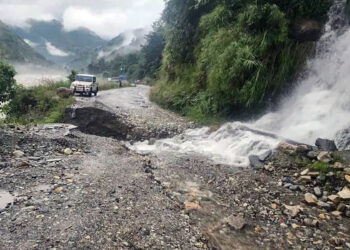
Business groups report growing fear of an “unofficial blockade” as delays and uncertainty persist at Chinese border points. The flood-damaged Rasuwagadhi crossing is waiting for a Bailey bridge installation, and the Tatopani border is working far below capacity. Over 300 containers of perishable fruits are stuck on the road, with traders urging the government to accelerate customs clearance. Imports from China reached Rs 132.56 billion in the first four months of the fiscal year.
Govt terminates contract for Sunkoshi–Marin diversion dam
The government has canceled the construction contract for the Sunkoshi–Marin Diversion Multipurpose Project’s dam and powerhouse with Patel-Raman JV. The company completed only 11 percent of the work despite using 61 percent of the allotted time, prompting the Department of Water Resources to end the Rs 14.75 billion contract.
The government is moving to seize the contractor’s Rs 2.40 billion bank guarantee. While the tunnel component has been finished, work at the dam site has stopped, leaving about 500 workers without jobs.
Cardamom prices decline to Rs 92,000 per man
The price of cardamom has continued to fall, dropping to Rs 92,000 per man (40 kg) on Thursday at the Phungling market—down Rs 1,000 from the previous day. Prices peaked at Rs 102,000 per man on November 9 but have since declined due to fluctuating international demand.
In the first quarter of fiscal year 2025/26, Nepal exported 1,072 metric tons of cardamom worth Rs 1.679 billion to India via the Kakarvitta border.
Industries call for immediate import of chickpeas and black pepper
Industrialists have urged the government to allow the immediate import of chickpeas and black pepper, citing severe shortages of these essential raw materials. Imports were restricted after the COVID-19 pandemic to conserve foreign currency, although annual quotas are typically granted for industry use. Producers of noodles, spices, and gutkha rely heavily on these ingredients, and shortages have reportedly increased smuggling. The Department of Commerce must recommend required import volumes to the Ministry of Industry for approval.
FMTC Dang buys Rs 1.44 crore in paddy
The Food Management and Trading Company (FMTC) purchased 4,183 quintals and 20 kg of paddy from 212 farmers across three local levels in Dang, totaling Rs 14.4 million. The procurement, conducted between October 24 and the first week of November, fell short of the 5,000-quintal target. Officials explained that the shortfall of 816 quintals occurred because the government required coarse rice, while most farmers in the area grew finer varieties.
Organic farmer grows sunflower on 2.5 bigha in Chitwan
Chandra Prasad Adhikari, an organic farmer in Bharatpur Metropolitan City–15, Shreepur, has cultivated sunflowers on 16,931.44 square meters using 100 percent organic methods. He expects a harvest of around 30 quintals this year. During a previous cultivation two years ago, sunflower oil sold for Rs 800 per liter and seeds for Rs 500 per kg. Adhikari employed ten laborers daily for five days to plant the crop. He also grows organic carrots and has established a “buffer zone” using rajma beans to protect the sunflowers from external contamination.
Citizens Bank wins ‘Bank of the Year’ award again
Citizens Bank International has received the prestigious “Bank of the Year” award for the second consecutive year, following its 2024 win. CEO Ganesh Raj Neupane accepted the honor at a ceremony in London on December 4. The award recognizes technical upgrades, new product launches, financial inclusion efforts, and sustainability contributions. Citizens Bank was the only Nepali bank among 132 countries to win, reflecting confidence from customers, shareholders, and employees.
Commercial coconut farming begins in Jhapa
Rabi Nepal of Mechinagar Municipality-4 in Jhapa has initiated commercial coconut farming by planting 300 saplings on one bigha of land as a trial, becoming the first farmer in Koshi Province to do so.
He turned to coconut cultivation as an alternative to rice due to wild elephant disturbances. Coconut trees take about nine years to bear fruit, but one existing tree already generates more than Rs 17,000 annually. Raw coconuts sell for Rs 90 to Rs 100 at the farm, making the crop highly profitable.
Mustang sees 10.61 percent rise in foreign tourist arrivals
Mustang recorded a 10.61 percent increase in foreign visitors during January–November 2025 compared to the same period in 2024, welcoming a total of 150,130 tourists—14,411 more than last year.
The Annapurna Conservation Area Project (ACAP) noted that numbers were affected in August and September by Gen Z protests and adverse weather. Of the total, 123,253 were from SAARC countries, while 26,877 came from other nations.
Tourist arrivals decline at Begnas Lake amid road construction
Tourism at Begnas Lake in Pokhara has steadily declined over the past decade, particularly since the 2015 earthquake. Local boat operators report that nearly 30 percent have switched professions due to reduced income. Road reconstruction on the Mugling–Pokhara and Talchok–Begnas routes has further hindered tourism. The 373-hectare lake hosts 280 boats, but operators often wait a week for a trip, highlighting the business slump.
Prabhu Management founder and four others charged with fraud
The Kathmandu District Government Attorney’s Office has filed a case against Devi Prakash Bhattachan, founder chairman of Prabhu Management Private Limited, along with four individuals and two companies, for fraud, criminal breach of trust, and illegal remittance.
The case concerns Rs 65.2 million owed to 38 cooperatives. Fraud carries a maximum seven-year jail term. Separately, Rajendra Shakya, chairman of the Guna Group, was arrested in connection with a banking offense linked to the Prabhu Group.
Ratna Park to offer free WiFi for visitors
Renovated Ratna Park (Shankhadhar Udyan) in Kathmandu will provide free WiFi access to the public. Kathmandu Metropolitan City (KMC) is installing six Nepal Telecom routers to deliver 500 Mbps service throughout the park by mid-December. Entry fees range from Rs 20 for students to Rs 100 for foreign tourists. Currently, the park generates between Rs 5 million and Rs 10 million annually for KMC.





Comment