




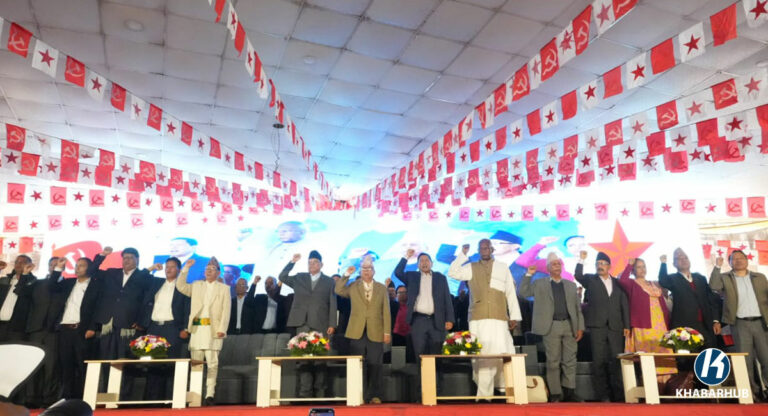
KATHMANDU: Ten leftist political parties, including the CPN (Maoist Center) and CPN (Unified Socialist), have announced their unification to form a new political force named the Nepal Communist Party.
The unification was announced during a special ceremony held at Bhrikutimandap, Kathmandu, on Wednesday. The alliance includes the Maoist Center, Unified Socialist, Nepal Socialist Party, Janasamajbadi Party Nepal, Nepal Communist Party, CPN (Maoist Socialist), and CPN (Samyabadi), among others.
Top leaders attending the unification ceremony included Maoist Center Chairman Pushpa Kamal Dahal ‘Prachanda’, Unified Socialist Chairman Madhav Kumar Nepal, senior Maoist leader Narayan Kaji Shrestha, senior Unified Socialist leader Bamdev Gautam, Nepal Socialist Party Chairman Mahendra Raya Yadav, and Nepal Communist Party General Secretary Chiran Pun.
The newly formed party has adopted Marxism–Leninism as its guiding ideology and scientific socialism with Nepali characteristics as its working program. The election symbol of the unified party has been revealed as a five-pointed star.
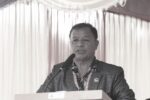
Promesh Hamal, senior leader of the Unified Socialist and member of the Unification Coordination Committee, said the unification was driven by the need to build a broader communist movement focused on good governance, social justice, and economic transformation.
According to him, the party’s immediate policy agenda includes safeguarding the achievements of the capitalist democratic revolution, protecting national sovereignty, and building the foundation for socialism through social and economic transformation.
The unified party has agreed to hold a National Unity General Convention within six months. The new central committee will be formed by integrating members from the previous central committees of the participating parties, based on mutual consensus.
Each level of the party, from central to provincial, district, municipal, and ward committees, will have both a coordinator and a co-coordinator.
The parties have also agreed that the functioning of all committees will follow a collective leadership model based on the principle of democratic centralism.

Comment