




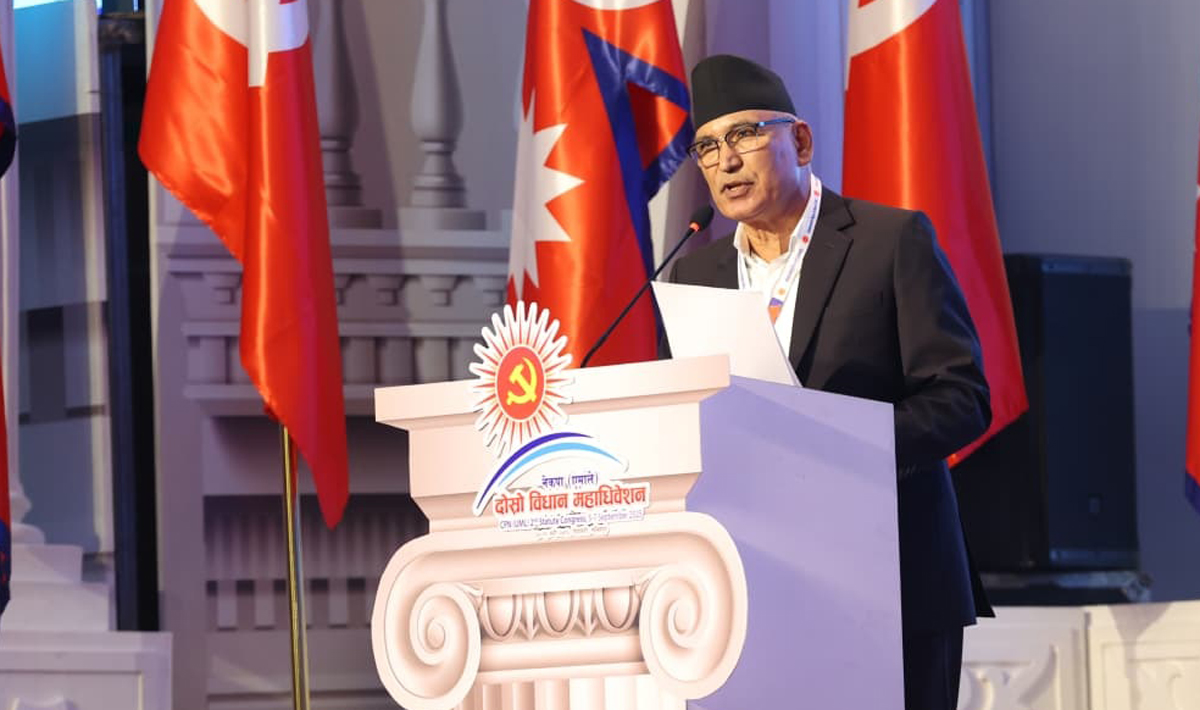
LALITPUR: The CPN-UML has proposed a major amendment to its party statute during its second statute convention, aiming to restructure the leadership hierarchy, reduce the size of central bodies, and expand the authority of the party chairperson.
The amendment proposal, presented by Vice Chairperson Bishnu Prasad Paudel, recommends downsizing the central committee from the existing 301 members to 251, including 15 office bearers. This proposal has already been endorsed by the UML Central Committee.
One of the key changes in the proposed statute is the removal of the senior vice-chairperson position. The number of vice-chairpersons has also been reduced from six to three.
According to the new structure, the party will have one chairperson, three vice-chairpersons, one general secretary, three deputy general secretaries, and seven secretaries. It has been made mandatory that at least one of the office bearers must be a woman.
The proposal also suggests significant changes in the composition of the party’s key decision-making bodies. The 45-member Standing Committee will be replaced by a 15-member committee comprising only the party’s office bearers.
Similarly, the current 99-member Politburo will be reduced to a maximum of one-third of its existing size, and its members will be elected through an internal electoral process.
With these changes, UML’s central bodies will expand from seven to eight, including the National General Convention, Policy Convention, National General Convention Representative Council, Central Committee, Central Disciplinary Commission, Central Accounts Commission, Central Election Commission, and Central Advisory Council. Both the Politburo and the Standing Committee will be placed under the Central Committee.
The proposed amendment also renames the “statute convention” mentioned in Article 15 as the “policy convention,” indicating a shift in its focus and function.
The powers of the party chairperson have been significantly increased under the new amendments. Articles 21(1)(c) and (d) have been revised to grant the chairperson the authority to lead the central branches, present political reports to central bodies, propose meeting agendas, preside over meetings, validate decisions, and issue inter-party directives. Moreover, the chairperson will be empowered to instruct the general secretary to convene meetings of the Central Committee, Politburo, and Standing Committee.
In a notable change, the proposal removes the existing structure of the party secretariat and the central office, which were previously influential bodies. Their functions will now be handled by the general secretary under the direct instruction of the party chairperson.
The proposed statute mandates organizing a General Convention Representative Council once between two general conventions. It also assigns the rank of the heads of the three central commissions—disciplinary, accounts, and election—as equal to that of Politburo members, while the commission members will be ranked equivalent to central committee members.
In terms of local structures, the amendment proposes that municipal committees will have 75 members, sub-metropolitan city committees will have 85 members, and metropolitan city committees will consist of 101 members. Ward committees will comprise between 31 and 51 members, while tole committees will have 21 members.
Through this sweeping amendment, the UML leadership aims to centralize authority within the party while introducing structural streamlining. If passed, the statute will significantly reshape the internal power dynamics and operational framework of Nepal’s main opposition party.




Comment