




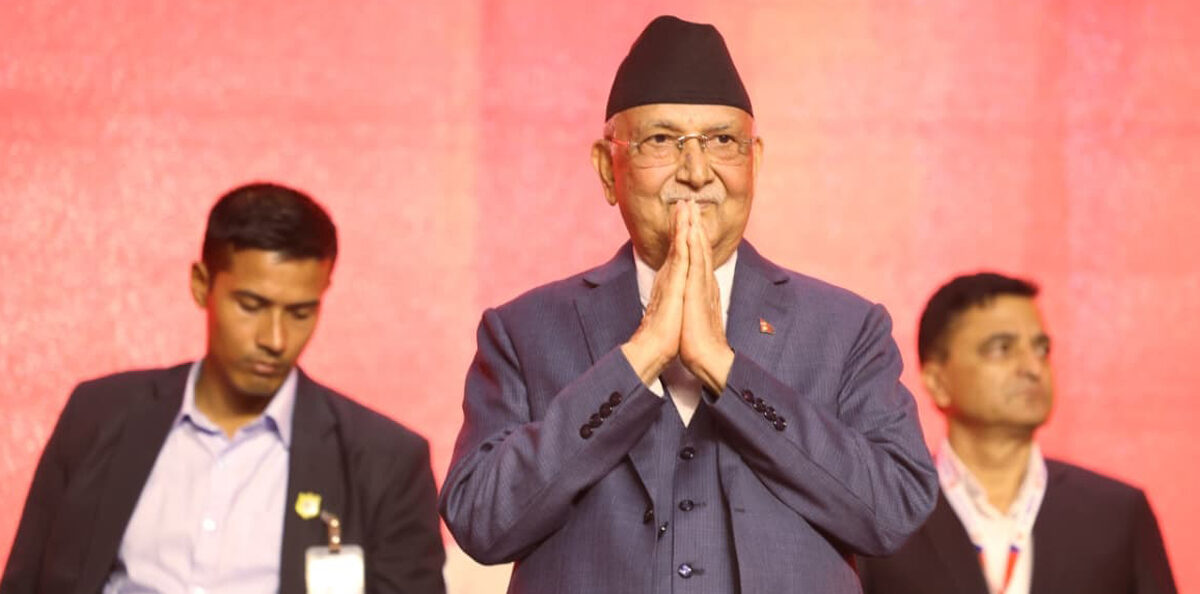
KATHMANDU: CPN-UML chair and Prime Minister KP Sharma Oli has asserted that no political party other than his own can fulfill the “historic responsibility” of building the foundations of socialism in Nepal.
Presenting his political document at the party’s second statute convention in Godavari, Lalitpur, on Friday, Oli argued that the Nepali Congress, the Maoist Centre, Madhes-based parties, royalist groups, and emerging populist forces had all proven incapable of providing long-term leadership to the nation.
“By ideology, People’s Multiparty Democracy, and by strength, UML is the sole charioteer of the socialist campaign. There is no confusion in this,” Oli declared.
He accused the Nepali Congress of repeatedly failing to safeguard the achievements of past democratic struggles, despite having held power with strong mandates. He said the Congress’s embrace of neoliberal economic policies had left the party unfit to lead the country toward prosperity.
Oli was even sharper in his criticism of the Maoist Centre, calling it ideologically and organizationally “in decline” since the peace process. “Almost all experiments the Maoists pursued — from state restructuring along ethnic lines to power grabs and military integration — ended in failure. The party today is suffering from opportunism, instability, and factionalism,” he said.
Madhes-centric parties and royalists, he argued, are equally unqualified to lead. He dismissed calls to restore the monarchy and attempts to use religion as a political weapon, branding them outdated and unacceptable.
Turning to newer forces such as the Rastriya Swatantra Party, Oli described them as “short-lived populists” who have already been exposed within two years. “They created ripples like waves in a pond, but lacked ideology, history, or a social base. Populism was never an alternative, nor can it be,” he said.
Oli emphasized that UML had already begun “re-engineering” itself to act as a decisive national force, capable of delivering on people’s aspirations for change. He stressed the importance of discipline, grassroots organization, and direct engagement with citizens, drawing parallels to the UML’s past experiences in building a strong movement under the Panchayat system.
“If revolutionary change does not translate into delivery and improved lives for the people, the achievements cannot be sustained. Dissatisfaction and frustration will open the door for regressive or extremist forces,” he said.




Comment