




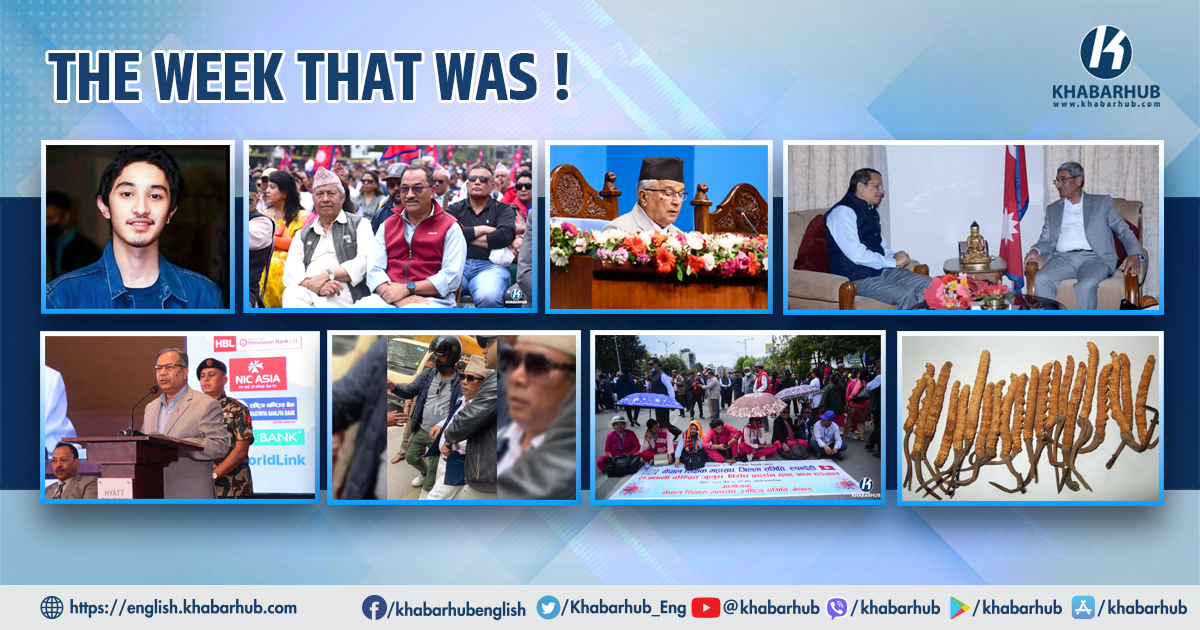
KATHMANDU: The past week in Nepal encapsulated the paradoxes that define its political journey—grand visions laid out in official speeches, entrenched tensions between the state and marginalized groups, a delicate diplomatic dance with powerful neighbors, and deep-rooted public skepticism about governance.
President Ram Chandra Paudel’s unveiling of the government’s annual policies and programs set the tone with ambitious reforms, but parallel developments—teacher protests, royalist rallies, judicial chaos, and climatic anxieties—raised questions about whether Nepal’s state machinery can deliver on its promises.
Vision 2081/82: A familiar recipe with a digital garnish
President Paudel’s address to Parliament heralded a broad and progressive blueprint for the upcoming fiscal year 2025/26. The focus on infrastructure rationalization, tax reform, and digital transformation indicated an attempt to modernize the Nepali state and economy.
Pledges such as scrapping unviable infrastructure projects, establishing a digital bank, and introducing a “faceless” public service mechanism are symbolic of a state trying to shed its image of lethargy and rent-seeking.
However, the recycling of unfulfilled promises—hydropower expansion, energy security, and the digital economy—raises concerns about implementation credibility. Many of these goals mirror those from previous budgets that failed to materialize due to political instability, bureaucratic inertia, or corruption.
The inclusion of green hydrogen, electric appliances, and bioethanol blending shows that the government is attempting to frame its development goals within global climate discourse. Yet without detailed roadmaps, these risk remaining buzzwords.
The emphasis on tax reforms is significant in a country where tax compliance is low and administrative harassment is high. However, given the entrenched interests that benefit from loopholes and discretion, reforming tax policy will require more than just speeches—it will demand political will to confront resistance from within.
Lofty tributes, uneven realities
President Paudel’s Labour Day message added a moral undertone to the week’s technocratic vision. His call to honor domestic production, ensure fair wages, and implement constitutional rights for laborers was timely and symbolically powerful.
Yet, this rhetoric sharply contrasts with the daily experience of workers, many of whom face informal employment, wage theft, and unsafe conditions.
The broader economic context further complicates the picture. Though the National Statistics Office projected a respectable 4.61% economic growth for 2081/82, underlying this are shrinking remittance inflows, youth unemployment, and a growing mismatch between education and labor market needs.
While government announcements show sensitivity to social protection and self-employment, actual delivery remains sporadic and largely donor-driven.
Teachers protest: A tactical truce or a lasting peace?
The Nepal Teachers’ Federation’s decision to suspend protests after receiving government assurances to pass the new School Education Act by 15 Ashadh is a welcome reprieve from escalating tensions.
The demonstrations had exposed deep dissatisfaction among teachers with the government’s delay and ambiguity regarding their rights and status.
However, this truce is precarious. The teachers’ demands are rooted in longstanding grievances over federal restructuring, employment security, and the politicization of education. The failure of previous agreements to translate into action has left many skeptical.
The Federation’s move signals pragmatism, but the pressure now lies on Parliament to show legislative urgency. Any further delay may reignite the agitation with more intensity.
Janamat-NUP merger falters amid a drama
The planned unification between the Janamat Party and the Nagarik Unmukti Party—a potential consolidation of Madhes-based and Tharuhat-centric forces—was derailed by the sudden arrest of Resham Lal Chaudhary.
The arrest, hours before the merger ceremony, was seen by many as a politically motivated maneuver aimed at disrupting the formation of a new power bloc outside the mainstream establishment.
CK Raut’s allegation of state retaliation reflects broader suspicions that Nepal’s security and legal apparatus are selectively deployed. Although the Supreme Court later issued an ambiguous letter ordering Chaudhary’s release, its legitimacy was questioned and subsequently dismissed by officials.
The mysterious disappearance of the Court’s detention letter and lack of institutional clarity further eroded public confidence in the judiciary.
This episode illustrates the fragility of Nepal’s transitional justice and the continuing manipulation of legal instruments to serve political ends.
The delay in clarifying Chaudhary’s status may carry significant consequences, both for the unity of marginalized parties and for perceptions of federal inclusion.
Royalists reunite: Monarchy’s echo grows louder
In a striking political spectacle, all major royalist factions—including the estranged Kamal Thapa and Rajendra Lingden—shared the stage, signaling renewed momentum behind demands for a return to monarchy and a Hindu state.
The symbolic handshake between Thapa and Lingden marked not just personal reconciliation but an attempt to unify the conservative right ahead of possible elections or public campaigns.
This resurgence is not occurring in a vacuum. It has been fueled by growing public disillusionment with republic-era governance, corruption scandals, and the elite’s perceived disconnect from common citizens.
Former King Gyanendra Shah’s recent popularity and the glorification of a stable monarchical past have added emotional weight to the royalist argument.
Although still on the political margins, the royalist movement’s increasing street presence, amplified by religious-nationalist sentiment, may push mainstream parties to recalibrate their positions or risk losing a disillusioned electorate.
Climate crisis on Nepal’s doorstep
Vice President Ram Sahay Prasad Yadav’s passionate call for international support at the climate dialogue event highlighted Nepal’s growing vulnerability to climate change. With water sources in the Terai drying up and the threat to nearly two billion people in river basins looming, the climate crisis is no longer a theoretical risk—it’s a daily reality.
Yadav’s plea for financial and technical support, ahead of the Sagarmatha Sambad at a program organized by the Institute for Strategic and Socio-Economic Research (ISSR), reinforced Nepal’s ambition to lead moral discourse on environmental justice, especially as a small emitter facing disproportionately large impacts.
However, domestic action still lags behind rhetoric. Implementation of emission targets, local adaptation plans, and disaster preparedness remains weak due to fragmented governance and limited resources.
The Vice President’s message is a timely reminder that Nepal’s climate diplomacy must be backed by robust local execution, else it risks becoming another “climate theater” for international forums.
Mt. Everest: An iconic summit, a crowded base
The Everest Base Camp has turned into a lively global village, with over 400 climbers from 53 countries attempting to summit the world’s highest peak this spring. The buzz, color, and commerce surrounding Everest exemplify both the opportunities and contradictions of Nepal’s tourism economy.
While the climbing season brings in hundreds of millions in royalties and global attention, it also reveals Nepal’s struggle to balance economic gain with environmental sustainability.
Overcrowding, waste management, and safety concerns continue to plague high-altitude expeditions. Moreover, commercialization has at times overshadowed the spiritual and ecological sanctity of the Himalayas.
Tea, Yarsagumba, and the rural economy
Nepal’s export of Rs 3.57 billion worth of tea and the commencement of Yarsagumba harvesting in Manang highlight the country’s reliance on traditional, resource-based livelihoods. These sectors provide significant employment—particularly in rural and marginalized areas—but remain vulnerable to climate change, price volatility, and lack of value addition.
While policies acknowledge their potential, government support for quality enhancement, branding, and international market access remains insufficient.
Without structural transformation and investment in agro-processing and sustainable harvesting, these sectors will remain economically underutilized.
Roadblocks and delays—Literally and politically
The extension of night-time road closures along the Narayangadh-Butwal section illustrates infrastructural bottlenecks that continue to hamper Nepal’s connectivity and logistics.
The urgency to complete works before the monsoon shows how short planning cycles and delayed execution often disrupt citizens’ lives without systemic reform.
Meanwhile, BJP Foreign Affairs head Vijay Chauthaiwale’s visit to Nepal, and his meetings with key leaders including KP Sharma Oli and Prachanda, hinted at India’s quiet recalibration of its Nepal policy.
As former Prime Minister Baburam Bhattarai suggested, the EPG report is now a “closed chapter,” underscoring that diplomacy must now rely on direct leadership-level engagement.
Bhattarai’s call for an Oli-Modi dialogue came at a time when bilateral ties are under strain due to border issues, media rhetoric, and speculations about Indian sympathy toward Nepal’s royalist movement. In this climate, diplomatic maturity and strategic clarity are more essential than ever.
Hridayendra Shah: A royal whisper in a republic
The unexpected appearance of Hridayendra Shah in national discourse—sparked by a casual film casting comment—led to a rare Instagram message promoting mutual respect and humility.
Though apolitical in tone, the statement triggered nostalgia among monarchy sympathizers and drew sharp contrasts with the chaos of republican politics.
His reserved persona and widespread public affection, especially among young Nepalis, are emblematic of a broader cultural sentiment: a yearning for civility and leadership with dignity. Whether this sentiment transforms into political momentum remains uncertain, but its emotional appeal is unmistakable.
Conclusion: A nation of parallels and possibilities
This past week was emblematic of a Nepal that is simultaneously looking forward—with ambitious digital and economic plans—and glancing backward—with rising royalist sentiment and judicial dysfunction.
The government’s agenda sounds transformative, but trust in delivery is low. Social movements, environmental threats, and diplomatic shifts are all demanding the state’s attention—yet it remains mired in bureaucratic delays and political myopia.
Nepal’s leaders must now decide: Will they pursue the structural reforms they promise, or will the state remain in a loop of well-written plans and poor execution? The people are watching—and waiting.





Comment