




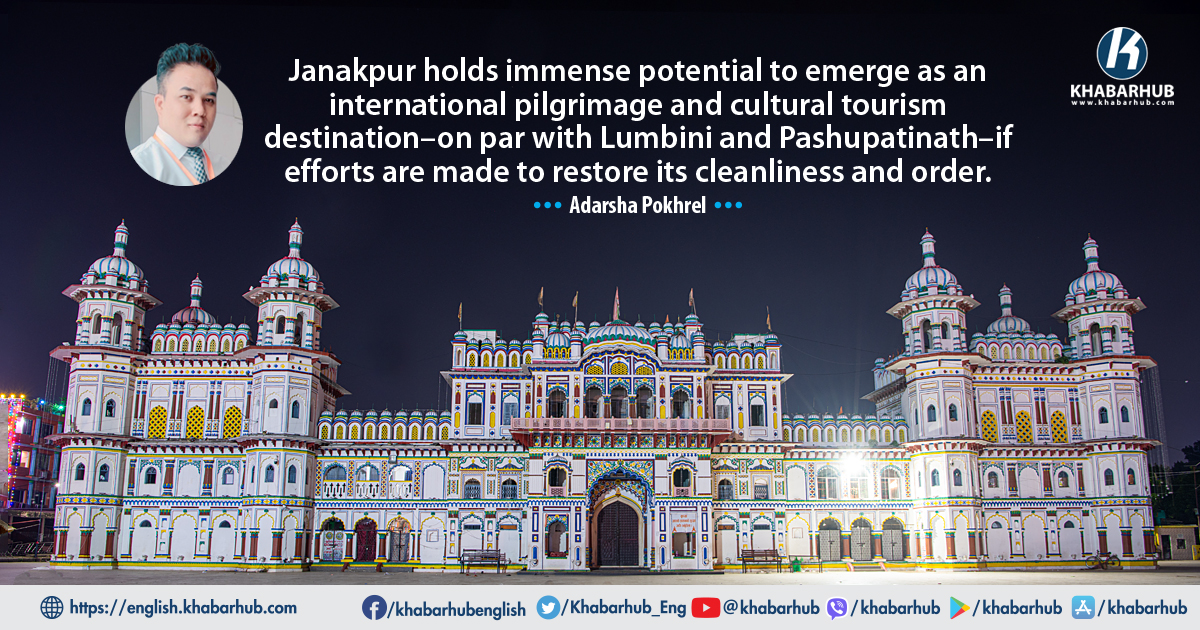
JANAKPURDHAM: Located in the heart of the Mithila region, Janakpurdham stands as a sacred city of deep religious and cultural significance. Revered as the birthplace of Goddess Sita and the site of her divine union with Lord Ram, it has long been celebrated as the “Land of Sita’s Mother” and the “Ram-Janaki Wedding Place.” Yet, the city that once symbolized devotion and grandeur is now struggling under the burden of garbage, pollution, and poor urban management.
At the center of the city stands the magnificent Ram-Janaki Temple, built around 1910 by Maharani Bhuvaneshwari Devi of Tikamgarh, India. The temple’s exquisite fusion of Hindu, Mughal, and Rajasthani architecture makes it one of Nepal’s most beautiful religious landmarks.
Its marble structure, adorned with statues of Ram, Sita, and Lakshman, draws thousands of pilgrims daily and millions during major festivals such as Chhath, Bibaha Panchami, and Ram Navami. The temple also represents the deep cultural connection between Nepal and India, united by Mithila’s shared heritage, art, language, and traditions.
However, the city surrounding this spiritual landmark tells a different story. Roads lined with garbage piles, foul-smelling drains, and unmanaged waste have tarnished Janakpur’s charm. Sacred ponds like Gangasagar, Dhanushsagar, and Bivahkunda—once central to religious rituals—are now polluted and neglected. Tourists and pilgrims often leave disheartened by the city’s lack of cleanliness and basic management. Despite its status as a religious and cultural hub, Janakpur’s municipal administration appears ineffective, leaving roads, drainage systems, and public spaces in disrepair.
The mismanagement extends to the temple premises as well, where waste from offerings and poor sanitation have diminished both the beauty and sanctity of the site. The lack of crowd control and hygiene measures during major festivals further exposes the city’s weak infrastructure.
The time has come for the government, citizens, students, entrepreneurs, and religious organizations to unite in restoring Janakpurdham’s lost splendor. Through sustained effort, awareness, and shared responsibility, Janakpur can once again shine as a clean, green, and sacred city—one that reflects the true beauty and discipline of Mithila’s heritage.
Janakpur holds immense potential to emerge as an international pilgrimage and cultural tourism destination—on par with Lumbini and Pashupatinath—if efforts are made to restore its cleanliness and order. But this transformation requires collective responsibility. Keeping Janakpur clean should not rest solely on government authorities; every resident must take ownership—segregating waste, avoiding littering, and treating public spaces with reverence.
Making Janakpurdham clean, green, and organized is both an environmental necessity and a cultural duty. The essence of Mithila civilization lies in beauty, balance, and discipline. Preserving Janakpur’s sanctity through collective effort will not only honor that heritage but also revive the city’s lost splendor—restoring it as the proud heart of Mithila once again.
Janakpurdham, the historic heart of the Mithila civilization and the sacred land of Goddess Sita, continues to face growing challenges of waste, pollution, and weak urban management. Despite its immense religious, cultural, and economic potential, the city’s beauty and sanctity are being eroded by the lack of awareness, inadequate infrastructure, and unstable governance.
The absence of education and environmental awareness has left many citizens indifferent to cleanliness and conservation. At the same time, the municipality struggles with limited technical and financial resources, hindering its ability to manage waste, maintain roads, and preserve the city’s sacred ponds. Political interference and frequent changes in leadership have further destabilized urban management, leaving long-term development plans incomplete.
Yet, Janakpurdham also stands at a turning point. The launch of Nepal’s own railway service connecting Janakpur with Jayanagar, India, has added a new chapter of progress. More than just a mode of transport, the railway strengthens the cultural and economic ties between Nepal and India, making travel easier for pilgrims and traders alike. However, without complementary improvements in city management and beautification, the benefits of this connection will remain limited. Garbage, disorder, and poor infrastructure continue to undermine the city’s image, discouraging visitors and pilgrims who come to experience its spiritual essence.
Transforming Janakpur into a clean, green, and well-managed city is not just an environmental priority—it is a cultural obligation. Mithila civilization has always emphasized balance, discipline, and beauty, and maintaining cleanliness is an act of respect toward the land of Sita. A well-managed city would not only enhance the religious experience but also expand tourism, create jobs for local youth, and strengthen the regional economy through hotels, transportation, and handicrafts.
The government formed after the recent Gen-Z movement must prioritize Janakpur’s revitalization through long-term planning, transparent governance, and active public participation. Regular cleaning of temple premises, roads, ponds, and public spaces should be institutionalized, supported by clear policies and community involvement.
The Ram-Janaki Temple, the spiritual soul of Mithila, continues to draw pilgrims from both Nepal and India—but its sanctity is overshadowed by unmanaged waste and disorganized surroundings. Without timely and coordinated action, Janakpur risks losing not only its religious heritage but also its economic opportunities and cultural pride.
The time has come for the government, citizens, students, entrepreneurs, and religious organizations to unite in restoring Janakpurdham’s lost splendor. Through sustained effort, awareness, and shared responsibility, Janakpur can once again shine as a clean, green, and sacred city—one that reflects the true beauty and discipline of Mithila’s heritage.






Comment