




The Bihar Legislative Assembly elections are being held on November 6 and 11. For decades, the people of Bihar have been bringing the political parties led by Lalu Prasad Yadav and Nitish Kumar to power.
In India, where coalition politics is dominant, the National Democratic Alliance and the India Alliance have been contesting the elections by forming two major blocs. Lalu Yadav has handed over his legacy to his son Tejashwi Yadav and presented him as the next Chief Minister of Bihar.
Similarly, Nitish Kumar has been ruling Bihar as the Chief Minister since 2005. Although Nitish has improved Bihar’s education, health, and physical infrastructure compared to Lalu Yadav, he has not been able to elevate it from the status of a backward state in India.
A new political party called Jan Suraj has emerged in this round of elections, as the Bihari people have no other option besides these two forces. The political party, which Prashant Kishor—an established electoral strategist in Indian politics—founded after traveling through Bihar for three years, is emerging as a third alternative force in the upcoming Bihar elections.
In this context, I have tried to discuss Lalu Yadav’s tenure and the rise of Nitish from a book written on modern politics in Bihar.
The average migration growth in other states during the same period was only 21.5 percent. During Lalu’s era, due to the “kidnapping industry” operating in Bihar, businessmen and other professionals fled the state, leading to a decline in human and industrial capital in Bihar.
The state of Bihar in India was once home to the Shaishunaga, Maurya, Gupta, and Pala dynasties. The capital of these empires, Patliputra, was praised by the Greek traveler and diplomat Megasthenes as an early and highly developed model of local governance. It was a center of advanced artistic practice, science, and education.
Bihar is also the birthplace of Buddhism and Jainism. But how did this land with a glorious history turn into the most backward state of independent India, plagued by caste inequality, organized crime syndicates, corruption, and a series of tainted governments?
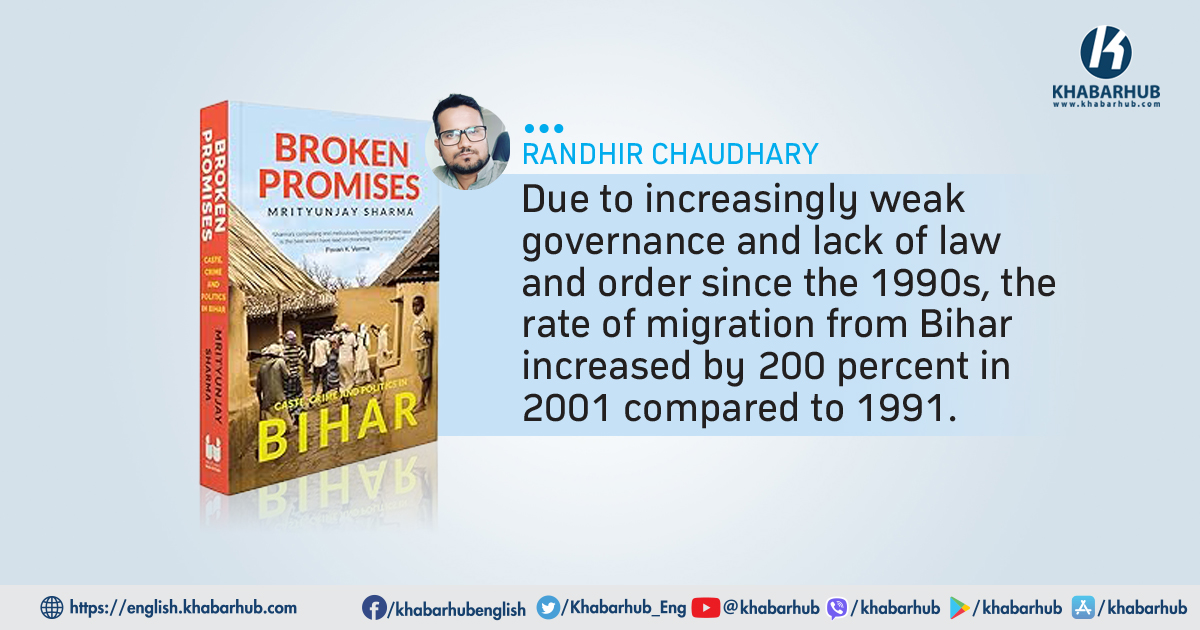
Last year (2024), the book Broken Promises: Caste, Crime and Politics in Bihar, written by Mrityunjay Sharma, covered the history of Bihar from its rise to the construction of modern Bihar.
It mainly tells the story of the social, economic, and political changes seen in Bihar from the 1990s to 2005. The 333-page book focuses on the rise and influence of Lalu Prasad Yadav and the decades-long tenure of Nitish Kumar.
Lalu Prasad Yadav is a name that conjures up two images in the minds of the common people. Some see Lalu as a social justice activist in Bihar, while others see him as the cause of the jungle raj that emerged in Bihar in the 1990s.
Lalu was born in 1948 in Phulwaria, a rural village in Gopalganj district of northern Bihar. Born as the sixth of seven children to Kundan Rai and Marchhiya Devi, he grew up in a family of moderate means. He reached Patna, the capital of Bihar, at the age of six with his maternal uncle Yadunand Rai, who was working as a milkman at Patna Veterinary College.
Before joining Miller Rai School, he started his education at the nearby Bihar Military Police Camp School. Especially for a family that was not traditionally inclined towards education, Lalu’s passing high school in the third division was a great achievement.
Lalu’s higher education and rise to high office are as fascinating as his life. In March 1990, when Lalu took the oath as the Chief Minister of Bihar, a sudden sense of hope and expectation was awakened in crores of Biharis who had been suffering from poverty, caste oppression, and lawlessness for decades.
The bright eyes of Dalits and oppressed castes shone with hope when Lalu made promises to transform Bihar and Biharis from Patna’s Gandhi Maidan.
For a year and a half after becoming Chief Minister, Lalu continued to present himself as an “action-oriented” leader. But over time, he started to create caste hatred and ignored the promises made to Biharis.
This must be the reason why the author named the book Broken Promises. Some of the decisions taken by Lalu’s government during his first term reflected his commitment to social justice. His government increased the old-age allowance from Rs 30 to Rs 100. Similarly, it announced an allowance for pregnant women for nutritious food during pregnancy.
At that time, the poor, Dalits, and landless people in Bihar began to look to Lalu as someone who would not only restore their long-lost dignity but also provide a way out of their miserable lives. There was a sudden change in the police response to complaints from Dalits and Other Backward Castes (OBCs).
Police stations that rarely heard or acted on complaints from the poor and Dalits during the previous Congress regime, dominated by upper castes, now began to pay attention.
Caste discrimination had long been ingrained in the psyche of Bihar. Even though Chief Ministers like Daroga Rai, Karpuri Thakur, Bhola Paswan, and Ram Sundar Das ruled the state, the people of the so-called upper castes did not even allow the people of the so-called lower castes to sit on a chair or a bed.
“We don’t need development, we need respect.”
Now the Yadav community started to “get seats” at police stations with acceptance. The police also started registering complaints from people of oppressed castes.
This increased respect for Lalu among the Yadavs and other backward classes, but Lalu started using this issue as a trump card to stay in power. To some extent, after a year of assuming power, Lalu started saying loudly, “Hume bikash nahi, samman chahiye” (We don’t need development, we need respect).
To anyone who demanded roads in his village, he would say with a smile, “If roads are built, the upper castes will benefit, because they have cars.” The simple, poor people were eager to become admirers of Lalu’s cleverness. However, Lalu did not apply this principle in his native village of Phulwaria.
Electrical substations, railway stations, hospitals, police posts, and block-level infrastructure were established in his village at a rapid pace. But Lalu left no stone unturned to create caste hatred in the name of social justice.
During Lalu’s tenure, no one except his close associates was free from fear and terror. Even the powerful and influential people of Bihar could not speak out against Lalu’s activities. Nearly two dozen administrative and police officials were killed or kidnapped during Lalu’s first term.
In the first five months of 1995, there was a frightening record of about 700 kidnappings per day from different parts of the state. Between 1992 and 2004, a total of 32,085 kidnappings were reported in Bihar.
Nitish Kumar’s Rise
Nitish Kumar was a leader who emerged from the JP movement in politics along with Lalu. Nitish played a special role in making Lalu the Chief Minister. Nitish once told Lalu, “You are not running Bihar according to the spirit of our movement.”
When Nitish tried to remind him of the promises he had made to the poor people of Bihar, Lalu retorted, “Are you going to teach me politics? Does power come from good governance? Power comes from vote banks. Do you live with the hangover of good governance?” To this extent, Lalu even started disrespectfully addressing the Kurmi caste represented by Nitish Kumar.
Karpuri Thakur, who had established an image as the true guardian of social justice, was even called a “hypocrite.” To challenge Lalu’s “Yadavism,” the Kurmi community announced that it would organize a Kurmi Mahasabha under the leadership of Nitish at Gandhi Maidan in Patna in 1994.
But Lalu even dared to scold Nitish, saying that if such a meeting was organized, he would charge him with sedition. But Nitish addressed the huge crowd, saying, “We want a share, not alms. A government that ignores our interests cannot remain in power.” In his address, Nitish called Lalu a despot intoxicated with power.
The social justice advocated by Lalu began to prove superficial within a year or so of his becoming Chief Minister. During Jagannath Mishra’s tenure, Lalu had opposed corruption, but he became even more corrupt and more caste-oriented than Mishra. Lalu converted many Yadavs into “Brahmins,” but this did not bring any fundamental change in the lives of the Dalit community in Bihar. It would not be an exaggeration to say that the condition of Dalits in Bihar remains the same as in the nineties.
Lalu was arrested in the fodder scam and went to jail on July 25, 1997. At that time, Lalu had more than a hundred assembly members in the Bihar Assembly. With that force, he appointed his illiterate wife Rabri Devi as the new Chief Minister of Bihar. This was a shameful demonstration of Lalu’s slogan of social justice. Rabri’s tenure also played a big role in giving Lalu Raj the nickname Jungle Raj.
In Lalu’s so-called era of social justice, 90 percent of the posts of doctors and 95 percent of the posts of paramedical staff in the health sector were vacant. From 1996 to 2006, only 30,000 teachers were appointed out of the approved 90,000 posts, and Lalu had recruited teachers keeping his vote bank in mind.
The student-teacher ratio, which was already weak before Lalu Raj came to Bihar, reached 90:1 after he came to power. Postponement of exams, early release of exam papers, and discrepancies in results had become common.
Due to increasingly weak governance and lack of law and order since the 1990s, the rate of migration from Bihar increased by 200 percent in 2001 compared to 1991.
The average migration growth in other states during the same period was only 21.5 percent. During Lalu’s era, due to the “kidnapping industry” operating in Bihar, businessmen and other professionals fled the state, leading to a decline in human and industrial capital in Bihar.
The conclusion that can be drawn from the six chapters of the book Broken Promises is that Lalu’s social justice was actually an illusion—he was running a Jungle Raj.





Comment