




Currently, media outlets across the country are highlighting a special weather bulletin from the Department of Hydrology and Meteorology, which states that a low-pressure system forming over the Bay of Bengal has intensified monsoon conditions in Nepal. As a result, widespread rainfall is affecting many regions.
The monsoon is especially active in Koshi, Madhesh, Bagmati, Gandaki, and Lumbini provinces, with light to moderate showers expected in several areas, including parts of the remaining provinces. Weather forecasting models such as the European ECMWF, German ICON, and U.S. GFS also predict the possibility of heavy to very heavy rainfall in the coming days.
Generally, the monsoon refers to the process of rain-bearing clouds entering Nepal from the Bay of Bengal. It is a continuous and dynamic climatic system that shapes weather patterns. By analyzing past data, present atmospheric conditions, and theoretical models, future weather patterns can be projected.
However, climate change has increasingly complicated weather predictions, making it difficult to forecast normal climatic processes reliably. This unpredictability has contributed to rising climate-induced risks and disasters.
Towards the end of Dashain, as the monsoon becomes more active, the risks of landslides, floods, soil erosion, and disruption of road and air transport increase. As the monsoon withdraws, it often brings destructive floods, landslides, inundations, and crop losses. Although this year’s monsoon entered Nepal earlier than average—on June 30 (Asar 16)—and was predicted to bring above-average rainfall, not all areas received sufficient rain.
The government, the Ministry of Home Affairs, the National Disaster Risk Reduction and Management Authority, security agencies, and disaster committees at all levels must strengthen coordination.
Madhesh Province, which earlier faced a prolonged drought and was declared a crisis-hit area by the government, is now highly vulnerable to excessive rainfall.
According to current analysis, the flows of the Narayani, Bagmati, Kamala, Koshi, and their tributaries are expected to rise significantly, reaching near-danger levels, while small rivers and streams originating from the Chure and Mahabharat ranges in Koshi, Bagmati, Gandaki, Lumbini, and Madhesh provinces may witness sudden flash floods.
Earlier this year, even before the main monsoon, the flash flood in the Roshi River of Kavrepalanchok and the glacial flood in Humla on May 14 already hinted at the forthcoming risks. During the four months of the monsoon season, Nepal typically receives around 80% of its annual average rainfall of 1,600 mm, sometimes reaching up to 1,800 mm.
Excessive monsoonal rainfall disrupts daily life, causes human and property losses, and damages infrastructure—these are termed monsoon-induced disasters. Although the monsoon itself is a natural and regular system, the associated risks and disasters have been intensifying due to various factors.
In Nepal, the monsoon is particularly influenced by the Bay of Bengal, making it a major driver of monsoon-related disasters. Another significant cause is unplanned and haphazard settlement expansion, infrastructure development, and human activities.
With over 6,000 rivers and rivulets, Nepal’s waterways can be broadly categorized into Himalayan-origin rivers, Mahabharat-origin rivers, and monsoon-fed streams. Settlements along riverbanks, steep slopes, and high-risk geographic areas face the highest vulnerability during the monsoon.
Floods and landslides claim significant human and material losses every year in Nepal. Landslide risks are higher in hilly and mountainous districts, while floods cause major damages in the plains (Tarai). Climate change, erratic rainfall, unplanned urbanization, poor drainage systems, unsystematic development, deforestation, encroachment of riverbanks, lack of geological studies before construction, and improper land use have all intensified flood and landslide risks.
While soil erosion and landslides are part of natural geomorphic processes, their human and infrastructural impacts are massive during the monsoon. Hilly regions remain highly vulnerable to landslides, while the plains face devastating floods. Droughts at the start of the monsoon affect agriculture-dependent livelihoods, while excessive rainfall during harvest seasons now threatens food security.
Floods occur in areas with heavy rainfall, glacial melt zones, and near rivers, lakes, and wetlands. Common flood-prone areas include the plains, low-lying floodplains, poorly drained urban zones, and riverbanks. Meanwhile, repeated earthquakes have loosened the Himalayan and hilly terrains, making them increasingly fragile. Rising atmospheric temperatures have accelerated glacial melting, leading to more glacial avalanches and higher river discharge. With monsoonal rains mixing sediments into rivers, the flood risk in the Tarai has been rising sharply—making it synonymous with flood disasters. Over the past 48 years, Nepal has recorded about 4,400 flood events.
Nepal ranks second after Bangladesh in South Asia and 20th globally in multi-hazard disaster risk. According to the 2019 Asian Development Bank report, floods alone cause an average annual loss exceeding USD 140 million, accounting for 1.4% of Nepal’s GDP.
Timely and factual information sharing is key to reducing the impacts of monsoon-induced disasters. With nearly 76% of Nepalese having access to mobile phones, telecom companies must be directed to rapidly disseminate early warning information across the country. Mass communication channels should be mobilized to provide rainfall forecasts, identify flood and landslide-prone areas, and raise community awareness.
Deep coordination, cooperation, and collaboration among federal, provincial, and local governments are needed, ensuring clear policies, legal frameworks, institutional mechanisms, adequate budgets, and resource mobilization in disaster risk management.
Regular and special bulletins from the Department of Hydrology and Meteorology should be rapidly disseminated to strengthen preparedness. In case of any emergencies, people should contact official numbers such as Nepal Police (100), Ambulance (102), Traffic Control (103), Armed Police (1114), Health (1115), National Emergency Operations Center (1149), and Flood/Weather Services (1155).
During high-risk periods, unnecessary travel should be avoided, and transportation authorities must halt night operations when conditions are unsafe. Emergency operation centers at the national, provincial, and local levels must activate their preparedness and response plans immediately. The government, the Ministry of Home Affairs, the National Disaster Risk Reduction and Management Authority, security agencies, and disaster committees at all levels must strengthen coordination.
Organizations such as the Nepal Red Cross Society, DPNet, NDRNet, along with international and national NGOs, humanitarian partners, and development agencies, must collaborate for rapid volunteer mobilization, first aid, search and rescue, and relief distribution as part of the emergency response. Political parties and their cadres should also support as volunteers during emergencies. Immediate arrangements must be made for modern equipment, data systems, relief materials, and rescue training.
Risk mapping of vulnerable areas should be prioritized, and relocation strategies should be planned accordingly. River water levels must be regularly monitored in upstream areas to provide timely alerts downstream. Reliable forecasting and effective communication can significantly reduce losses from floods and landslides. Communities must be trained in preparedness and survival strategies.
While emergency responses are often visible during disasters, long-term risk reduction and preparedness remain weak. Annual monsoon disasters continue to prove that Nepal lacks practical and sustained approaches to disaster risk management. To reduce risks, modern, technical, and multi-dimensional measures based on strong coordination must be applied.
Risk-based land-use planning should be enforced, and construction should proceed only after geotechnical studies, proper engineering standards, and environmental impact assessments. Forest encroachment and overexploitation must be controlled, while reforestation and forest conservation should be promoted. For flood control, riverbank protection, bioengineering, eco-friendly diversion systems, and natural methods should be applied.
Deep coordination, cooperation, and collaboration among federal, provincial, and local governments are needed, ensuring clear policies, legal frameworks, institutional mechanisms, adequate budgets, and resource mobilization in disaster risk management.
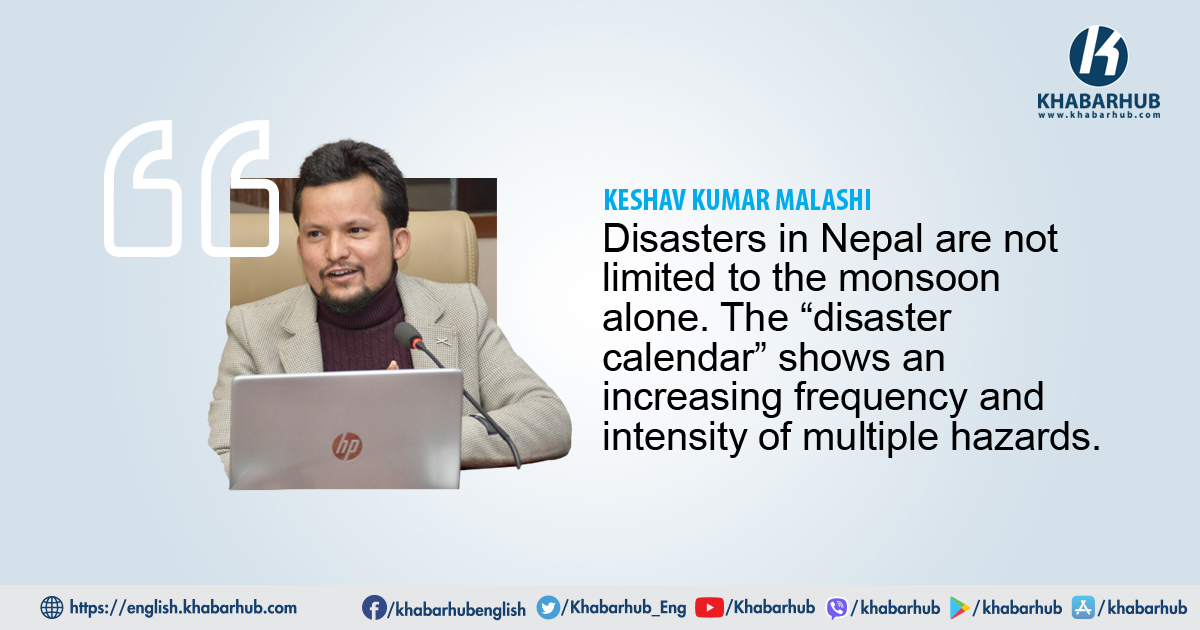
Disasters in Nepal are not limited to the monsoon alone. The “disaster calendar” shows an increasing frequency and intensity of multiple hazards. While Nepal has policies, laws, committees, and plans on paper, their effective implementation always remains weak. With short-term emergency responses and a long-term vision, post-Dashain disaster risks can be mitigated. Otherwise, Nepal faces yet another severe crisis. Let us understand disasters in time and help others understand them too. Let us become more aware and alert.
(The author, Malashi, is actively involved in writing on forests, environment, disasters, development, and contemporary social issues.)




Comment