




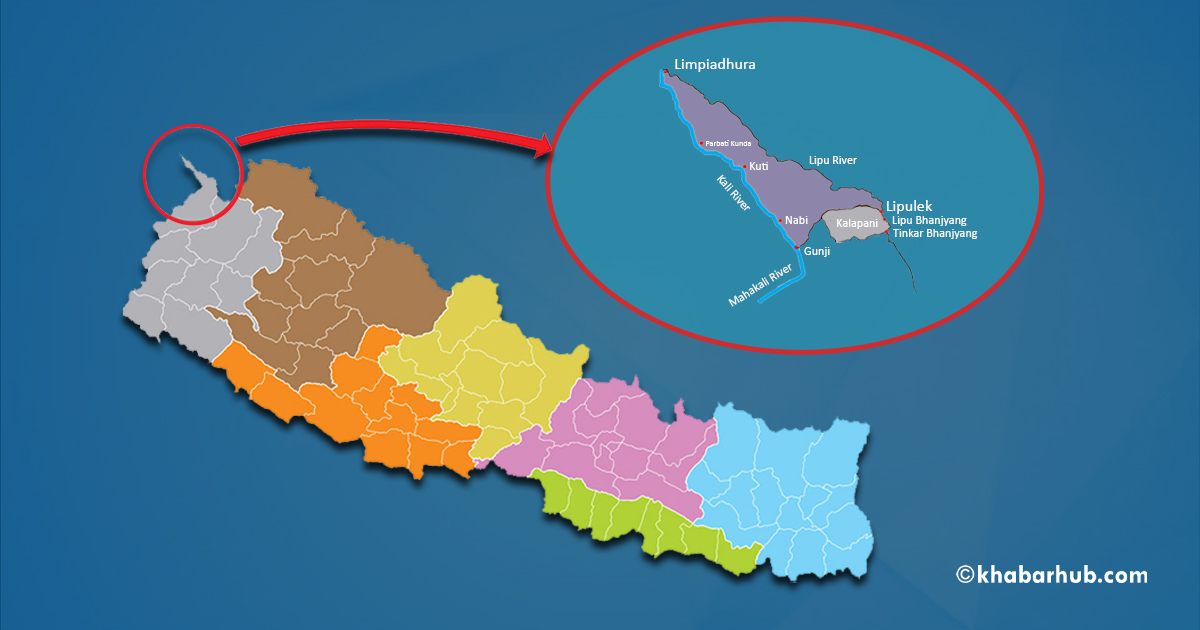
KATHMANDU: Prime Minister KP Sharma Oli is returning from China today after taking part in the Shanghai Cooperation Organization (SCO) summit in Tianjin. While there, he is believed to have raised strong objections with Chinese President Xi Jinping over the recent India–China agreement to reopen border trade through Lipulekh Pass, a territory claimed by Nepal.
During their meeting on August 30 in Tianjin, on the sidelines of the Shanghai Cooperation Organization (SCO) summit, Oli told Xi that the bilateral deal between Beijing and New Delhi had bypassed Nepal and was objectionable, according to Foreign Secretary Amrit Bahadur Rai, who was part of the Nepali delegation.
On August 19, Chinese Foreign Minister Wang Yi and Indian National Security Adviser Ajit Doval signed a 12-point agreement in New Delhi. Clause nine of the pact announced the reopening of border trade through three points, Lipulekh, Shipki La, and Nathu La. Lipulekh lies just 56 kilometers east of Nepal’s far-western boundary marker at Limpiyadhura. Nepal insists the 1816 Sugauli Treaty establishes Lipulekh, Kalapani, and Limpiyadhura as sovereign Nepali territory.
According to Rai, President Xi acknowledged Nepal’s historical claims but made clear that China does not wish to be drawn into the Nepal–India boundary dispute. “This is an issue for you and India to resolve,” Xi reportedly told Oli, while stressing that China’s recognition of Nepal’s traditional border crossings does not diminish Nepal’s position.
In Kathmandu, ruling UML party cadres praised Oli for defending Nepal’s sovereignty, flooding social media with messages of support. Analysts, however, are divided over the effectiveness of Oli’s démarche.
Foreign policy scholar Rupak Sapkota described Oli’s move as positive and necessary, noting that the prime minister represented Nepal’s bipartisan parliamentary consensus on Lipulekh. However, he stressed that raising the issue with Xi alone was insufficient: “Diplomatic and political initiatives must follow if Nepal truly wants to reclaim its territory.”
Others were more critical. Political analyst Shankar Tiwari argued that Oli’s approach “backfired” because the issue was raised at the top level without prior groundwork at the foreign minister or secretary level. “Xi’s response was predictable. Without sustained lower-level talks, expecting China to pressure India was unrealistic,” he said.
Commentator Vishnu Sapkota dismissed the move as cosmetic politics, saying Oli raised the issue merely to show he had done so. “It was symbolic, not substantive. There is no follow-up, no roadmap,” he noted.
Experts like Geja Sharma Wagle believe the Lipulekh dispute demands far more than ad-hoc interventions. He urged the government to forge a national consensus in parliament, establish a panel of border and international law experts, and prepare an authoritative evidence-based document to underpin negotiations.
“Nepal must adopt multi-track diplomacy, engaging not just governments but also intellectual and policy circles in both India and China,” he advised, adding that Prime Minister Oli should personally write to Indian Prime Minister Narendra Modi and Chinese Premier Li Qiang with Nepal’s formal position.
This is not the first time Nepal has expressed discontent. In 2015, China and India had similarly agreed to use Lipulekh for bilateral trade, sparking protests in Kathmandu. Successive Nepali governments have issued diplomatic notes, but the boundary dispute remains unresolved.
Analysts warn that unless Nepal backs up Oli’s words with a sustained diplomatic campaign, the Lipulekh issue risks becoming yet another episode of symbolic politics rather than a step toward reclaiming disputed territory.





Comment