




Southern Asia below the Himalayas has long served as a steadfast strategic bridge, particularly linking the far-western part of South Asia—Afghanistan and Pakistan—to the Middle East and the Arabian Sea—a region often marked by unpredictability.
At the same time, Myanmar, at the far east, positioned as the gateway to Southeast Asia and the Bay of Bengal and the Andaman Sea, also finds itself mired in an autocratic political system, strategic instability, and humanitarian crises. These dual challenges in critical geopolitical corridors highlight the region’s fragile connectivity and the volatility of its strategic routes.
Meanwhile, as China remained relatively dormant on the global stage prior to the 1990s, its sudden emergence and growing global responsibility and influence in the decades since has raised concerns and drawn the attention of both regional and global powers.
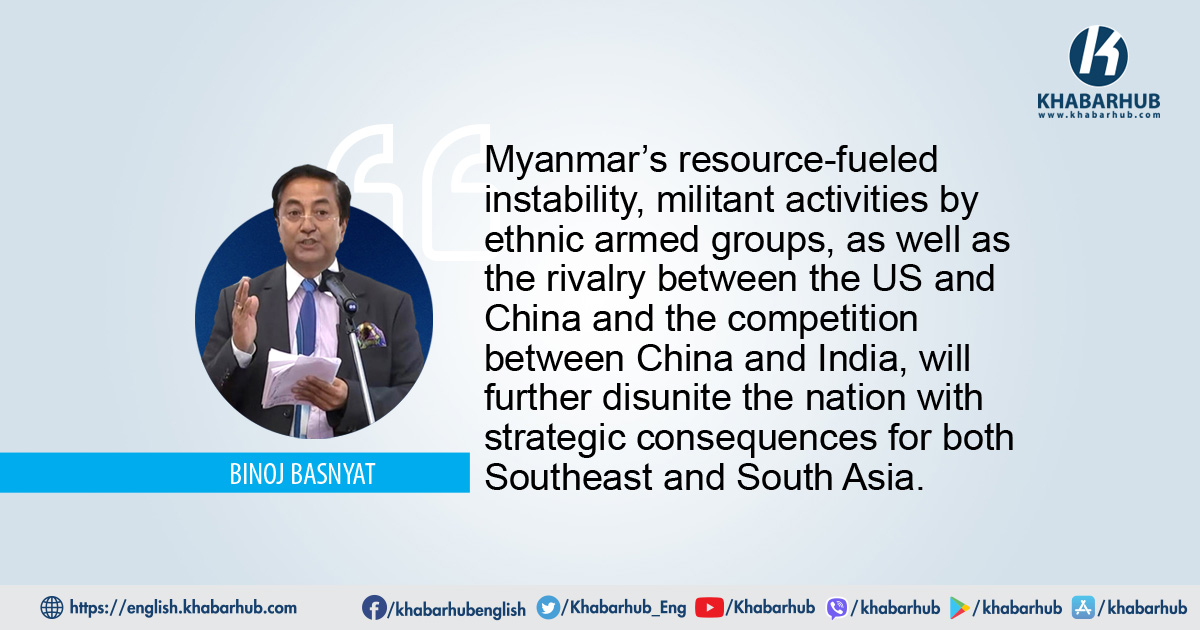
Myanmar, envisioned as a bridge between South Asia and Southeast Asia, has devolved into a critical fault line of instability. The convergence of armed ethnic conflicts, illicit resource extraction, and growing geopolitical competition—particularly among China, India, Thailand, and the United States—moreover compounded by domestic disunity and military rule as a uniting political discourse, has transformed Myanmar into a theater of multi-dimensional contestation.
This volatility not only threatens Myanmar’s internal cohesion through the strategic contest among the EAGs but also undermines regional security frameworks by linking China and India with the EAGs, disrupting economic corridors, and fueling instability across South Asia.
India and China have complex and often contrasting engagements with ethnic armed groups (EAGs) in Myanmar, driven by security imperatives, border dynamics, and resource interests. Both countries maintain ties—direct or indirect—with these groups to protect their strategic and economic stakes.
The National Socialist Council of Nagaland–Khaplang (NSCN K) provides sanctuary to Indian insurgents in Sagaing and operates across the India–Myanmar border. The fifth group, the Karen National Union (KNU), operates in southeastern Myanmar bordering Thailand.
Over 20 EAGs operate in Myanmar’s states, exploiting weak state structures to assert territorial control with a political schema. The fragmented, militarized, and resource laden periphery is fueled mainly by five key groups: the Kachin Independence Army (KIA) in northern Myanmar bordering China, which controls vast rare earth mineral (REM) reserves in Kachin State essential for defense and renewable technologies, along with jade mined in the billions annually, timber, gold, and more.
The United Wa State Army (UWSA) dominates jade rich Shan State in the northeast bordering China. The Arakan Army (AA) operates along the India–Myanmar border in western Rakhine and Chin states, now controlling large swaths of land and critical minerals bordering India via Mizoram.
The National Socialist Council of Nagaland–Khaplang (NSCN K) provides sanctuary to Indian insurgents in Sagaing and operates across the India–Myanmar border. The fifth group, the Karen National Union (KNU), operates in southeastern Myanmar bordering Thailand.
These groups finance their operations by taxing or extracting jade, REMs, gold, timber, and narcotics—making Myanmar a classic example of a “resource conflict” state. Their rise has effectively fractured the central state’s sovereignty and exposed its peripheries to external manipulation.
While the central junta struggles to maintain authority after the 2021 coup, these groups have transformed their regions into de facto autonomous zones. Ethnic conflict, once political, has become deeply entangled with black market capitalism, tacitly supported by foreign actors with geopolitical stakes.
China and India: Strategic Interests, Tactical Vulnerabilities
Beijing’s strategic approach combines official support to the junta with unofficial linkages to EAGs, particularly the UWSA, Ta’ang National Liberation Army (TNLA), and KIA.
Through these militias or informal proxies, China secures resource corridors for REM, jade, and timber while simultaneously maintaining border stability to avert refugee influx and conflict spillover, creating buffers along its Yunnan frontier.
Increasingly, Washington views Myanmar as a node in countering China’s monopoly over REM supply chains and limiting Beijing’s continental connectivity ambitions. Yet, without direct engagement with ethnic-controlled territories producing these minerals, the US strategy remains disconnected from on-the-ground realities.
China also leverages internal politics to protect its investments in the China–Myanmar Economic Corridor (CMEC)—a crucial component of its Belt and Road Initiative (BRI). With direct access to the deep sea of the Bay of Bengal, CMEC enables Beijing to bypass the strategic chokepoint of the Strait of Malacca.
India follows a more cautious and reactive path and is concerned about cross-border insurgency spillover. New Delhi has engaged in counter-insurgency cooperation against Naga and Meitei insurgents and in border security management along Manipur, Nagaland, Mizoram, and Arunachal Pradesh.
In addition, the Kaladan Multi-Modal Transit Transport Project—vital to India’s “Act East” policy—has suffered repeated disruptions due to the presence of NSCN K and AA in or near Indian territory, complicating bilateral ties.
Cross-border insurgents operating along the India–Myanmar border have revived linkages such as the People’s Liberation Army of Manipur and the United Liberation Front of Asom (ULFA) from the Sagaing region, threatening security in Assam, Manipur, Nagaland, and Mizoram. After the 2021 coup, thousands of Chin, Kuki, and other minorities fled to Mizoram and Manipur as refugees.
New Delhi avoids overt support to EAGs but has been accused by the Myanmar military of harboring anti-junta elements across its border.
Despite military diplomacy with the Tatmadaw, India lacks a consistent approach to non-state armed actors that control critical border territories and resources, rendering its position reactive and susceptible to external disruptions.
Russia’s engagement in Myanmar cannot be ignored and has grown significantly in recent years, particularly through arms exports, industrial cooperation, and trade.
This relationship has strategic, economic, and political dimensions, especially since the 2021 military coup. For Russia, Myanmar is a strategic partner in Southeast Asia—providing access to the Indian Ocean region and counterbalancing Western influence.
This involves energy, mining, and infrastructure cooperation, civilian nuclear power projects via Rosatom, interests in REM mining, technology transfer deals related to defense and heavy industries, and involvement in railway and power plant construction.
Russia is one of Myanmar’s largest arms suppliers, alongside China—especially following arms embargoes imposed by Western nations after the 2021 coup. Some weapons supplied include MiG 29 and Yak 130 fighters, Mi 17 and Mi 35 helicopters, radar systems, and regular military exchanges.
Politically and strategically, both nations share Western sanctions and isolation, collaborate in forums such as the ASEAN Defence Ministers’ Meeting Plus (ADMM Plus), and align through anti Western influence expansion in Southeast Asia.
While Myanmar benefits from Russia’s diplomatic and military backing—with arms at the forefront—deeper economic and industrial ties are also emerging. This relationship is likely to strengthen unless there is a dramatic political shift in either country.
The US: Caution, Contradictions, Sanctions, and Strategic Latency
For the US, Myanmar remains a theater of strategic caution with multiple engagements since the Trump 2.0 administration.
While Washington has imposed sanctions on the junta and vocally supported the pro democracy National Unity Government (NUG), it has limited leverage over ground realities. However, Myanmar’s rare earth minerals (REM)—which feed into Chinese supply chains—have caught Washington’s interest.
South Asia and Southeast Asia cannot thrive if their eastern corridors—continental and maritime—disintegrate. Myanmar, strategically positioned between the Indian Ocean and Mekong Basin, is too pivotal to fail quietly.
Recently, the US has leveraged economic sanctions, supported civil society and the NUG, and explored partnerships under ASEAN mechanisms to diversify rare earth sourcing and curb China’s dominance.
Increasingly, Washington views Myanmar as a node in countering China’s monopoly over REM supply chains and limiting Beijing’s continental connectivity ambitions. Yet, without direct engagement with ethnic-controlled territories producing these minerals, the US strategy remains disconnected from on-the-ground realities.
Regional Spillover and Strategic Consequences: A Clear and Present Danger
Myanmar’s instability has four geostrategic implications for South Asia and Southeast Asia. First, border security is deteriorating. The porous India–Myanmar border has become a conduit for arms, drugs, insurgents, and refugees. Previously dormant ethnic insurgent groups are reactivating, emboldened by lawless corridors.
The 2021 coup drove thousands into Mizoram, Manipur, and Nagaland, heightening ethnic tensions and drawing Indian forces deeper into counterinsurgency operations. Hundreds of thousands of Rohingya refugees fleeing Myanmar also strained Bangladesh’s capacity.
Second, economic corridors are disrupted. This vulnerability undermines regional connectivity under the Bay of Bengal Initiative for Multi Sectoral Technical and Economic Cooperation (BIMSTEC), India’s “Act East” policy, and China’s access to the Bay of Bengal through CMEC.
The Kaladan corridor faces AA disruptions, while roads through Chin and Sagaing remain insecure. In Shan and Kachin states, hostile EAG control challenges CMEC progress. This impairs South Asia’s broader integration with Southeast Asia.
Third, proxy warfare proliferates. Both India and China risk escalating proxy involvements, distorting Myanmar’s internal power dynamics, delaying peace negotiations, perpetuating violence, and complicating ASEAN’s central role. Militias are morphing into strategic pawns—deepening militarization along borderlands, often replicating a “cold war in miniature.”
Fourth, the illicit resource economy expands. Illegal mining of jade and REMs devastates the environment in Kachin and Shan, funds arms purchases, drives black market networks, erodes indigenous livelihoods, destabilizes local governance, and accelerates ecological decline. These illicit economies stretch into South and Southeast Asia.
What Can Be Done: Toward Strategic Convergence?
The time for ambivalence has passed. Myanmar’s drift into armed decentralization is both a humanitarian tragedy and a regional strategic liability. Its instability holds significant implications for the Indo Pacific’s South and Southeast Asia.
First, initiate a Myanmar regional dialogue involving ASEAN, China, India, and the US. Use back-channel diplomacy under a neutral platform focused on border stabilization, ceasefire monitoring, democratic restoration, safe humanitarian access, and resource governance.
Second, support federalization and inclusive civil structures for long-term stability. Myanmar needs a power-sharing arrangement granting EAGs political voice, reducing reliance on military rule, and promoting demilitarization.
The only path forward lies in strategic cooperation, sustainable resource governance, and inclusive political solutions. For India, China, and Thailand, the real threat is not each other but the collapse of the nation that connects their borders.
Third, incentivize legal resource trade frameworks with regional partners to establish traceable, environmentally responsible supply chains for REM, jade, and timber aligned with US and EU standards.
Fourth, strengthen border infrastructure, management, and humanitarian corridors with Bangladesh, China, India, Laos, Thailand, and ASEAN. Secure crossings to reduce arms and refugee flows with federal and local consent.
Fifth, resist proxy militarization. China and India must commit to disengaging from militia support and restore diplomatic channels through ASEAN.
Conclusion: An Avoidable Collapse
South Asia and Southeast Asia cannot thrive if their eastern corridors—continental and maritime—disintegrate. Myanmar, strategically positioned between the Indian Ocean and Mekong Basin, is too pivotal to fail quietly.
Its disintegration is no longer a domestic crisis—it is a regional emergency. The region’s security architecture, global supply chains, and stability are at stake.
If China, India, Thailand, and the US continue viewing Myanmar through the prism of unilateral control rather than cooperation, it will remain a vacuum where instability breeds, economies stagnate, and warlords flourish.
A new regional consensus is urgently needed to reverse this trajectory. Otherwise, Myanmar risks becoming the first domino in a broader South Asian unraveling.
The intersection of ethnic insurgency, resource exploitation, and great-power rivalry has created a vortex endangering both South and Southeast Asia.
The only path forward lies in strategic cooperation, sustainable resource governance, and inclusive political solutions. For India, China, and Thailand, the real threat is not each other but the collapse of the nation that connects their borders.
Maj General Basnyat (Retd) from the Nepali Army is a strategic analyst and is an observer on South Asian security affairs. He is affiliated with Rangsit University, Thailand.






Comment